When it comes to choosing between an English Goldendoodle and an American Goldendoodle, prospective pet owners are often met with a blend of similarity and distinction. Essentially, the primary difference lies in their lineage—English Goldendoodles typically have English Cream Golden Retriever ancestry, while American Goldendoodles are descended from American Golden Retrievers. The disparities extend beyond genetics, influencing aspects such as temperament, health, and even cost.
Our article dives into the nuances that define and differentiate these two beloved Doodle variations. We’ll explore everything from their distinct breeding backgrounds and physical characteristics to their health profiles and the significance of generational breeding, be it F1 or F1B.
Whether you’re weighing which Goldendoodle would be the perfect fit for your lifestyle or simply curious about what sets these curly companions apart, our side-by-side comparison provides the insights you crave. Keep reading to uncover the subtle and not-so-subtle traits that could sway your decision to bring home the ideal furry family member.
Table of Contents
What’s the Difference Between English Goldendoodle vs. American Goldendoodle?


The difference between an English Goldendoodle and an American Goldendoodle stems from their Golden Retriever lineage. English Goldendoodles are a crossbreed between English Cream Golden Retrievers—known for their lighter coats, stockier builds, and calmer demeanors—and Poodles. Conversely, American
Goldendoodles are bred from American Golden Retrievers, which have darker coats, are often more slender, and display a higher energy level, also mixed with Poodles. The Poodle parentage in both English and American Goldendoodles contributes to their intelligence, low-shedding coats, and allergy-friendly features regardless of the Golden Retriever variant. These combined characteristics result in unique differences in appearance, behavior, and overall health between the two types of Goldendoodles.
How Do Parent Breeds Compare Between English Goldendoodles and American Goldendoodles?
Exploring the parent breeds of English Goldendoodles and American Goldendoodles reveals distinct traits and characteristics. How do these differences influence the two popular Goldendoodle variations?
The Poodle

The Poodle, an integral part of the Goldendoodle’s heritage, is famed for its intelligence, hypoallergenic coat, and graceful agility. As a parent breed, the Poodle bestows upon both English and American Goldendoodles these desirable traits, playing a key role in the appeal and characteristics of these hybrid dogs.
The English Cream Golden Retriever

The English Cream Golden Retriever, also known as the White Golden Retriever, boasts a pale, creamy coat and a sturdy physique, which it lends to the English Goldendoodle’s lineage.
Despite being a much-loved variation, it’s interesting to note that the American Kennel Club doesn’t recognize this paler variant as a separate breed. In contrast, kennel clubs in the UK and Canada acknowledge the distinction, highlighting the unique status of the English Cream Golden Retriever in different parts of the world.
History Of The Breed
The English Cream Golden Retriever is a variation of the Golden Retriever breed with a lineage traced back to the mid-1800s. It is thought that these dogs may have a distant ancestry connected to a now-extinct breed of Russian tracker dogs.
The modern Golden Retriever, including the English Cream variety, was developed by Baron Tweedmouth on the Dudley Marjoribanks estate in Scotland. The breed, affectionately known as “Goldens,” was originally bred as a bird dog, skillfully assisting duck hunters and retrieving shot birds during hunting parties. Their duties were to locate and fetch downed birds from both water and marshlands within the rugged Scottish terrain.
The English Cream Golden Retrievers share this rich history, distinguished by their pale cream coat, a trait that has been selectively bred for in the UK and acknowledged by the UK and Canadian Kennel Clubs.
Built For The Job

The English Cream Golden Retriever, much like its Golden Retriever kin, was purposefully bred with a flat, double coat suitable for the freezing and oftentimes unforgiving weather conditions of the Scottish highlands. This coat features an outer layer of guard hairs that repel water and UV rays, while a dense, fluffy undercoat provides crucial insulation against cold in the winter and heat in the summer.
Additionally, these retrievers are known for their “soft mouth”—an ability to carry and retrieve game gently without causing damage, which is a highly desirable trait for hunting dogs.
In their original role, Golden Retrievers faced a demanding workday traversing the rugged Scottish terrain and swimming in icy waters. These conditions shaped the breed into strong, resilient animals with impressive stamina, characteristics that the English Cream Golden Retriever still embodies today.
What Is An American Golden Retriever?

An American Golden Retriever conforms to the breed standards set by the American Kennel Club (AKC). This variant of the Golden Retriever is known for its rich, golden-colored coat, which can range from light golden to dark golden hues. American Golden Retrievers are often more slender and longer in stature than their English counterparts, with a coat that is typically less dense and wavy.
They are energetic, intelligent, and friendly dogs, renowned for their versatility as family pets, service dogs, and participants in dog sports and obedience competitions. Their lineage is the same as all Golden Retrievers, originally bred as gundogs capable of retrieving game in various conditions, but American breeding standards have emphasized certain aesthetic and physical traits unique to this group.
What Are the Key Differences Between English Goldendoodles and American Goldendoodles?
Here’s an at-a-glance overview of the English and American Goldendoodle:
Breed Summary Table
Features
English Goldendoodle
American Goldendoodle


Height:
Small: 12” to 15” tall
Medium: 16” to 19” tall
Large: 19” to 25” tall
Small: 12” to 15” tall
Medium: 16” to 19” tall
Large: 19” to 25” tall
Weight:
Small: 18 to 30 pounds
Medium: 30 to 50 pounds
Standard: 50 to 85 pounds
Small: 18 to 30 pounds
Medium: 30 to 50 pounds
Standard: 50 to 85 pounds
Color:
Generally paler in color than American Goldendoodles
Darker shades and more variety than English Goldendoodles
Coat:
Can be curly, straight, or wavy
Can be curly, straight, or wavy
Lifespan:
10 to 15 years
10 to 15 years
Health:
PRA, Hip dysplasia, Cancer, Skin conditions, Epilepsy Patellar luxation, cataracts.
PRA, Hip dysplasia, Cancer, Skin conditions, Epilepsy Patellar luxation, cataracts.
Intelligence:
High
High
Temperament:
Friendly, loyal, trainable, and eager to please
Friendly, loyal, trainable, and eager to please
Exercise requirement:
Needs at least one hour of exercise daily
Needs at least one hour of exercise daily
Price:
Around $3,500
From $2,000
English Goldendoodle
Height:
Small: 12” to 15” tall
Medium: 16” to 19” tall
Large: 19” to 25” tall
Weight:
Small: 18 to 30 pounds
Medium: 30 to 50 pounds
Standard: 50 to 85 pounds
Color:
Generally paler in color than American Goldendoodles
Coat:
Can be curly, straight, or wavy
Lifespan:
10 to 15 years
Health:
PRA, Hip dysplasia, Cancer, Skin conditions, Epilepsy Patellar luxation, cataracts.
Intelligence:
High
Temperament:
Friendly, loyal, trainable, and eager to please
Exercise requirement:
Needs at least one hour of exercise daily
Price:
Around $3,500
American Goldendoodle
Height:
Small: 12” to 15” tall
Medium: 16” to 19” tall
Large: 19” to 25” tall
Weight:
Small: 18 to 30 pounds
Medium: 30 to 50 pounds
Standard: 50 to 85 pounds
Color:
Generally paler in color than American Goldendoodles
Coat:
Can be curly, straight, or wavy
Lifespan:
10 to 15 years
Health:
PRA, Hip dysplasia, Cancer, Skin conditions, Epilepsy Patellar luxation, cataracts.
Intelligence:
High
Temperament:
Friendly, loyal, trainable, and eager to please
Exercise requirement:
Needs at least one hour of exercise daily
Price:
From $2,000
English Goldendoodle versus American Goldendoodle: What Sets Them Apart?
Exploring the contrasts between English Goldendoodles and American Goldendoodles reveals a captivating tapestry of traits shaped by their respective lineages. This comparison aims to highlight the distinct qualities that define each breed and guide potential owners in making an informed choice.
Appearance
Although they are essentially similar in looks, there are some notable differences between them.
Color
English Goldendoodles inherit the pale cream or white shades from the English Cream Golden Retriever, while American Goldendoodles exhibit a broader spectrum of colors such as black, cream, apricot, golden, white, or red, reflective of the American Golden Retriever’s varied palette.
Notably, if a deep red hue is desired, an American Goldendoodle is likely the variety to consider. It’s important to remember, however, that Goldendoodles can undergo a significant change in coat color as they transition from puppyhood to adulthood, and predicting the exact shade or coat type can be challenging due to the complex genetics of Poodle mixes.
Build
The build of English Goldendoodles tends to be stockier and more robust, mirroring the physique of the English Cream Golden Retriever. In contrast, American Goldendoodles often have a leaner, more athletic build, reflecting the sleeker body type of the American Golden Retriever.
These differences in build can affect not only the Goldendoodles’ appearance but also their physicality and sometimes their temperament.
Shedding
Shedding in Goldendoodles is generally minimal due to their Poodle heritage, which is known for being low-shedding and hypoallergenic.
However, the degree of shedding can vary between English Goldendoodles and American Goldendoodles, depending partly on which parent breed’s traits are more dominant in the mix. English Goldendoodles may have a slightly denser coat, potentially leading to a bit more shedding than American Goldendoodles, whose coats might inherit the Poodle’s tightly curled hair that typically sheds less.
It’s essential for potential owners to note that while Goldendoodles are often marketed as hypoallergenic, no dog is entirely free from shedding or producing allergens.
Hypoallergenic
The hypoallergenic qualities of Goldendoodles make them a popular choice for those with allergies, as they tend to produce fewer allergens compared to many other breeds.
While no dog is completely hypoallergenic, the Poodle’s influence in both English Goldendoodles and American Goldendoodles means that they typically have a coat that sheds less and produces less dander.
The extent of these hypoallergenic properties can vary between individual dogs and is not solely determined by whether they are an English or American Goldendoodle, but also by the specific traits inherited from their Poodle and Golden Retriever parents.
Brushing And Grooming
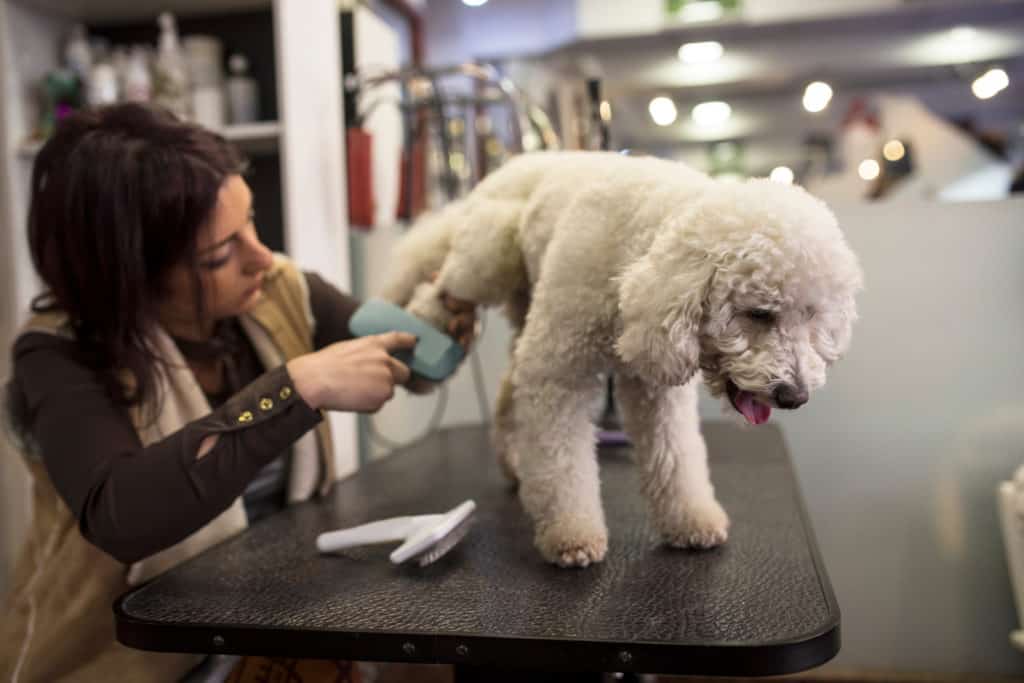
Regular brushing and grooming are essential for both English Goldendoodles and American Goldendoodles due to their Poodle heritage, which gives them a coat prone to matting and tangling.
English Goldendoodles may have a slightly denser coat that could require more frequent brushing to prevent mats, while American Goldendoodles often have a slightly looser curl that also needs regular grooming to maintain coat health.
Professional grooming every 6-8 weeks is generally recommended to keep their coat in optimal condition and to avoid issues like overgrown nails, ear infections, and excess hair in the pads of their feet.
What Are the Temperament Differences Between English Goldendoodles and American Goldendoodles?
The temperament of English Goldendoodles is often described as gentle and laid-back, mirroring the calm and affable nature of their English Cream Golden Retriever lineage.
American Goldendoodles may exhibit a more energetic and spirited personality, aligning with the typically vivacious and outgoing nature of the American Golden Retriever.
Both variations inherit the intelligence and friendliness of their Poodle and Golden Retriever parents, making them highly sociable and trainable, but the nuanced differences in temperament can be influenced by the specific traits of the Golden Retriever strain in their heritage
What Are the Health Differences Between English Goldendoodles and American Goldendoodles?
The health of a mixed breed like the Goldendoodle is deeply influenced by the health of the parent breeds. Studies and statistics suggest that American Golden Retrievers face a higher incidence of cancer—estimated at around 60%—compared to approximately 38.8% of English Golden Retrievers.
This disparity in health outcomes may contribute to the observed difference in life expectancy; American Golden Retrievers have an average lifespan of about ten years, while English Golden Retrievers typically live around twelve years. This variance is often attributed to the more rigorous health testing protocols for breeding dogs implemented in Europe relative to those in the United States.
As a consequence, these factors can affect the overall health and longevity of their Goldendoodle progeny, making the English Goldendoodle potentially less susceptible to certain genetic health issues than their American counterparts.
Why Should You Avoid Puppy Mills?

When choosing a Goldendoodle puppy, it’s imperative to purchase from a reputable and trustworthy breeder who conducts thorough health testing on their breeding dogs. While the upfront cost of a puppy from such breeders may be higher, the alternative—buying a cheaper puppy from a puppy mill—carries significant risks.
Puppy mills typically do not provide the necessary health checks for their dogs, often resulting in puppies suffering from genetic conditions and other severe health problems that can be both emotionally and financially draining, and potentially fatal shortly after bringing the puppy home.
Investing in a responsibly bred puppy not only supports ethical breeding practices but also increases the likelihood of a healthy, happy pet joining your family.
What Are the Size Differences Between American and English Goldendoodles?
American and English Goldendoodles often exhibit size differences due to the particular size and build of their Golden Retriever ancestors. English Goldendoodles tend to have a stockier, more robust frame, reflecting the generally larger and broader build of English Cream Golden Retrievers.
In contrast, American Goldendoodles usually lean towards a slightly more slender and taller stature, indicative of the typically leaner American Golden Retriever. Consequently, English Goldendoodles may appear somewhat more substantial in build when compared to the American version, even if they belong to the same weight category.
Price
Prices for English Goldendoodles may range from approximately $2,500 to $5,000, while American Goldendoodles might be priced slightly lower, around $2,000 to $4,000. This estimation reflects the premium often placed on the English variety due to factors such as coat color and pedigree lineage.
Remember, these prices can vary significantly depending on the breeder’s location, the puppies’ lineage, and the individual breeder’s practices, including health screenings and care of the puppies.
It’s always advised to thoroughly research and select a reputable breeder to ensure that the higher cost correlates with a responsibly bred and healthy puppy.
Summarizing the Distinctive Traits and Commonalities of American Goldendoodles and English Goldendoodles
The distinctions and likenesses between American Goldendoodles and English Goldendoodles encapsulate a spectrum of both physical and temperamental traits:
Similarities:
- Both varieties have a friendly and affectionate nature, making them great family pets.
- They share intelligence and trainability, thanks to their Poodle heritage.
- Both types exhibit the potential for hypoallergenic coats and minimal shedding.
- American Goldendoodles and English Goldendoodles typically require regular grooming and exercise.
Differences:
- Coat Color: English Goldendoodles often have lighter coats, ranging from cream to nearly white, while American Goldendoodles display a wider variety of colors, including apricot, red, and dark golden.
- Size and Build: English Goldendoodles usually have a stockier build, reflecting the physique of the English Cream Golden Retriever, while American Goldendoodles often have a leaner build like the American Golden Retriever.
- Health and Longevity: English Goldendoodles may have a slightly longer lifespan and lower incidence rate of certain health issues, in part due to the stringent breeding standards in Europe. Conversely, American Goldendoodles can sometimes be more prone to health issues common in their American Golden Retriever lineage.
- Temperament: English Goldendoodles are often regarded as more laid-back, aligning with the temperament of the English Cream Golden Retriever. In contrast, American Goldendoodles may be more energetic and outgoing, reflecting the American Golden Retriever’s personality.
When considering bringing a Goldendoodle into your home, weighing these similarities and differences can help you choose the right fit for your lifestyle and preferences.
In Conclusion

Choosing between an English Goldendoodle and an American Goldendoodle is easier now with our comprehensive comparison. Both breeds excel as family pets with their loving, intelligent, and active nature perfectly suited for families who relish outdoor activities and training opportunities.
The key distinctions lie in the initial purchase price, with the American Goldendoodle typically being less expensive, and the potential long-term health benefits of the English Goldendoodle, which may result in lower veterinary costs.
After delving into the unique qualities and shared traits of these wonderful dogs, which Goldendoodle wins your heart? Share your decision in the comments and join the conversation. If you found this article helpful, please share it with fellow dog lovers who may be making this very choice. Your input helps others on their journey to finding their ideal canine companion.
