From a leash that can break a hip to diarrhea that drags on for months, these are the goldendoodle problems that cost real time, money and worry.
Read through to #1. The biggest risk on the page shows up on an ordinary walk, and the fix starts with what you clip the leash to.
The puppy in the breeder’s photo wore a red bow and had a face like a stuffed bear. Now there are curls on the couch cushions, a damp nose pressed to the crack under the bathroom door, and a vet bill on the fridge with “Giardia” circled on it. Nobody lied to you, exactly. They just skipped the goldendoodle problems owners only learn by living them. Most of these have an end date. A few never do.
Table of Contents
#17 The hypoallergenic claim that often fails
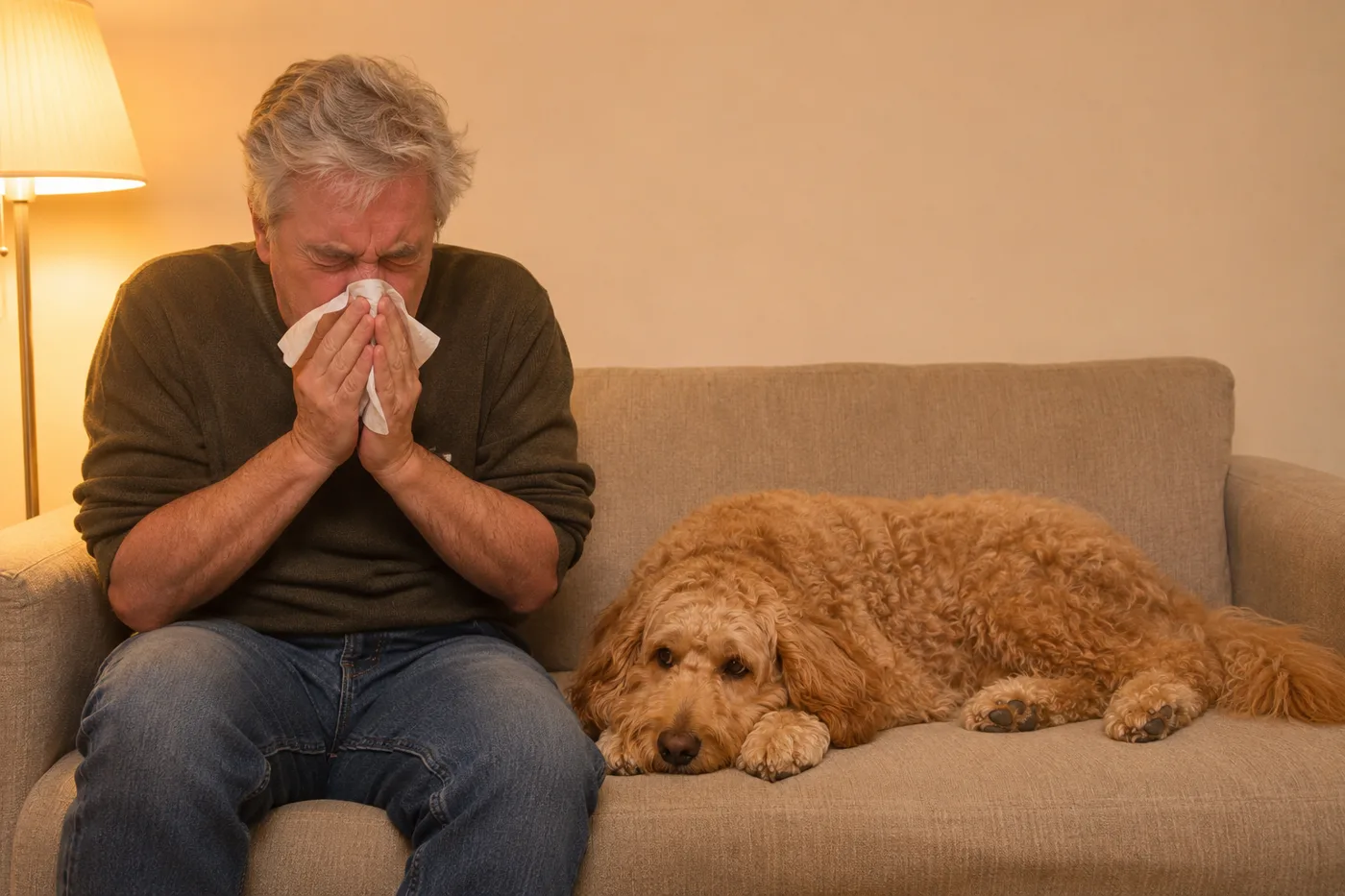
No breed is allergy-free, doodles included. The allergists’ society ACAAI says it flatly: “a truly allergy-free breed does not exist.”
What surprises people is how the “hypoallergenic” dogs did when someone actually measured. Researchers at Utrecht University in the Netherlands sampled the hair of nearly 200 Labradoodles, Poodles and other so-called hypoallergenic dogs, plus about 160 Labs and mixed dogs. The “hypoallergenic” group’s hair carried about three times as much of the main dog allergen as the others. In the air of their homes, there was no difference at all.
Labradoodle homes did have less allergen in the dust that settles around the house. Nice footnote. It won’t stop a sneeze.
Dr. Rachel, a veterinarian in Texas who posts about breeds on YouTube, says in one of her videos that many clients expect a doodle to be hypoallergenic, non-shedding and low maintenance, and that in her experience none of that holds.
If someone in your home is allergic and the dog is staying, ACAAI’s advice is short:
- Keep the dog out of the bedroom.
- Wash your hands after petting, and skip the face kisses.
- Run a HEPA air cleaner (the fine-filter kind) and use a high-efficiency vacuum.
- Bathe the dog at least once a week.
- Ask an allergist about allergy shots.
The bedroom rule is the hard sell if the dog already sleeps on your pillow. The weekly bath is the real work.
#16 Shedding like a plain Golden Retriever
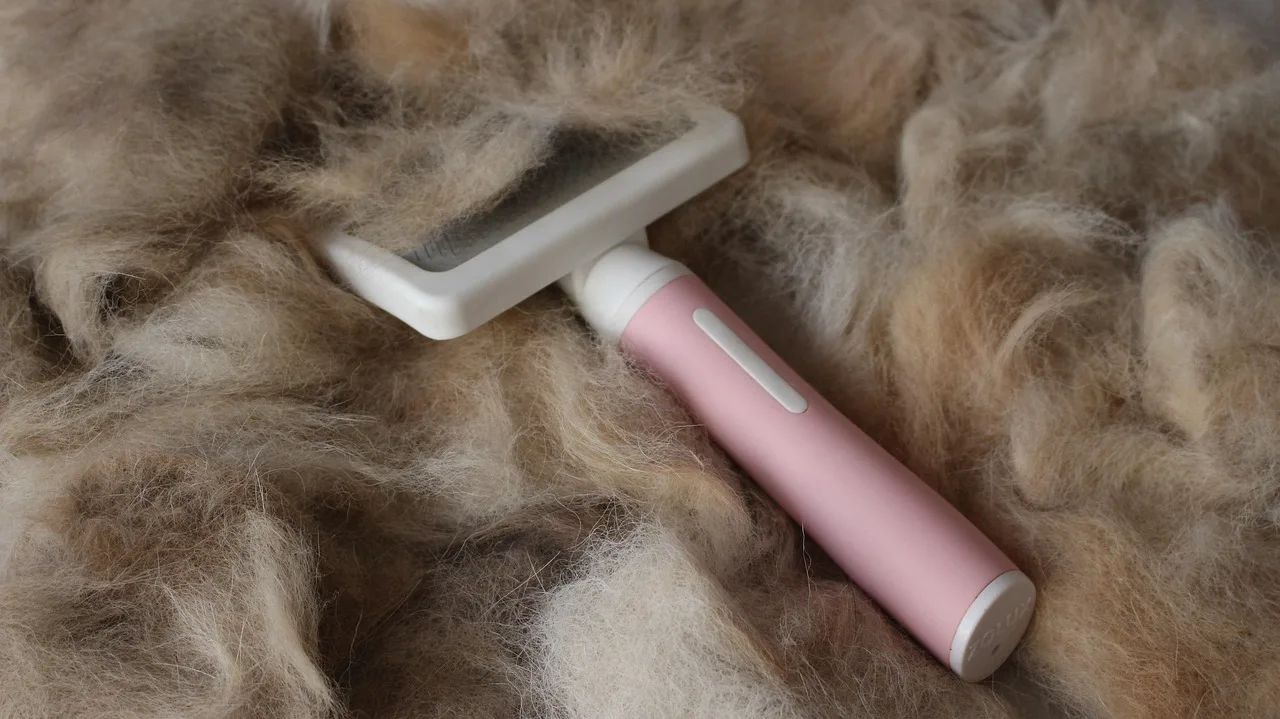
Some doodles shed as much as a Golden. Owners on r/Goldendoodles say so plainly, and others call the no-shedding promise a gamble.
The reason sits in a handful of genes. A 2009 government study of about 1,000 dogs from 80 breeds found that three genes explain most coat types: one for “furnishings” (the beard and eyebrows), one for long hair and one for curl. Poodles carry all three.
The furnishings gene is the one that matters for your vacuum. The DNA-testing company Embark says low shedding goes with a variant in that gene, called RSPO2. A puppy that misses it gets a coat whose shedding is decided by yet another gene, heavy or moderate. Embark adds that most indoor dogs will shed at least some amount, whatever their coat type.
So the generation label, F1 (a Golden crossed with a Poodle) or F1b (an F1 bred back to a Poodle), tells you who the grandparents were. It can’t tell you which genes this particular puppy drew. Breeder websites print odds for each label, and when we compared them, they contradicted each other.
Ask for both parents’ furnishings DNA results. A breeder who has them will hand them over. A breeder who doesn’t is selling the same coin flip with a nicer name.
Already have a doodle leaving tumbleweeds under the table? A DNA test can at least tell you it’s genetics and not something you did.
#15 Crying the moment you leave the room
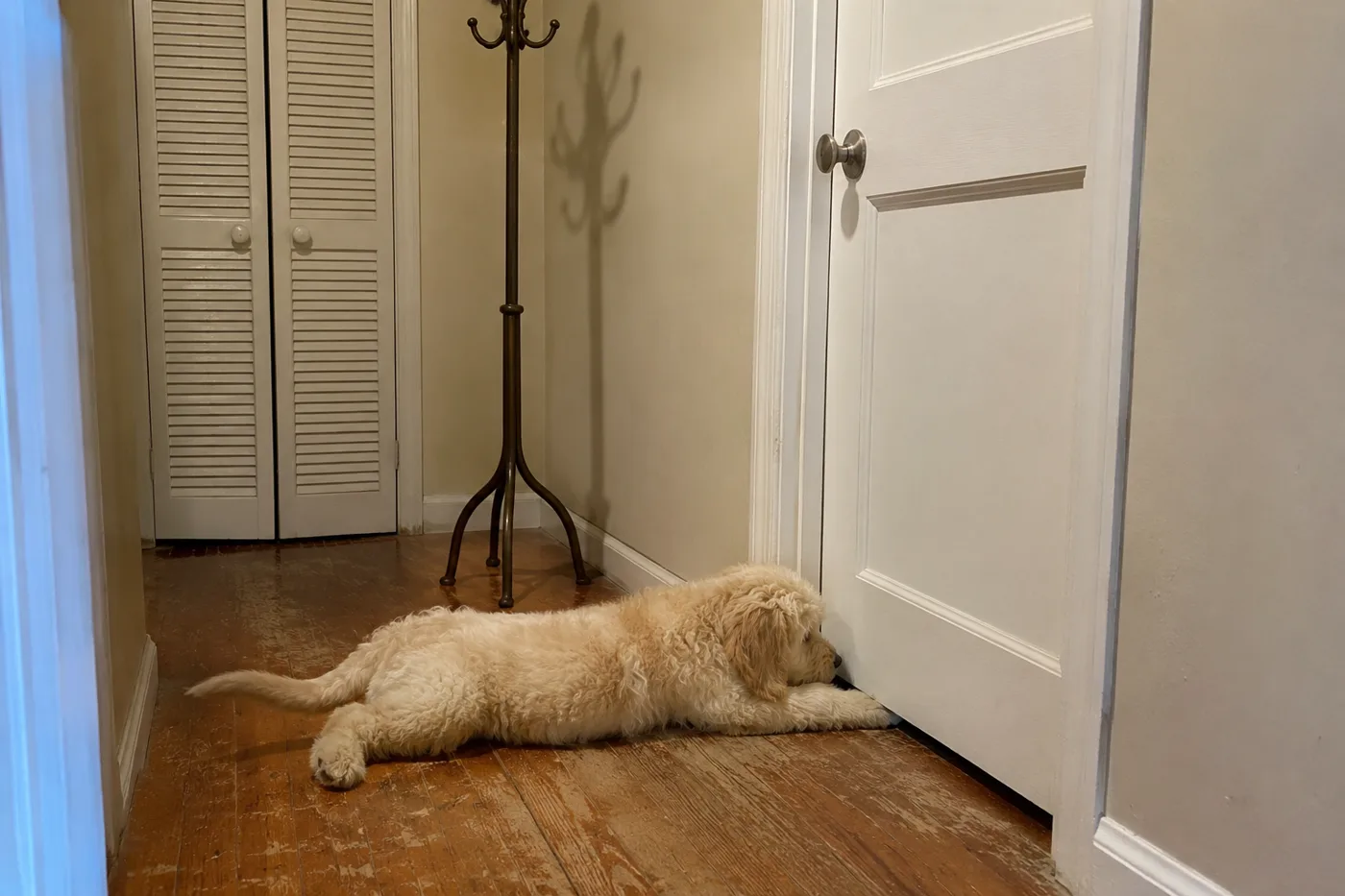
You step into the bathroom and close the door. Within seconds, the whimpering starts, then a paw under the gap. Is that separation anxiety? Maybe not.
The ASPCA’s signs of true separation anxiety are toileting indoors, barking or howling, destruction, escape attempts, pacing, and drooling or fretting as you get ready to leave. Its list of look-alikes is just as useful: unfinished house training, marking, boredom, barking at noises outside, and what it calls “juvenile destruction.” A chewed couch cushion may be just that, not separation anxiety.
How long can you leave a doodle alone, and will the crying stop? That’s the whole question in a long thread on r/Goldendoodles. Owners there describe young doodles that panic when they can’t see you, then settle once absences become short and steady. Several say the crying stops soon after the door shuts. One owner of a 7-year-old Goldendoodle jokes that the dog has just enough separation anxiety to never run away, but not enough to wreck anything.
If your dog is past joking, the ASPCA’s practice plan starts absurdly small.
The leave-alone ladder
- Step behind an inside door for 1 to 2 seconds, then come back.
- At 5 to 10 seconds, hand over a stuffed food toy as you go.
- Build slowly to 40 minutes, then add time in 5-minute steps, later 15-minute steps.
- A dog that stays calm for 90 minutes can usually handle 4 to 8 hours.
That takes weeks, and one long day out can set it back. Line up a friend or neighbor for the days you can’t avoid while you’re still climbing.
Two ASPCA rules matter most. Don’t scold: “Anxious behaviors are not the result of disobedience or spite.” And skip the crate for a dog that pants hard, drools heavily or tries frantically to get out of it.
#14 The groomer bill every six to eight weeks
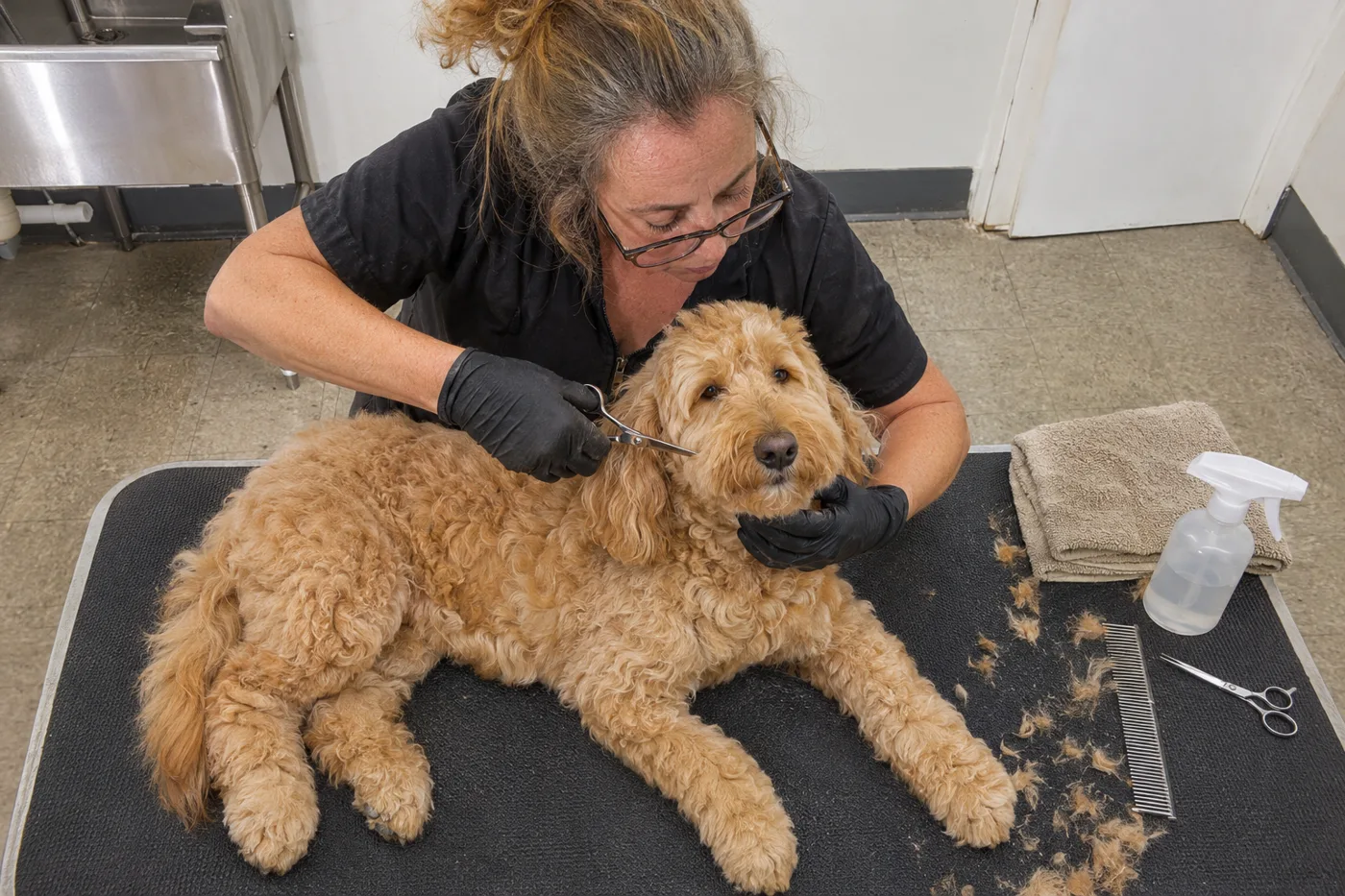
Budget about $605 to $1,040 a year for professional grooming, before tips or dematting fees. Set aside roughly $50 to $87 a month and the bill never ambushes you.
That figure comes from the pricing guide Animal Friends, which puts a standard Goldendoodle full groom at $93 to $120 in 2026, with dematting adding $15 to $50. Professional grooming every 6 to 8 weeks is the standard advice, so a six-week schedule lands near the top of that range.
The bill is the visible part. In between, Coreen Saito, writing for Petful, says to brush every day or two, daily for curly coats. A Goldendoodle owner who thought they’d done the homework says the upkeep didn’t end at daily brushing and monthly groomer visits. Another, in the same thread, says the coat picks up dirt constantly.
It’s tempting to stretch the schedule to ten weeks to save a visit. Saito’s warning is not to let a groom slide past 8 weeks. She calls a late groom “the number one reason Goldendoodles end up shaved to the skin.” The visit you skip comes back as a dematting fee, or a shave.
Book the next appointment at the counter before you leave the current one.
#13 The “mini” that grows much bigger
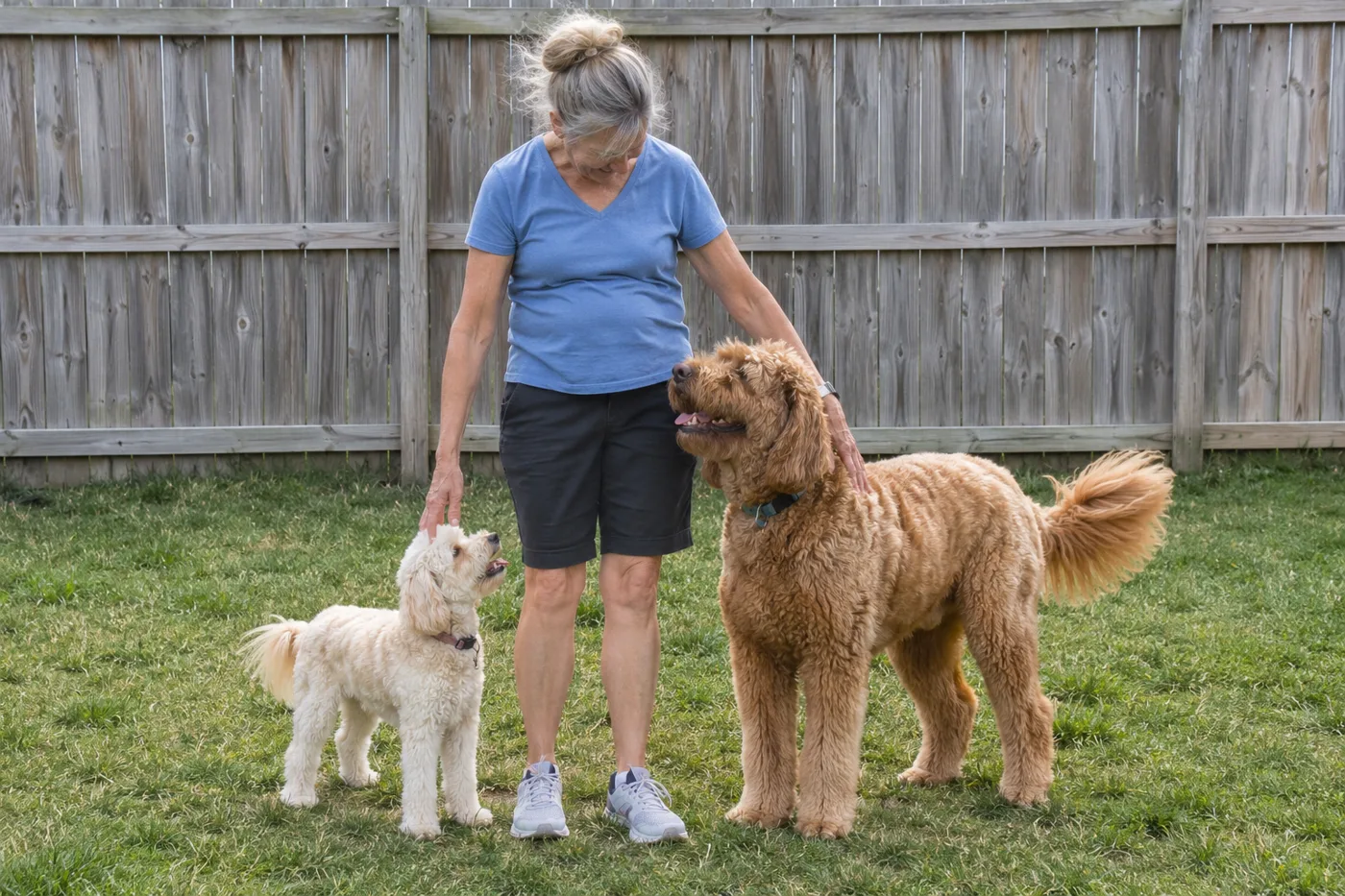
The word “mini” on a puppy contract is a breeder’s best guess. In an owner poll on the doodle site Happyoodles, 58% of mini Goldendoodles ended up outside the weight range their breeder expected. Most missed on the heavy side: 45% came in heavier, 13% lighter. The site didn’t say how many owners answered, so treat it as a rough picture. It still matches what you see at any dog park.
Here’s how the Goldendoodle Association of North America sorts sizes, as Happyoodles reports it:
| Size | Height at the shoulder | Weight |
|---|---|---|
| Miniature | 14 to 17 inches | 26 to 35 lb |
| Medium | 17 to 21 inches | 36 to 50 lb |
| Standard | Over 21 inches | 51 lb and up |
If a small dog is the whole reason you chose a mini Goldendoodle, plan for a medium anyway: the crate, the car seat cover, the harness, the jump onto the bed. If yours already blew past 35 pounds, you’re in the 45%.
#12 A puppy stage that runs to two years
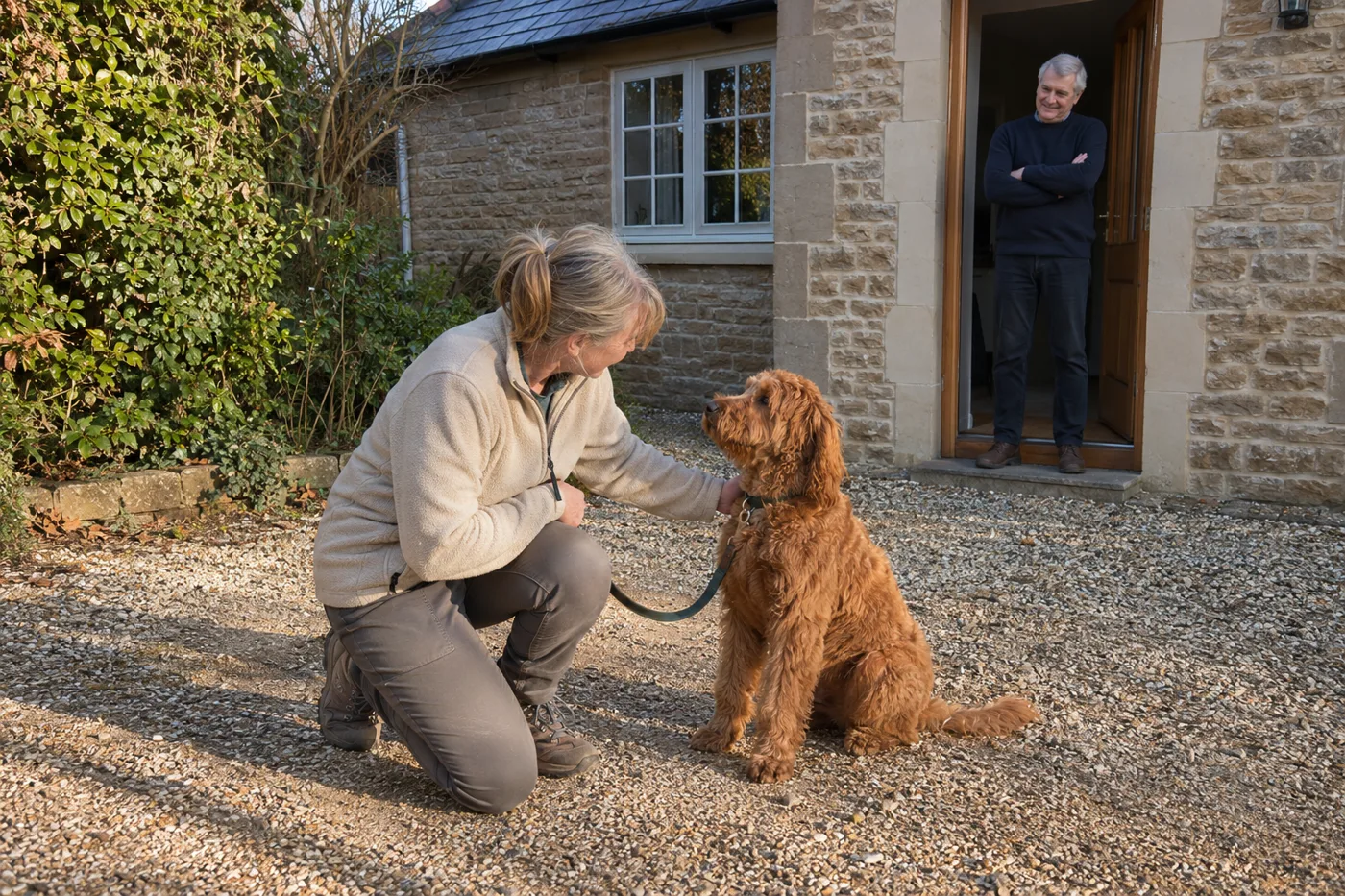
Expect the puppy stage to run to around two years, sometimes past it. The Merck Veterinary Manual says dogs reach sexual maturity at 6 to 9 months, but social maturity at 12 to 36 months. That’s the grown-up part.
Owners land in the middle of that window. A longtime dog owner on r/Goldendoodles says their doodle was a constant challenge until it grew out of puppy brain, at around 18 to 24 months.
Many goldendoodle behavior problems peak in a phase that looks a lot like the teenage years. A UK study of young guide dogs, Golden Retrievers, Labs and crosses among them, found that at 8 months the dogs obeyed “sit” less often, but only for their own carer. A stranger got the same good dog as ever. Carers rated them less trainable at 8 months, and the scores bounced back by 12.
So if the dog walker gets a perfect sit and you get a blank stare, that’s textbook.
The researchers flagged one more thing: adolescence lines up with the peak age dogs get surrendered to shelters. If you’re standing at month nine wondering what you’ve done, you’re right on schedule, and it gets better.
#11 Too much freedom in the first weeks
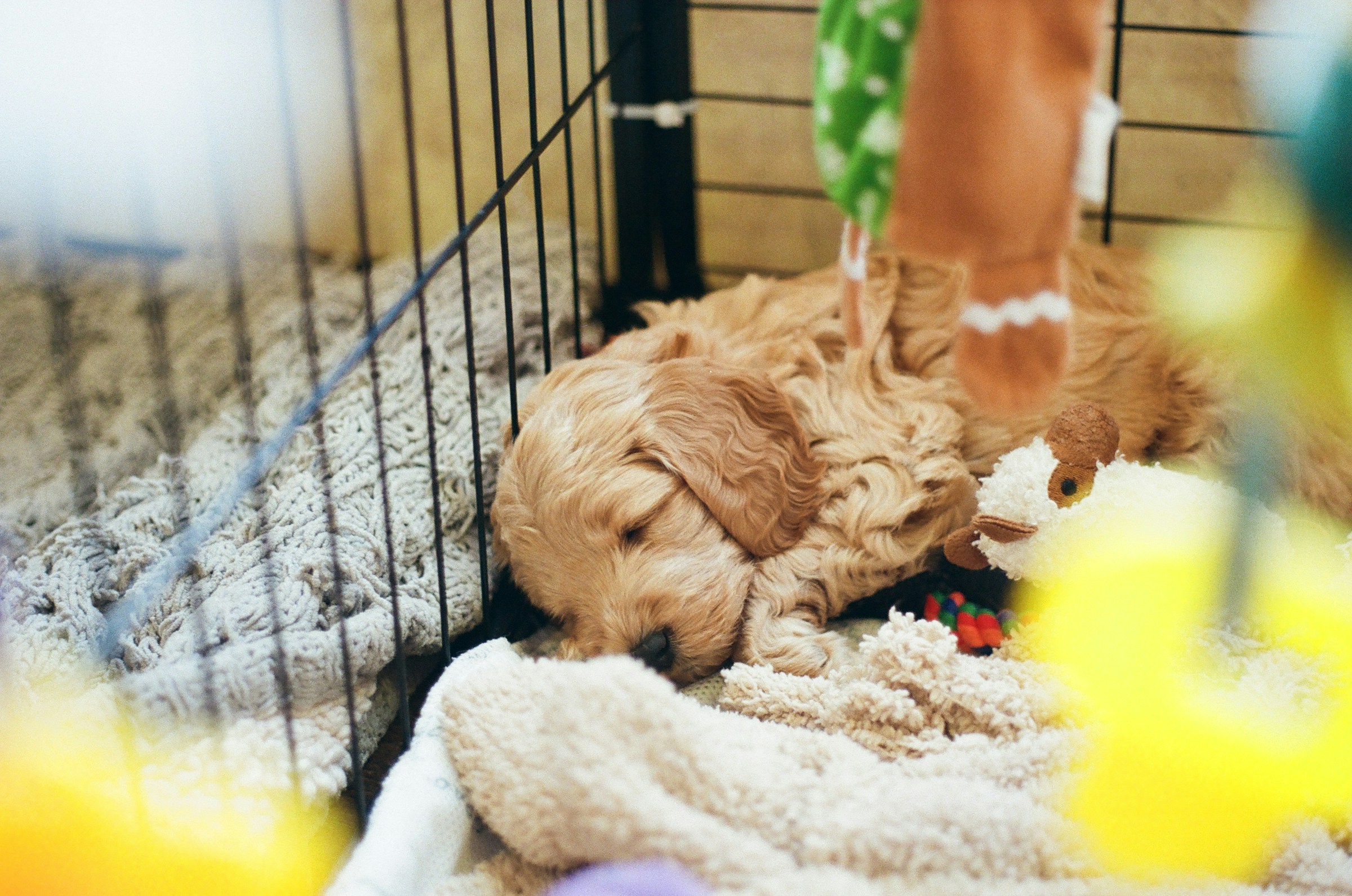
The mistake shows up weeks after you make it. Instructor Steve of McCann Dog Training in Ontario, whose classes see plenty of poodle mix and doodle puppies, says the first mistake new owners make is giving a puppy too much freedom.
His reasoning is in the recipe: a doodle packs a couple of busy dog breeds into one cute little package. In the first days, the puppy sticks to you like lint. A couple of weeks later, it discovers the hallway, the shoe basket and anything left on the floor. That’s when the trouble starts.
What he suggests stops mistakes before they happen:
- a crate for naps and nights
- a pen for when you can’t watch
- a baby gate across the doorway to the rest of the house
- a house line, a light leash the puppy drags indoors so you can steer without a chase
There’s a payoff for you, too. When the University of Helsinki surveyed more than 2,000 owners in 2024, Prof. Hannes Lohi reported that “just under half of owners report having had significant negative experiences” during puppyhood, with about a tenth at the most severe level. Psychologist Aada Ståhl describes these “puppy blues” as “anxiety, frustration and weariness.” Owners on Reddit describe feeling overwhelmed even though they’d prepared.
The good news from Ståhl: the feelings “fade relatively quickly.” A puppy with fewer chances to wreck things gets you there faster.
#10 Fear of the groomer and the vet table
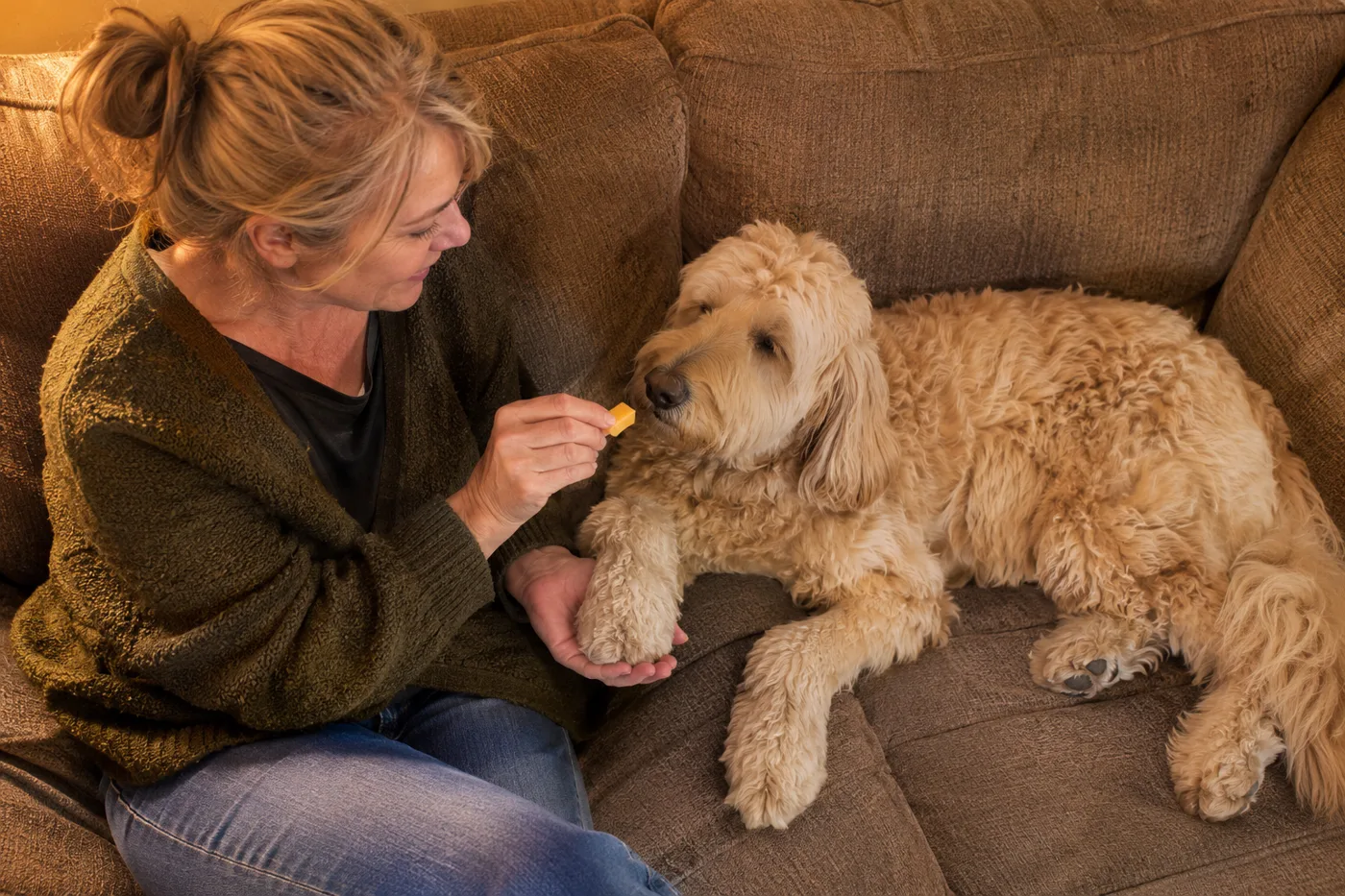
A doodle gets handled more than most dogs: clippers near the face every six to eight weeks, ears checked, nails trimmed, for life. A dog that hates hands turns every one of those visits into a wrestling match.
Dr. Aly Cohen, a veterinarian at Cornell’s Riney Canine Health Center, lays out the training most owners skip:
- Handle paws, nails and ears while the dog is already relaxed, like on the couch at night.
- Pair each tool with a treat. The brush appears, the cheese appears.
- Keep sessions short.
- Teach a chin rest, where the dog rests its chin in your palm and holds still.
Cornell’s reasoning: “Dogs that feel safe and in control are far more likely to tolerate and even relax during grooming and veterinary care.”
Instructor Steve’s version: handle a puppy’s collar, ears, paws, toes and tail from the start, rewarding as you go, so it learns hands on it are a normal part of life.
Cornell says to start in puppyhood, and when you look for a groomer, it points to Fear Free certified groomers near you.
#9 A coat that hides extra weight
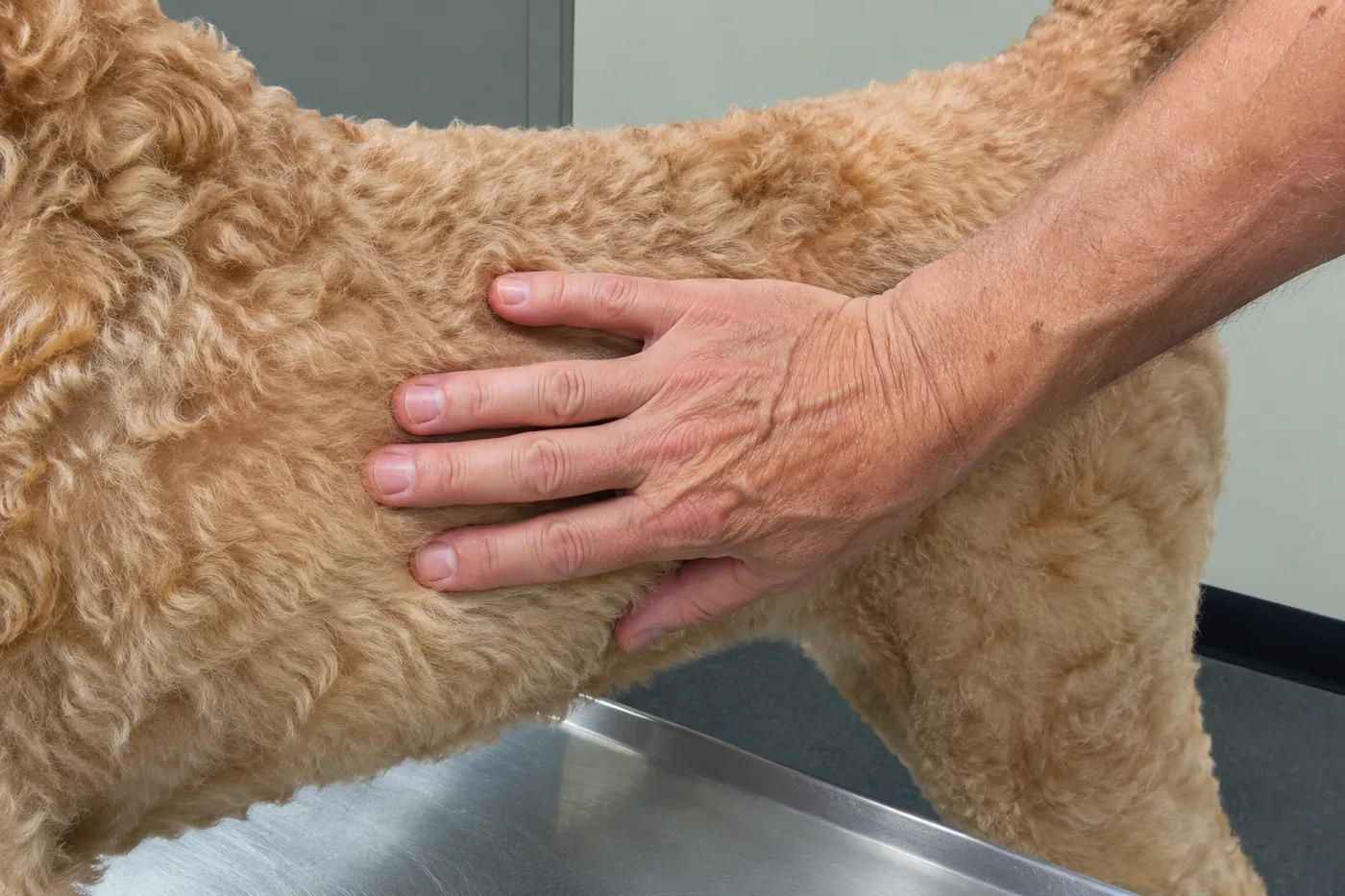
That fluffy coat is built to hide a waistline, and the missing waist often only becomes visible after a short haircut.
It’s an easy miss. The Association for Pet Obesity Prevention found that 59% of US dogs seen by vets in 2022 were overweight or obese, and many owners of heavy pets thought theirs looked normal.
Your hands are better than your eyes here. Slide a flat hand through the curls and along the side of the chest until you feel ribs, then compare it to VCA Hospitals’ hand test.
The hand test for hidden weight
- Ribs at a good weight feel like the back of your hand.
- Ribs on a heavy dog feel like the fleshy part of your palm.
- On the vet’s 9-point body scale, ideal is a 4 or 5.
- Overweight means 10% to 20% above ideal; obese means more than 20%.
Why bother: VCA says “being even moderately overweight can reduce life expectancy by nearly two years.” If you’re not sure what you’re feeling, ask the vet to show you on your own dog at the next checkup. The day after a groom is the easiest time to see it.
#8 Hip and elbow dysplasia, the surprising reversal
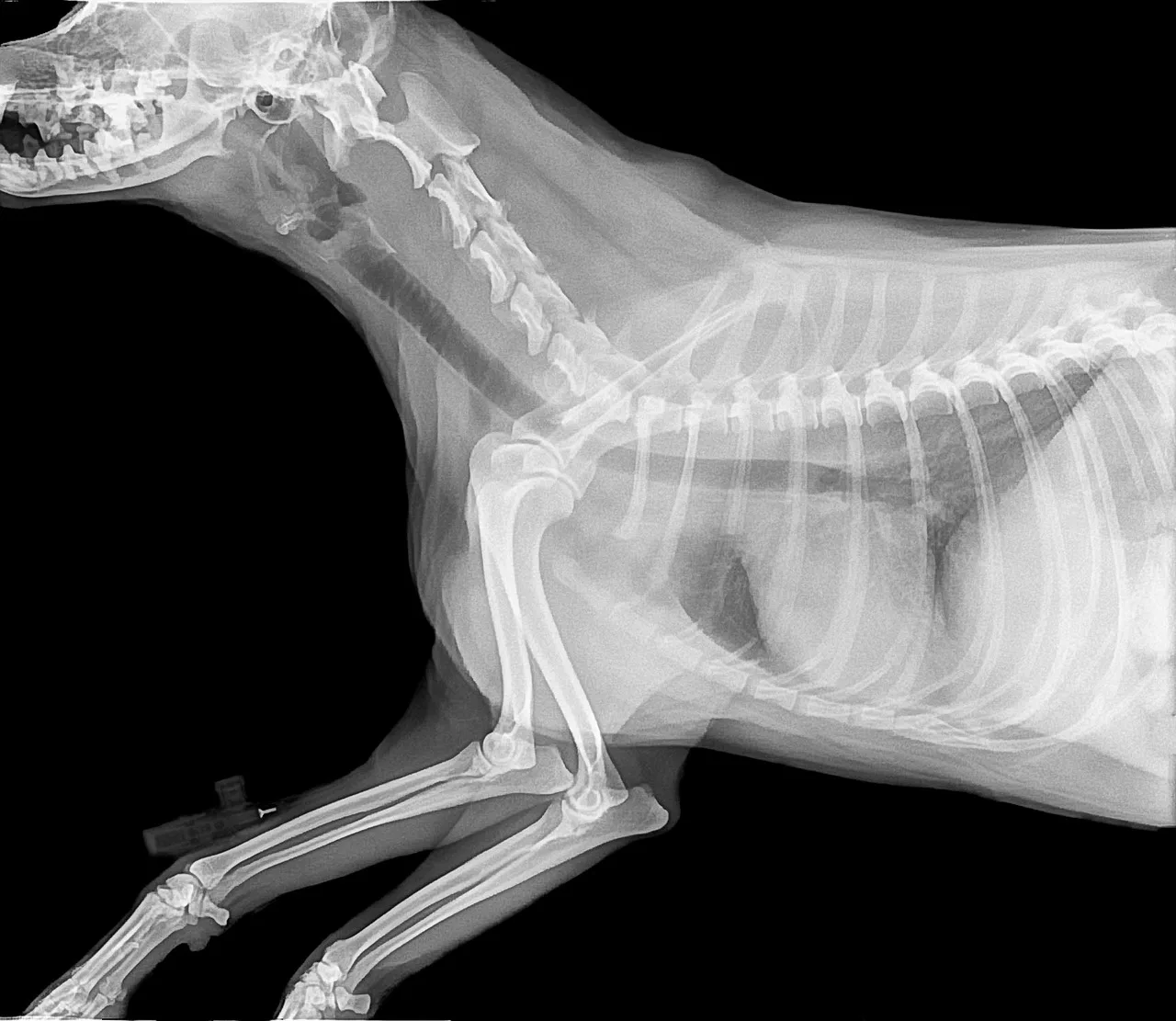
Here’s a twist most buyers don’t expect. In the Royal Veterinary College’s “doodle dilemma” survey of UK owners, Labradoodles were far less likely than Labradors to have hip or elbow dysplasia, at about a third the odds.
Read the fine print before you celebrate. That survey covered Labradoodles under age 5, and owners reported the conditions themselves. No study like it exists for Goldendoodles. Still, it pushes against the idea that a cross gets every parent’s problems.
The bigger lesson is on the purebred side. A study of more than a million hip records from the Orthopedic Foundation for Animals (OFA), a nonprofit that grades dogs’ X-rays, found hips and elbows improved genetically in all 60 breeds it looked at, Golden Retrievers included. Screening works when breeders do it.
Those registry numbers also likely look rosier than reality. Owners of dogs whose X-rays look dysplastic may not readily submit them.
So the health testing question isn’t optional. Ask to see OFA or PennHIP results for both parents’ hips and elbows, from the registry itself, before any deposit changes hands. OFA posts passing results in a free public database, so you can look up each parent by name yourself. On its hip scale, Excellent, Good and Fair pass, and Borderline or anything worse doesn’t. A breeder who says the cross makes testing unnecessary is telling you something about the breeder.
#7 Bloat, the emergency to recognize
It’s an hour after dinner. Your dog stands up, heaves as if to vomit, and nothing comes up. Then again. The belly looks tight, and the dog can’t settle.
That’s the picture of bloat, or gastric dilatation-volvulus, when the stomach fills with gas and can twist. It’s an emergency. Cornell’s Riney Center lists the signs:
- retching that brings nothing up
- a swollen, bloated belly
- drooling and restlessness
- pale gums
- a “praying” stance, front legs stretched out with the chest low
An upset stomach usually produces something. Repeated dry heaving with a swelling belly means the emergency vet now, not in the morning. Untreated bloat is fatal. With treatment, Cornell puts survival above 80 percent.
Why it’s on a Goldendoodle list: Standard Poodles are on Cornell’s list of breeds prone to it.
One more thing to ask the vet. A surgery called gastropexy tacks the stomach in place. After a bout of bloat, it drops the chance of another to as low as 3 to 5 percent, against up to 80 percent without it. Vets may also recommend it ahead of time for large breeds like the Standard Poodle, or for a deep-chested or anxious dog. It can be done during a spay or neuter, so the time to ask is before that appointment. At NC State’s veterinary hospital in 2024, adding it to a laparoscopic spay cost about $200 more.
#6 Addison’s disease, the great pretender
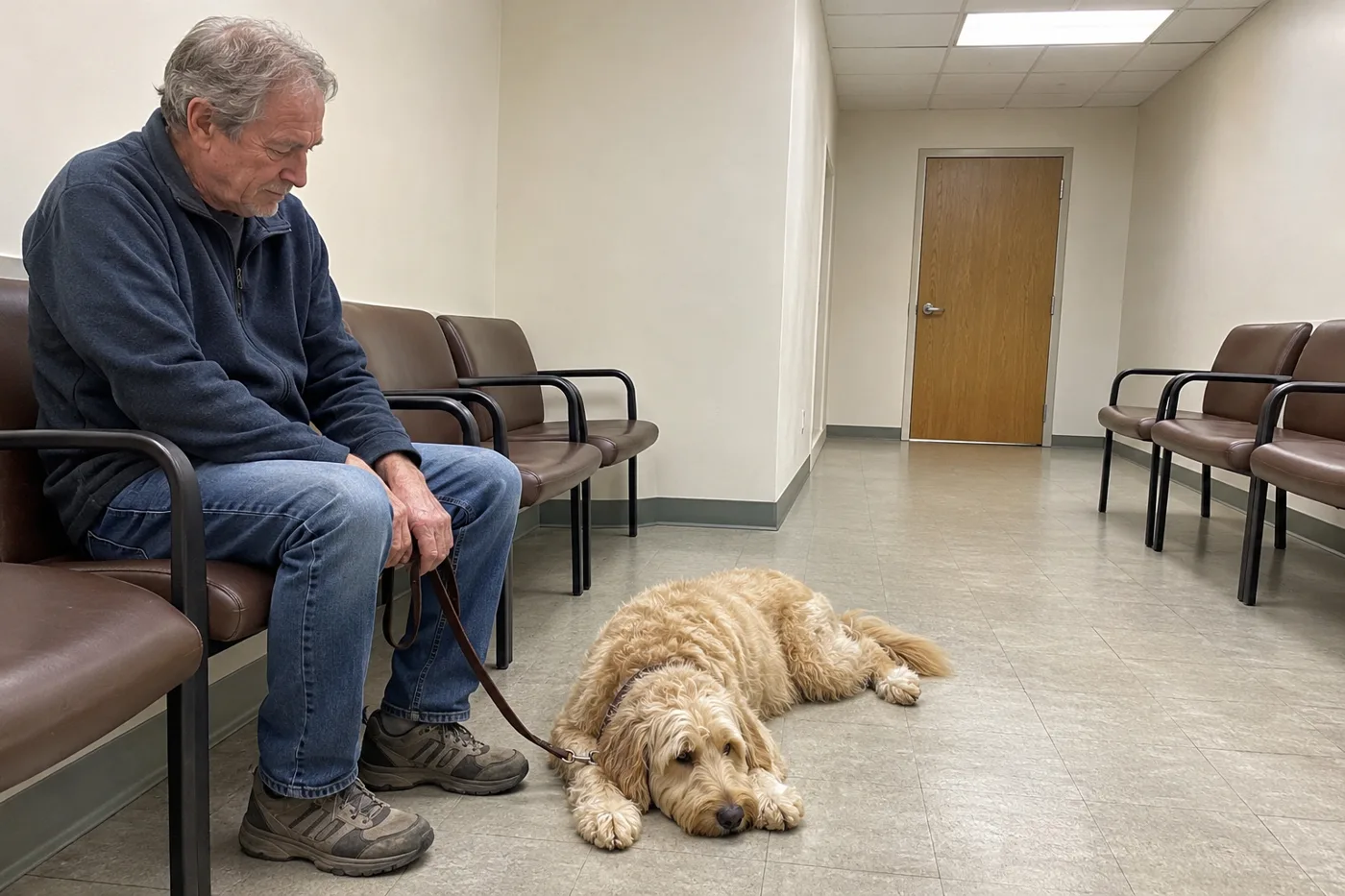
Addison’s disease is a hormone disorder that copies ordinary tummy trouble so well that Whole Dog Journal calls it “the great pretender”. It “resembles so many other illnesses.”
The signs VCA Hospitals lists are maddeningly vague: tiredness, diarrhea, vomiting, drinking and peeing more, weight loss. They “may wax and wane.” The dog has a bad week, perks up, and you stop worrying.
Then sometimes it doesn’t perk up. A crisis looks like sudden weakness, severe vomiting and diarrhea, and sometimes collapse. Whole Dog Journal says 30 to 35 percent of dogs are first diagnosed that way, in crisis.
The Poodle side brings this one in. Standard Poodles are predisposed, and diagnosis typically comes between ages 4 and 6. Two doodle owners in a long stomach-trouble thread say their dogs were diagnosed after vague gut symptoms, and both say it’s manageable once it’s caught.
If on-and-off gut trouble keeps coming back in an adult doodle, ask your vet one direct question: has Addison’s been ruled out? The confirming blood work is called an ACTH stimulation test. Treatment is lifelong: a hormone shot every 3 to 4 weeks, or daily pills. At the labeled dose, the DOCP shots ran roughly $40 to $237 a month in 2019, depending on the dog’s size.
#5 Temperament you truly cannot predict
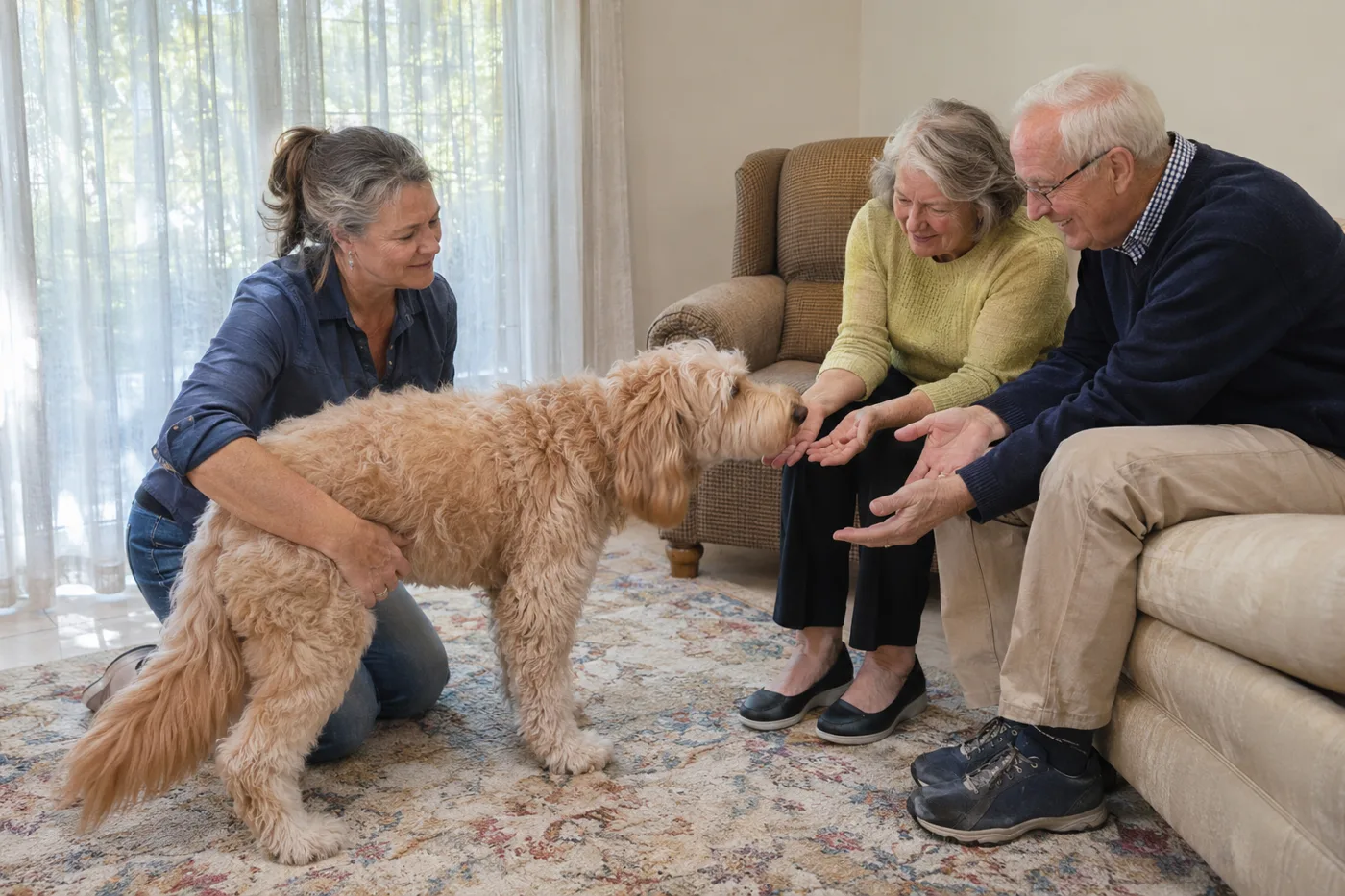
Every honest look at goldendoodle pros and cons ends up here. The Goldendoodle temperament you’re promised is a hope, and the science says breed decides very little of it.
A 2022 study of more than 2,000 dog genomes and 18,000 owner surveys found that breed explains only about 9% of behavior in individual dogs. Senior author Elinor Karlsson: “A dog’s personality and behavior are shaped by many genes as well as their life experiences.”
Dr. Rachel, the Texas vet from #17, sees both ends at her clinic. Many doodles are a pleasure to work with, but some have had serious behavior problems. Her short version: with a mix, you can’t know what you’re getting.
The other side is loud, too. About eight owners across several r/Goldendoodles threads call theirs easy to train, gentle with toddlers and other dogs, the best dog they’ve had. Several credit doing the research first and putting in training time.
Even a reputable breeder can’t promise a personality. The fix almost nobody mentions is to skip the guessing: adopt a grown doodle whose personality is already on display. Owners on Reddit point out that doodles land in shelters like any dog. IDOG Rescue, a national rescue founded in 2006, places doodles through foster homes and has rehomed more than 3,000. A foster family can tell you whether this dog cries at the door, jumps on visitors or sleeps through the doorbell.
#4 Painful mats and the full shave-down
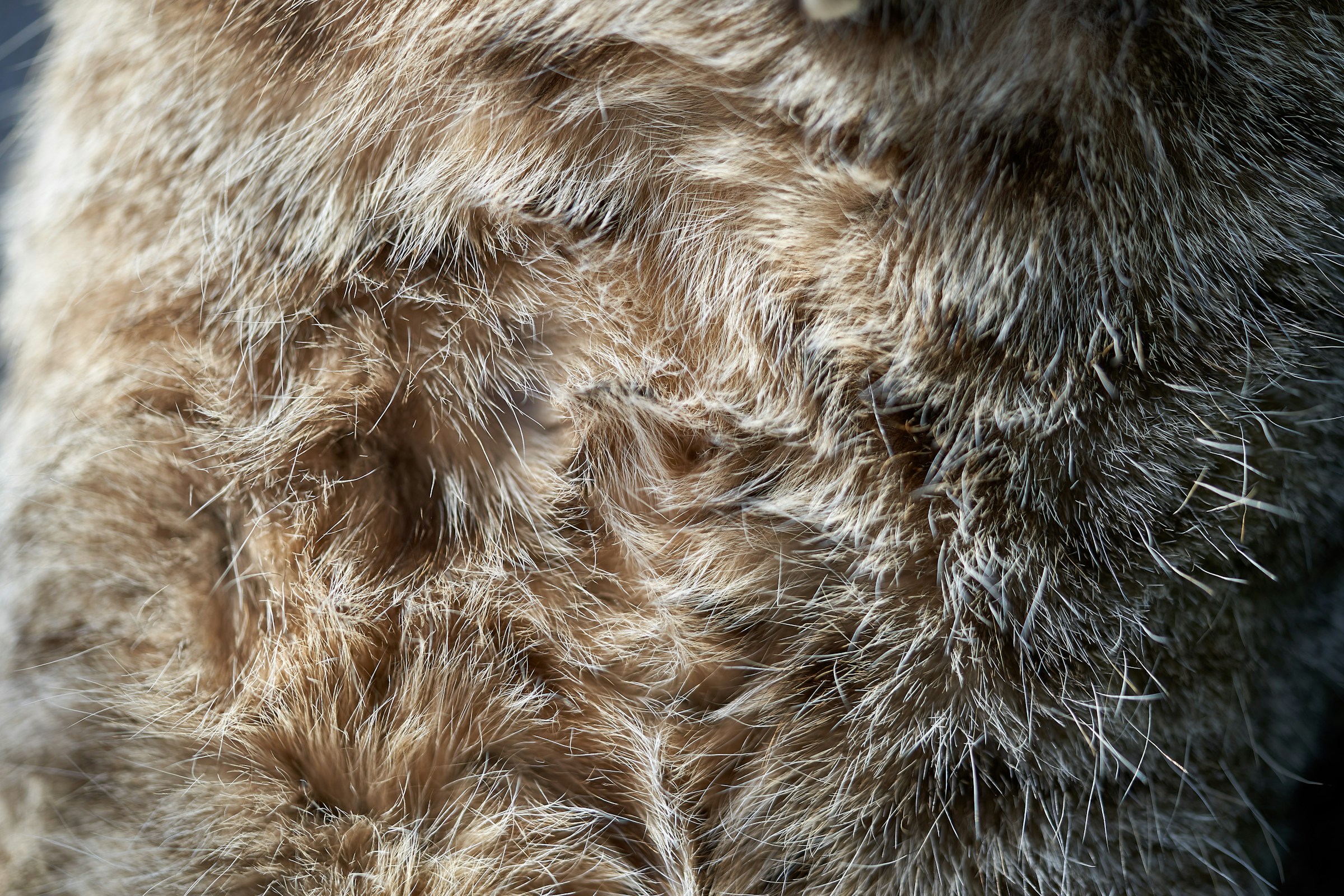
You run your fingers through the coat and find a hard little knot. Then another. By the time you can feel mats, they’re already pulling.
Preventive Vet, quoted in Newsweek, says mats can pull tightly on the skin, “causing pain, bruising, sores or hematomas” (pockets of blood under the skin), and can trap moisture, dirt, bacteria and parasites. The same 2026 story told of a groomer who shaved Cooper, a one-year-old Poodle, because brushing out his tight mats could have torn his skin.
That’s why the shave happens. MobileDog, a mobile grooming business in Northern Virginia, explains it simply: “As a mat tightens, it twists the skin underneath it.” Brushing out a coat matted solid to the skin is “prolonged, painful, and hard on the skin.” Groomers have a phrase for choosing the clippers anyway: “humanity over vanity.”
If you pick up a shaved dog and see red patches and sores, the mats caused those, and the clippers only uncovered them. Call your vet if the redness spreads, or you see swelling, discharge or a smell, or the licking won’t stop.
Brush the problem spots between visits, and the next groom stays a haircut.
#3 Diarrhea that won’t stop in puppyhood
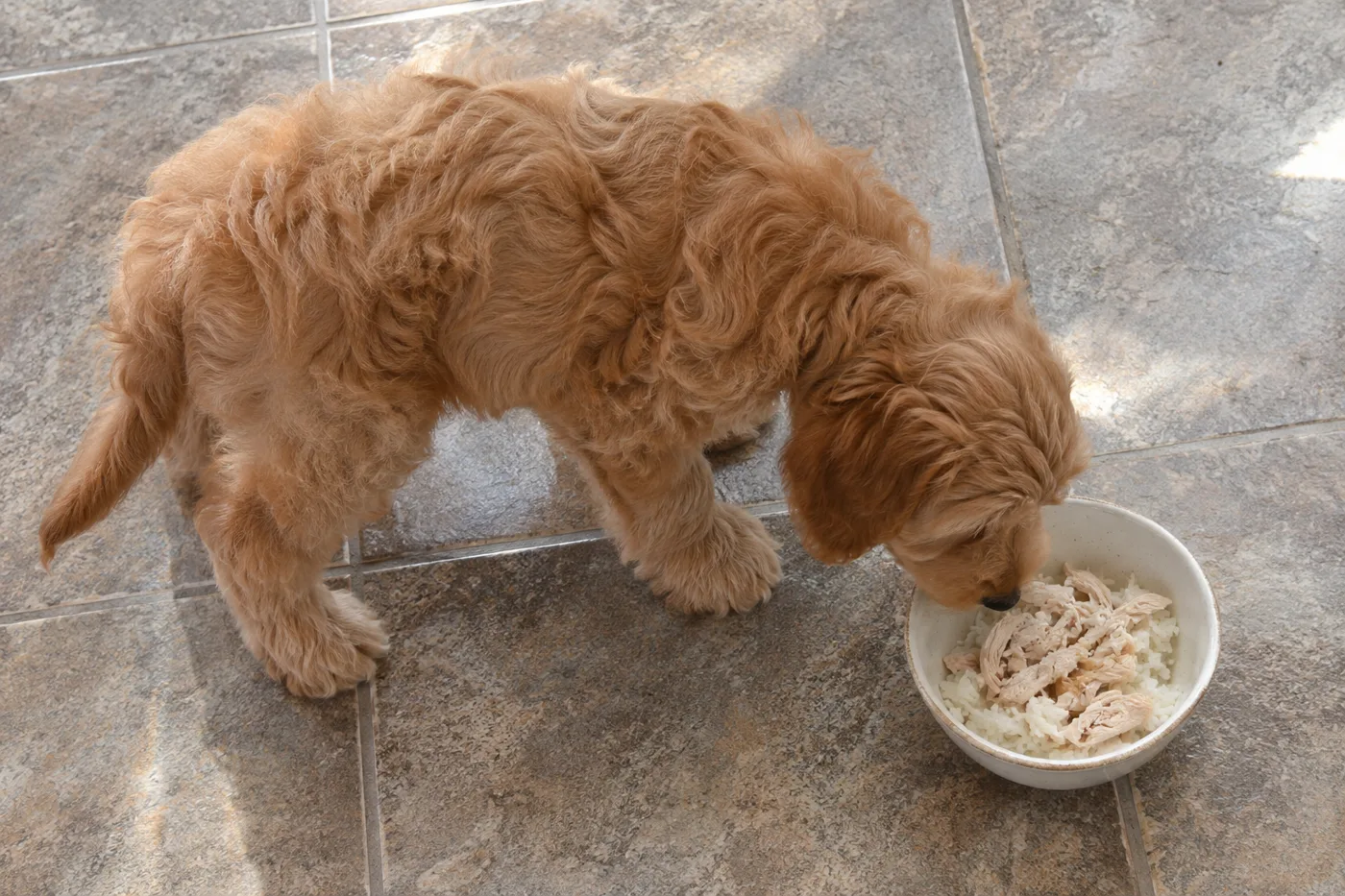
This is the one that wears owners down. Owners in two long r/Goldendoodles threads describe months of diarrhea starting in young puppyhood: vet visit after vet visit, rounds of antibiotics, a Giardia diagnosis, food change after food change, prescription diets. Some say it only settled at 12 to 18 months.
Dr. Abby Sullivan, a veterinarian in West Fargo, North Dakota, tells doodle owners on TikTok to expect it: any kind of doodle, golden, Labradoodle or Bernedoodle, is prone to a sensitive stomach, with diarrhea and vomiting.
The closest research backs her up. In the UK doodle survey from #8, Labradoodles had higher odds of diarrhea and vomiting than Poodles, and about twice the odds of “dietary indiscretion,” vet-speak for eating things they shouldn’t.
Giardia, a gut parasite, is the usual first suspect. The Merck Veterinary Manual says it infects about 10 to 30 percent of dogs, more in young ones, and causes diarrhea that comes and goes, with pale, soft, bad-smelling stools. The catch is reinfection. A puppy finishes the medicine, steps in the yard, licks a paw, and starts over. Merck’s fix:
- Bathe the dog after treatment to wash parasite cysts out of the coat.
- Pick up stool right away.
Then comes the twist several owners didn’t see coming: they traced the loose stools back to chicken. That’s the very thing in the chicken-and-rice bowl everyone makes for an upset stomach. A review of 297 dogs with food allergies found chicken was one of the most-reported triggers, behind beef and dairy. That research was about itchy skin, not diarrhea, so it’s a lead to raise with your vet rather than proof.
Bring a fresh stool sample to every gut visit, and tell the vet exactly what’s in the bland diet.
#2 Jumping up on you and your guests
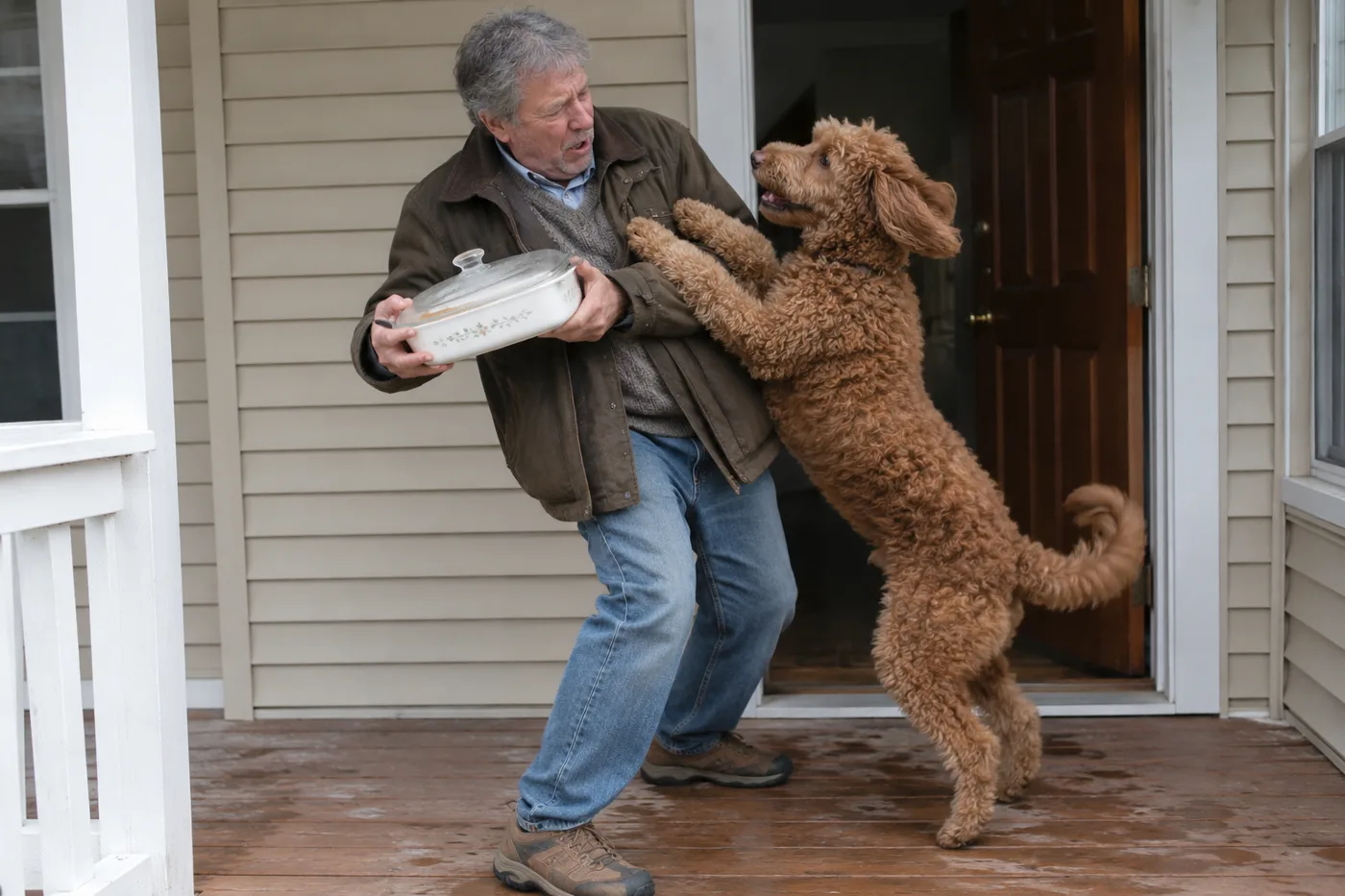
The friendly jump at the front door has a real cost. A CDC report on emergency rooms found that dogs were involved in about 88% of an estimated 86,000-plus pet-related falls a year. About one in five of the dog falls came from a dog pushing or pulling someone over. The rate climbed with age, from about 47 per 100,000 people at 65 to 74 to about 71 at 85 and up. Among people admitted to the hospital, four out of five were there for a fracture. Those figures are from 2001 to 2006, before doodles were everywhere.
Now picture a 50-pound teenager from #12, all elbows, launching at a visitor holding a casserole dish. The CDC’s own fix is obedience training. The AKC’s Stephanie Gibeault, a certified trainer, gives the method:
- Pick one rule: sit, or all four paws down.
- Reward it the instant it happens.
- Turn away when the dog jumps.
- Don’t grab, push or knee the dog.
- Ask every guest to play by the same rule.
Number five is where it falls apart. The neighbor who says “oh, I don’t mind” and scratches the jumping dog’s ears just paid it to jump at the next person. Gibeault explains why: “Dogs repeat behaviors that get them what they want. If your dog wants attention, make sure appropriate greeting behavior earns it immediately.”
Keep a jar of treats by the door, and hand one to the guest before they ring the bell.
#1 Leash pulling that can break a hip
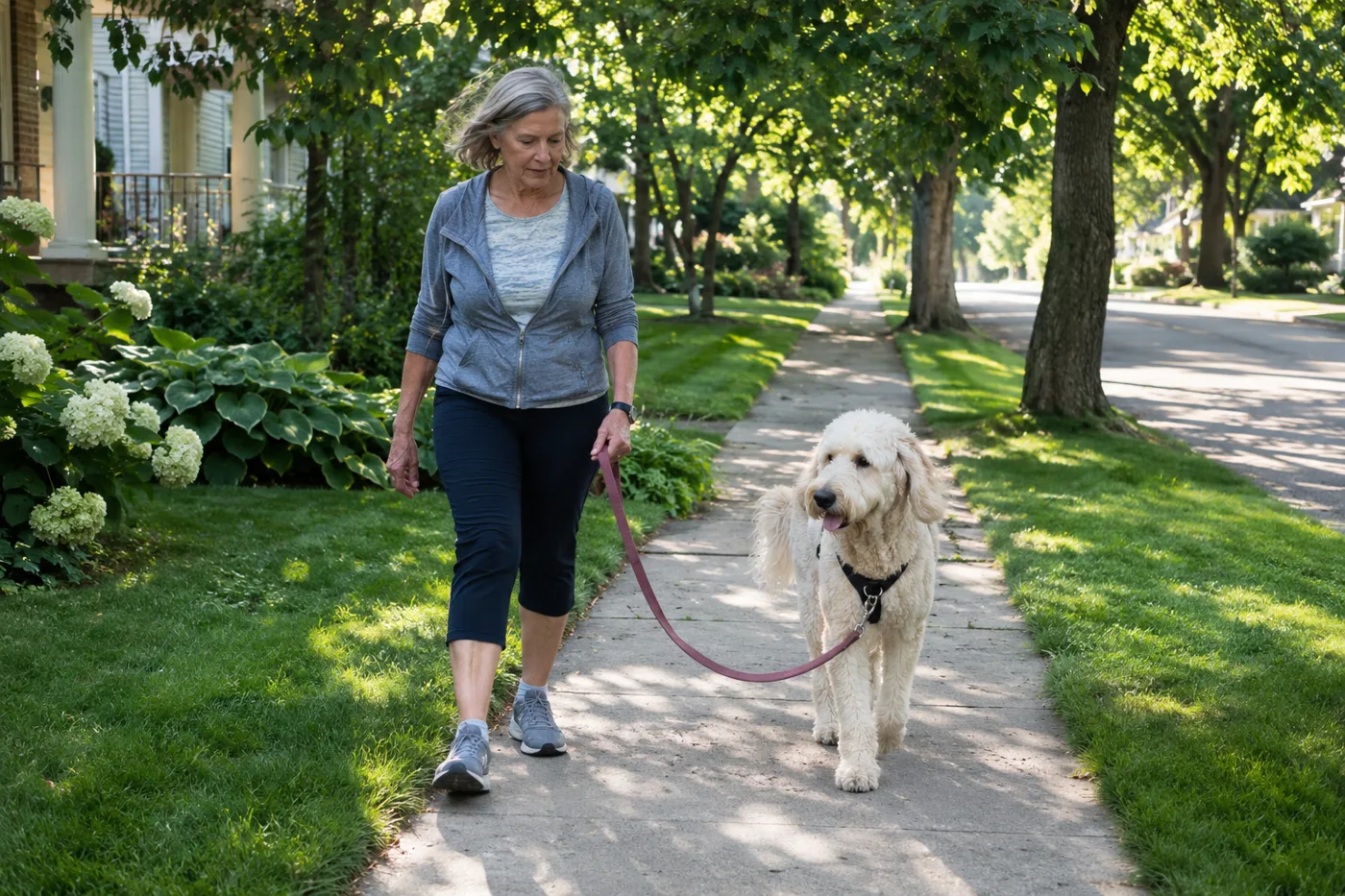
The quiet walk is where the worst injuries happen. Penn Medicine researchers looked at national emergency room data for adults 65 and up and found fractures from walking a leashed dog more than doubled in 13 years.
The leash numbers
- Leash-related fractures in adults 65 and up: 1,671 in 2004, then 4,396 in 2017
- About 79% of the people hurt were women
- The hip was the most common single break, at 17.3%, and nearly 29% were admitted
The hip is the one that matters. The authors note that hip fractures carry “mortality rates approaching 30%.” They also suggest older adults thinking about a new dog consider a smaller breed. That’s worth hearing honestly if you’re eyeing a standard Goldendoodle, and if you already love one, the next part is for you.
You’ve felt it: the squirrel, the other dog, the sudden yank that pulls your arm straight. A 2025 review by Cavalli and Protopopova notes that poor leash control causes injuries from falls and strain of the arm and shoulder. Their answer is a non-tightening, front-clip harness, the kind where the leash attaches at the chest instead of the back, plus reward-based training. One catch from the same review: on a Y-shaped harness, clipping to the front ring noticeably limited the dog’s shoulder and elbow movement, so ask a trainer or the store which front-clip style suits your dog.
A harness alone won’t stop a determined lunge, and training takes time and consistency with a teenage doodle. Do both. The walk around the block is the one thing you’ll do with this dog every single day for the next decade.
The bottom line
Sort the list into two piles. In one goes everything with an end date: the crying at the door, the teenage stare, the puppy diarrhea, the jumping. In the other goes everything that lasts as long as the dog: the coat, the groomer, the handling, the walk.
The first pile is about patience. The second pile is a monthly budget line and a daily habit, and it’s the one to be honest about.
If you’re still deciding, ask yourself which pile scares you more. If the doodle is already snoring next to you, pick one item from the second pile and start on it before the week is out.
Bonus: five checks owners rarely hear about
Read the peanut butter label before you stuff a food toy. The Merck Veterinary Manual lists some peanut butters among the products that can contain xylitol, a sweetener that’s toxic to dogs, along with gum, mints and toothpaste.
Save the ASPCA Animal Poison Control number in your phone: (888) 426-4435. It handled over 376,000 calls in 2025.
Ask the breeder whether at least one parent tested Normal or Clear for prcd-PRA, an inherited eye disease that the Poodle health group Versatility In Poodles says leads to blindness and shows up late, around 5 or 6 years.
Tell the groomer not to pluck hair from healthy ears. VetVine reports that plucking a healthy ear can cause irritation and inflammation.
Lift your dog’s lip once a month. The AVMA says most dogs have some gum disease by age three, and bad breath or pawing at the mouth is a sign.
Questions people also ask
What health problems do Goldendoodles get?
Little research covers Goldendoodles themselves, but a UK survey of Labradoodles under 5 found higher odds of ear infections than Labradors, higher odds of allergies, diarrhea and vomiting than Poodles, and lower odds of hip and elbow dysplasia than Labradors. From the parent breeds, cancer caused 70% of deaths in a lifetime study of Golden Retrievers, and Standard Poodles are prone to bloat and Addison’s disease.
Are Goldendoodles really hypoallergenic?
No, Goldendoodles are not truly hypoallergenic, and no dog breed is. The allergists’ society ACAAI says “a truly allergy-free breed does not exist.” In a Dutch lab study, the hair of “hypoallergenic” breeds, Labradoodles included, carried about three times more of the main dog allergen than other dogs’ hair, and the air in their homes was no different.
How long can a Goldendoodle be left alone?
A Goldendoodle that has been trained up to it can usually manage 4 to 8 hours alone, but there’s no doodle-specific figure. The ASPCA’s general method builds absences up from a few seconds, and a dog calm for 90 minutes can usually handle that longer stretch. Puppies and anxious dogs shouldn’t be left alone for long periods until they’ve been built up gradually.
How often does a Goldendoodle need to be groomed?
Plan on professional grooming every 6 to 8 weeks, with brushing at home every day or two in between. Petful’s grooming writer warns not to let a groom slide past 8 weeks, calling a late groom the top reason doodles end up shaved to the skin. At 2026 prices of $93 to $120 per groom, that comes to about $605 to $1,040 a year.
At what age do Goldendoodles calm down?
There’s no doodle-specific study, but owners’ reports commonly fall between 18 and 24 months, inside the Merck Veterinary Manual’s general 12-to-36-month range for social maturity. A UK study of young guide dogs found a “teenage” dip in obedience around 8 months that had eased by 12 months.
What’s the life expectancy of a mini Goldendoodle?
No study has measured mini Goldendoodle lifespan specifically, so any exact figure you see is a guess. The closest guide to goldendoodle lifespan is the largest UK dog-lifespan study, which found crossbred dogs live a median of 12 years, just under the 12.7-year median for purebreds. That study grouped designer crosses with all other crossbreeds.