Lassie and Scooby-Doo lunch boxes, Pound Puppies and the spaniels on the mantel: what these vintage dog collectibles sold for where we found sales, and how to tell if yours is the real thing.
At #1 is a doll that sold for $1,625, and its helmet is signed by an Apollo astronaut.
The box from the attic still smells like the attic. Under a folded tablecloth there’s a metal lunch box with a dent in the lid. Next to it is a little painted dog wrapped in newspaper so old the grocery ads make you laugh.
Before any of it goes on eBay or the yard sale table, you want to know if it’s worth money. Mostly it’s worth a little. Now and then it’s worth a lot, and the clue is usually on the underside, or in a price someone actually paid.
Asking price or sold price? – “Asking” or “dealer” means what a seller hopes to get. “Sold” means a recorded sale or an auction result. Every price below says which. – To price your own piece, look up sold listings for ones like it, never the ones still for sale.
- Antiques Roadshow appraisers may give a value at auction, at retail or for insurance, and auction prices are often lower than retail. Value depends on condition, market trends and where an item is sold.
Table of Contents
#14 Lassie and Scooby-Doo lunch boxes
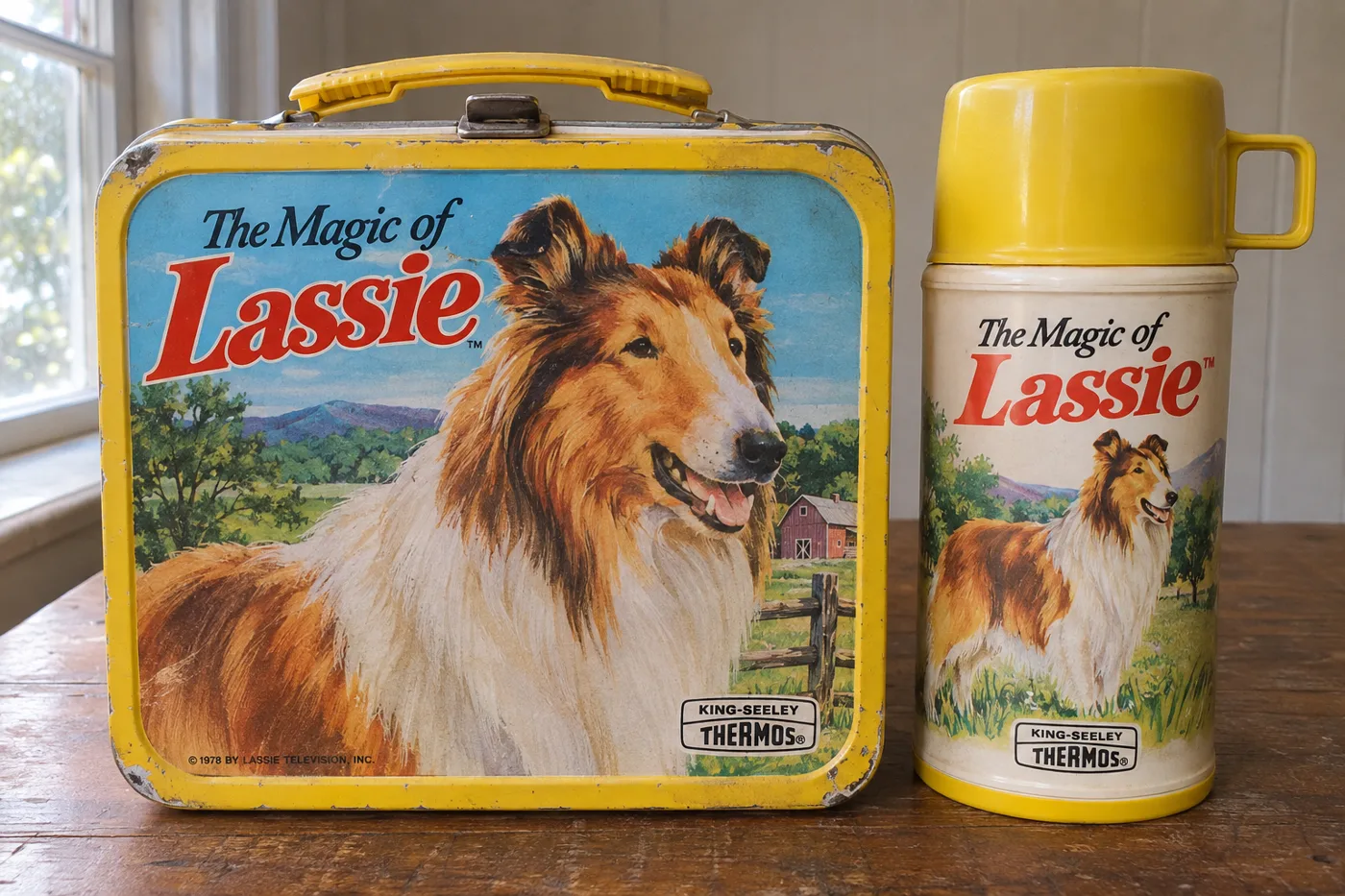
“Everything that was on television ended up on a lunch box,” Allen Woodall, founder and curator of the Lunch Box Museum in Columbus, Georgia, told NPR.
Lassie made it onto more than one. A price guide lists 1962 boxes called “Lassie and Black Beauty” and “Pets & Pals,” and then there’s the 1978 “The Magic of Lassie,” made by King-Seeley Thermos. Here’s how that 1978 box has done, next to the Scooby-Doo box from 1973:
| Box | Condition | Sold for |
|---|---|---|
| 1978 Magic of Lassie, with thermos | Dented, scuffed | $25 (2023 auction) |
| 1978 Magic of Lassie, with thermos | Near mint | $180 (2019, eBay) |
| 1973 Scooby-Doo | Condition not given | $102 to $250 (2021 eBay sales) |
| 1973 Scooby-Doo | Pristine, with tags | $995 |
The two Lassie boxes are the same design, and both still had the thermos. The $25 box had a dent, discoloration, scuffs and oxidation; the $180 box was near mint. Van Eaton Galleries had estimated the dented one at $50 to $100, and it went for about $30 once the 21% buyer’s premium was added.
The Scooby-Doo sales put a pristine box with tags at $995, against $102 to $250 for boxes sold on eBay in 2021. You probably remember your thermos smelling faintly of milk no matter how often it got rinsed. If it’s still rolling around a closet shelf somewhere, keep it with the lunch box.
The CollectionHero guide shows an “average value” of $60.17, with a low of $5 and a high of $475. The page doesn’t say which sales those cover. Go by sold results for your design in your condition instead. No reliable price turned up for Lassie plush, games or figures.
#13 Pound Puppies from the 1980s
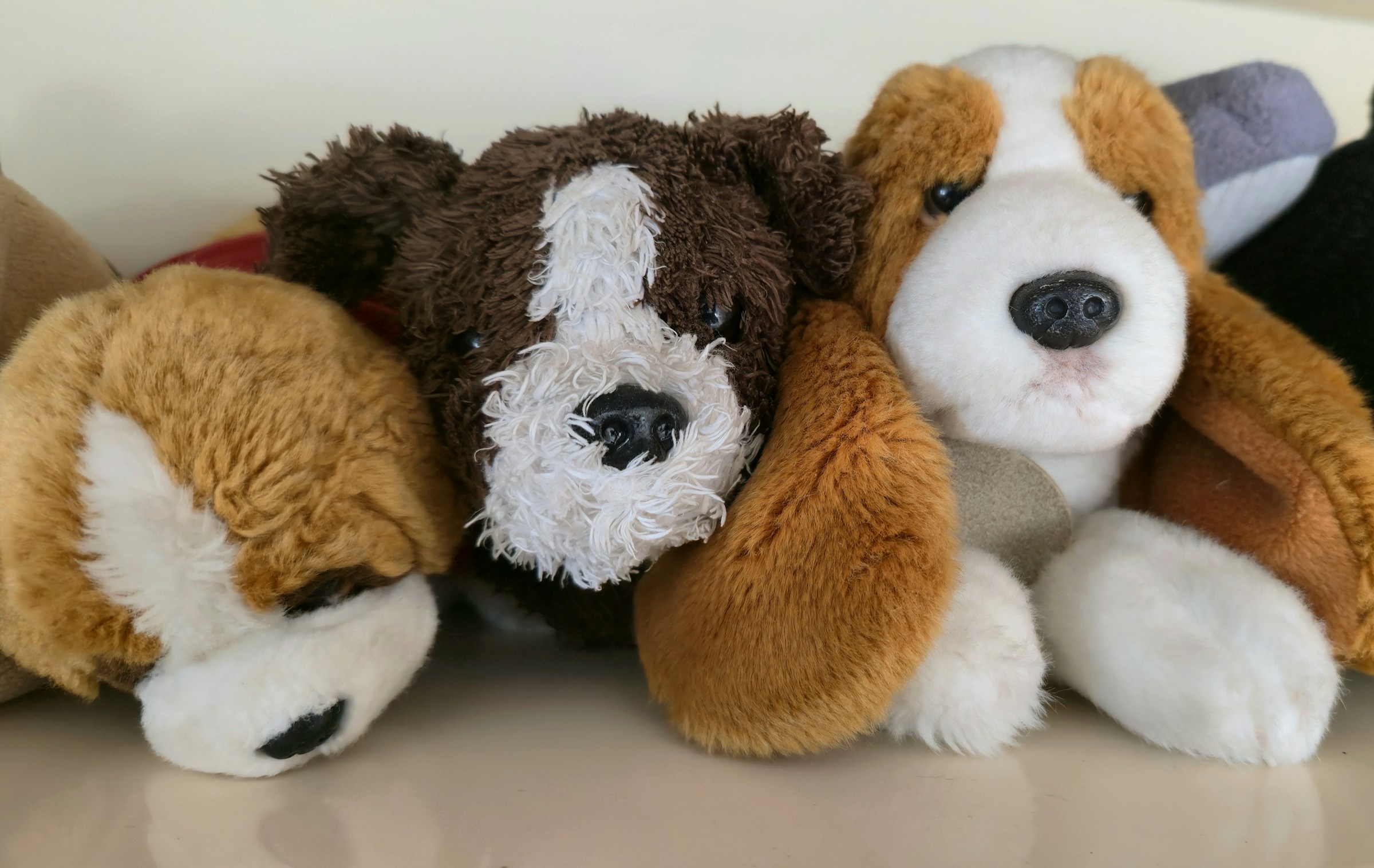
Flip the puppy over and look near the tail. A genuine Pound Puppy has a small “PP” emblem there, according to the Fab Tin Toys price guide, which also recorded these sales in early 2025:
- 1985 Tonka adult No. 7805, new in box with papers: $200
- Another No. 7805, new old stock: $200
- 1985 “2nd Edition” signed by creator Mike Bowling: $149
- A loose 1985 gray-spotted puppy: $19
- A 1985 puppy in its box with its collar: $10
Look at the last one. The box alone didn’t help it much. One $200 puppy was new in its box with papers; the other was new old stock.
Bowling spent nearly 20 years on a Ford assembly line in Cincinnati before he got the idea in 1983. Fourteen companies turned him down, Mental Floss reports. Then in 1985, more than 2.5 million puppies sold at $30 each.
That $30 is about $90 in 2025 dollars, so a loose puppy at $19 sells for a fraction of what it cost new.
If somebody paid the extra $3.50 for the stickers and a personalized dog tag, that tag is a sweet thing to find.
#12 The tiny Lady from Lady and the Tramp
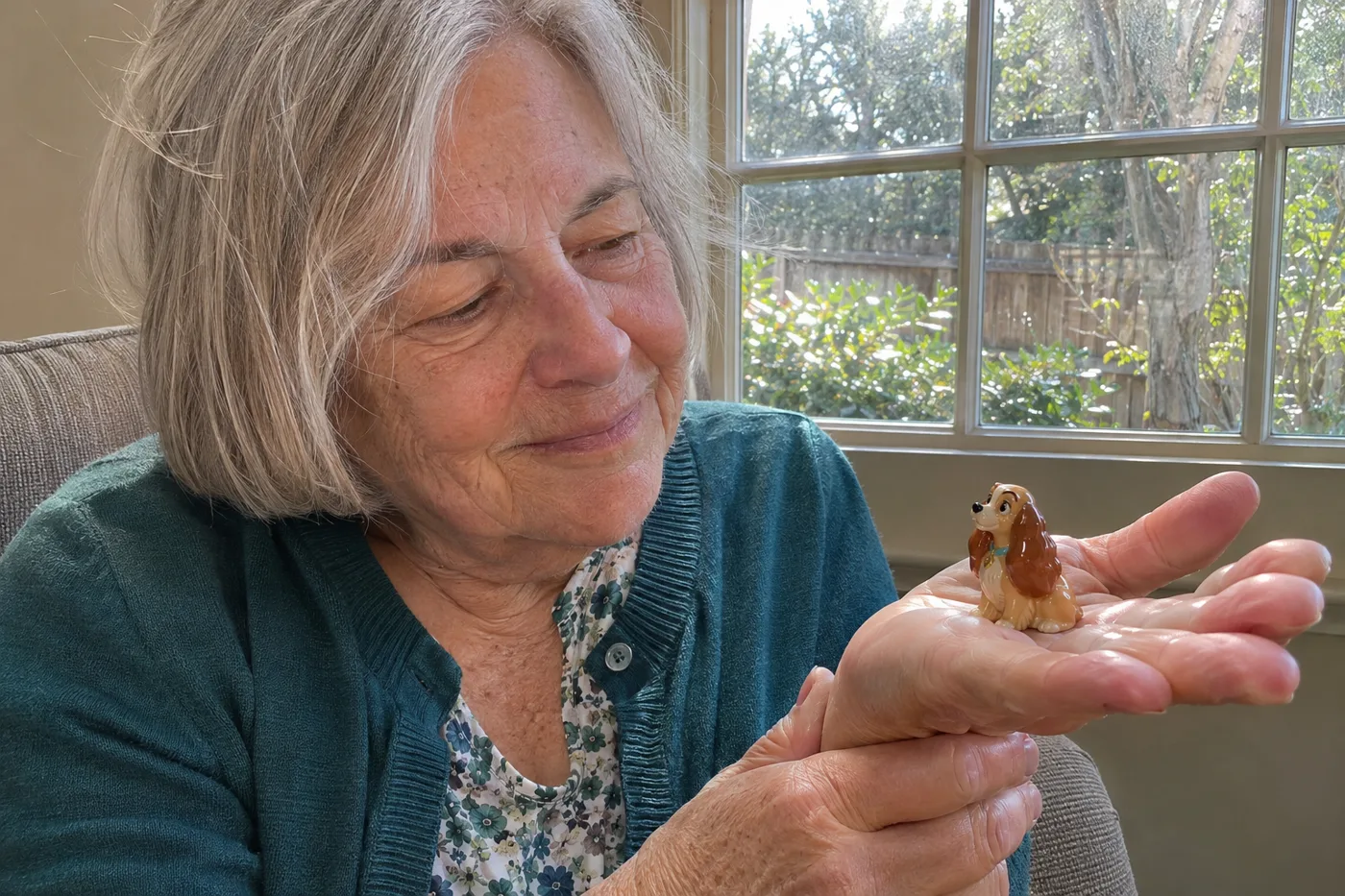
Of all the vintage dog figurines in an attic box, she’s the easiest to mistake for a dime-store knickknack.
The California firm Hagen-Renaker made the Disney dog miniatures from fall 1955 to fall 1959, for the opening of Disneyland, and artist Don Winton designed every one. Walt Disney called the firm’s work “the finest three-dimensional reproductions of (the animated) drawings that he ever saw,” according to Van Eaton Galleries. The gallery sold a 1950s Lady about an inch and a half tall for $75.
Collectors know these pieces by item number and size, so get out a ruler. Lady #5001 is listed at 1 inch and Trusty #5013 at 2 inches.
No source we found shows how to tell an original from a reissue, so show yours to someone who knows Hagen-Renaker before you put a price on it.
Pluto was in the line for only six months, in fall 1956. If a tiny Pluto is wrapped in the same tissue, unwrap him first.
#11 Rin Tin Tin cereal-box prizes
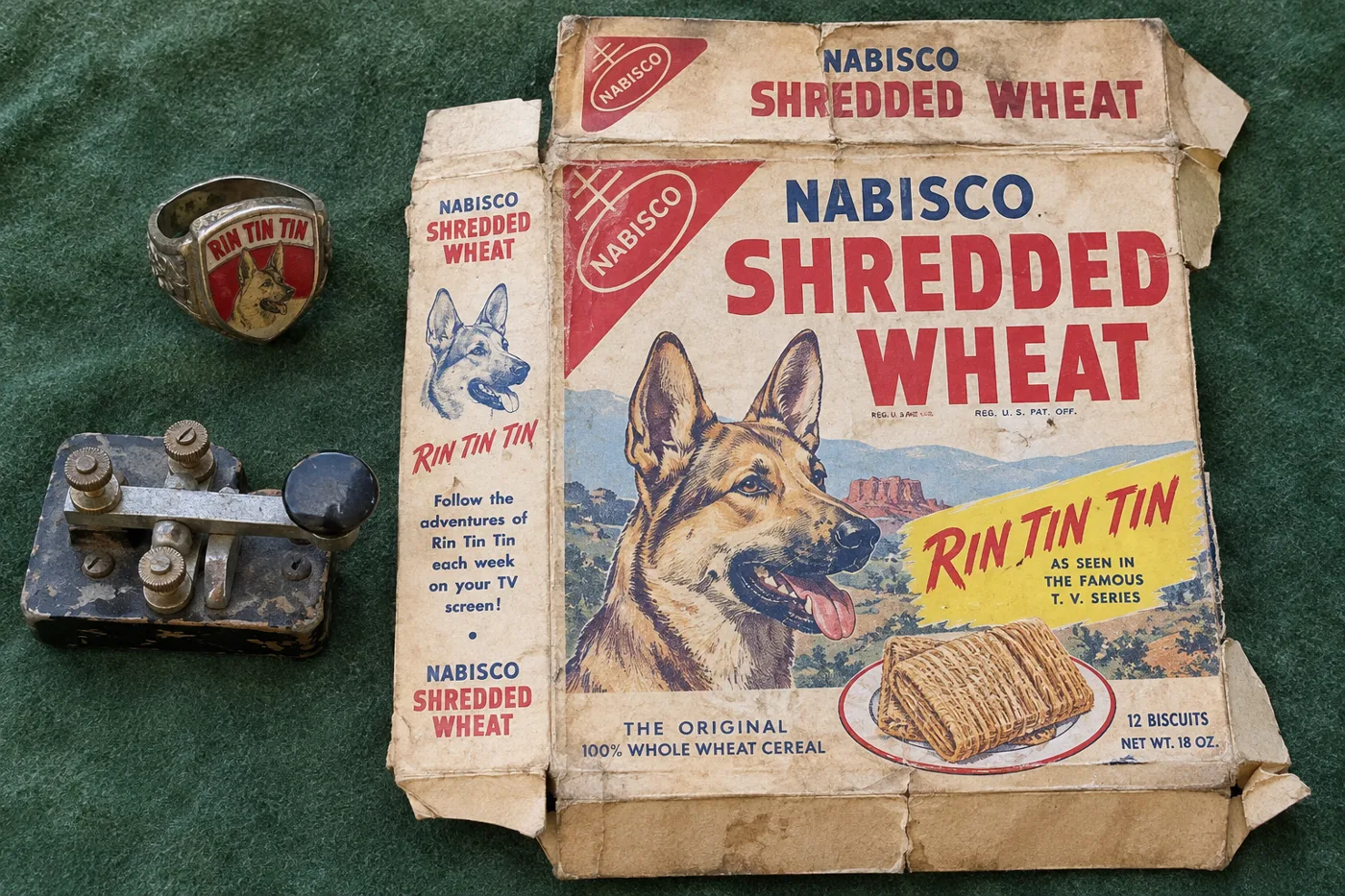
Somebody in the house had to eat all that Shredded Wheat. In the 1950s, Nabisco offered Rin Tin Tin rings, puzzles and mail-in items. Today Gasoline Alley Antiques lists Rin Tin Tin items at these asking prices:
- A complete c.1956 Shredded Wheat box, flattened: $169.50
- The 1954 mail-in stereo card set with viewer: $150
- The 1955 Transogram “Adventures of Rin-Tin-Tin” game: $59.95
- A Morse code clicker that still works: $42.95
- Cereal premium rings: $25 each
- Metal “B-B Puzzles”: $18.50 each
These are a dealer’s prices, and no auction results turned up to show what buyers actually pay. Still, look at the top line: the complete, flattened Shredded Wheat box is priced higher than any of the premiums.
If you’re sorting a pile of these, set the “Fort Apache” headquarters piece apart. The dealer lists it at $45 as a Cheerios premium, not a Nabisco one.
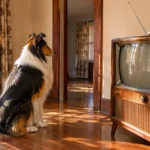 You might also like25 Classic Movie and TV Dogs, and What Really Happened to Them
#10 The Snoopy Sno-Cone Machine
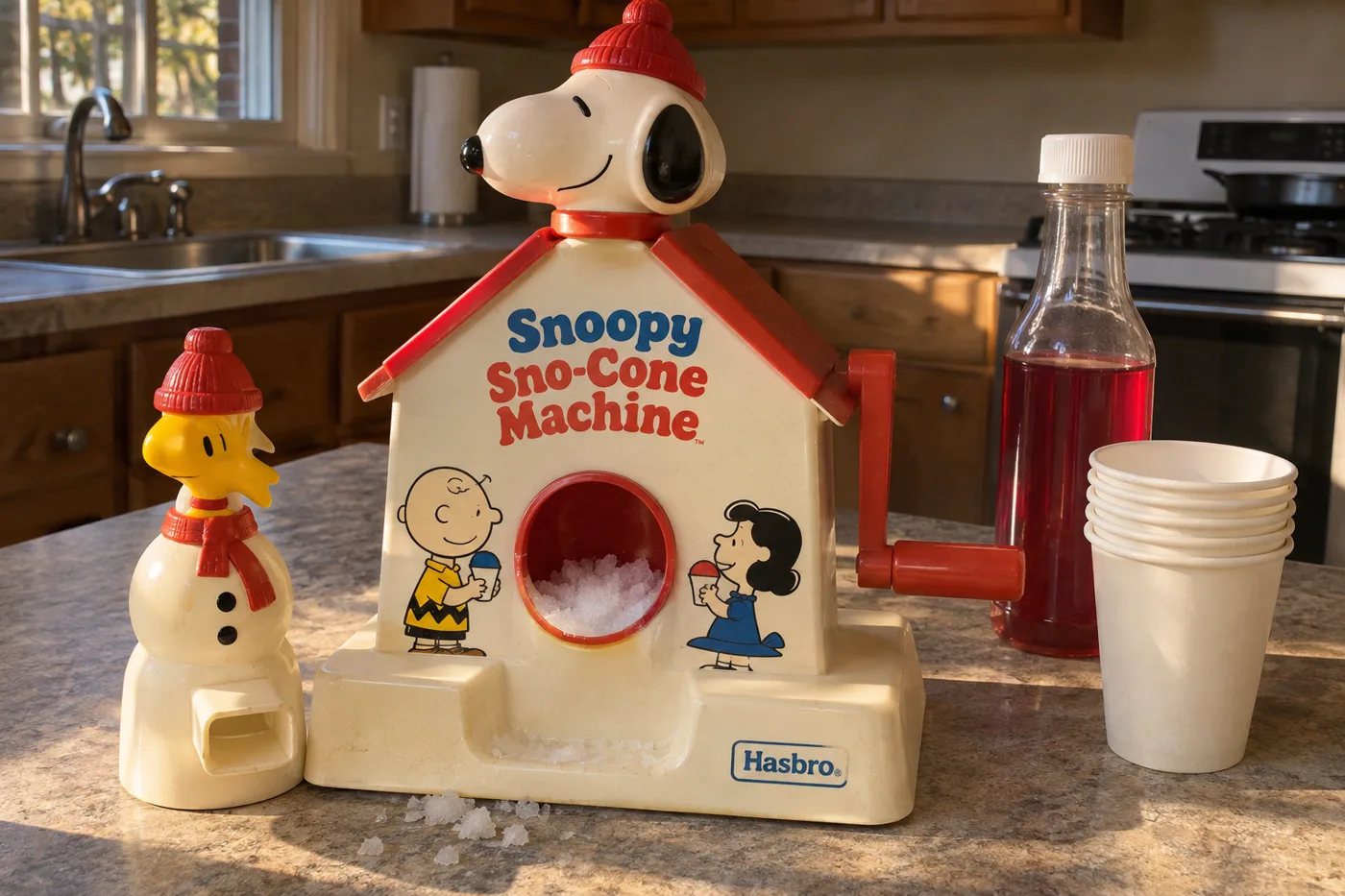
You pushed and pushed, and the ice came out of Snoopy in slow, crunchy flakes while everyone stood around holding a paper cup. Hasbro introduced the Snoopy version in 1979, after phasing out the Frosty Sno-Man machine it had made since the early 1960s.
Then it never really stopped. In 2004, Hasbro’s CEO Al Verrecchia called the machine an “annuity”: “It just keeps coming off the line, year after year.” That’s great for Hasbro and a puzzle for you, because the mid-1980s Playskool reissue is hard to tell apart from the original. CollectPeanuts.com sorts them out:
| Version | How to spot it |
|---|---|
| 1979 Hasbro | Woodstock snowman flavor dispenser, plunger, shovel, syrup bottles, cups, drink mix |
| Mid-1980s Playskool | Nearly identical to 1979 |
| 1989 | Adds sticker sheets and Fla-Vor-Aid packets |
| 1992 Kid Dimension | Redesigned Snoopy, no Woodstock snowman |
The 1992 Kid Dimension version dropped the Woodstock snowman, so a machine with one is not that version. The snowman can’t separate a 1979 set from a mid-1980s one, though. Cra-Z-Art took over the license in 2012, so anything with that name on it is newer still.
Check for cracked rubber caps, yellowed plastic and missing parts. No reliable sold price turned up for the machine.
#9 The “Made in Japan” dog on the shelf
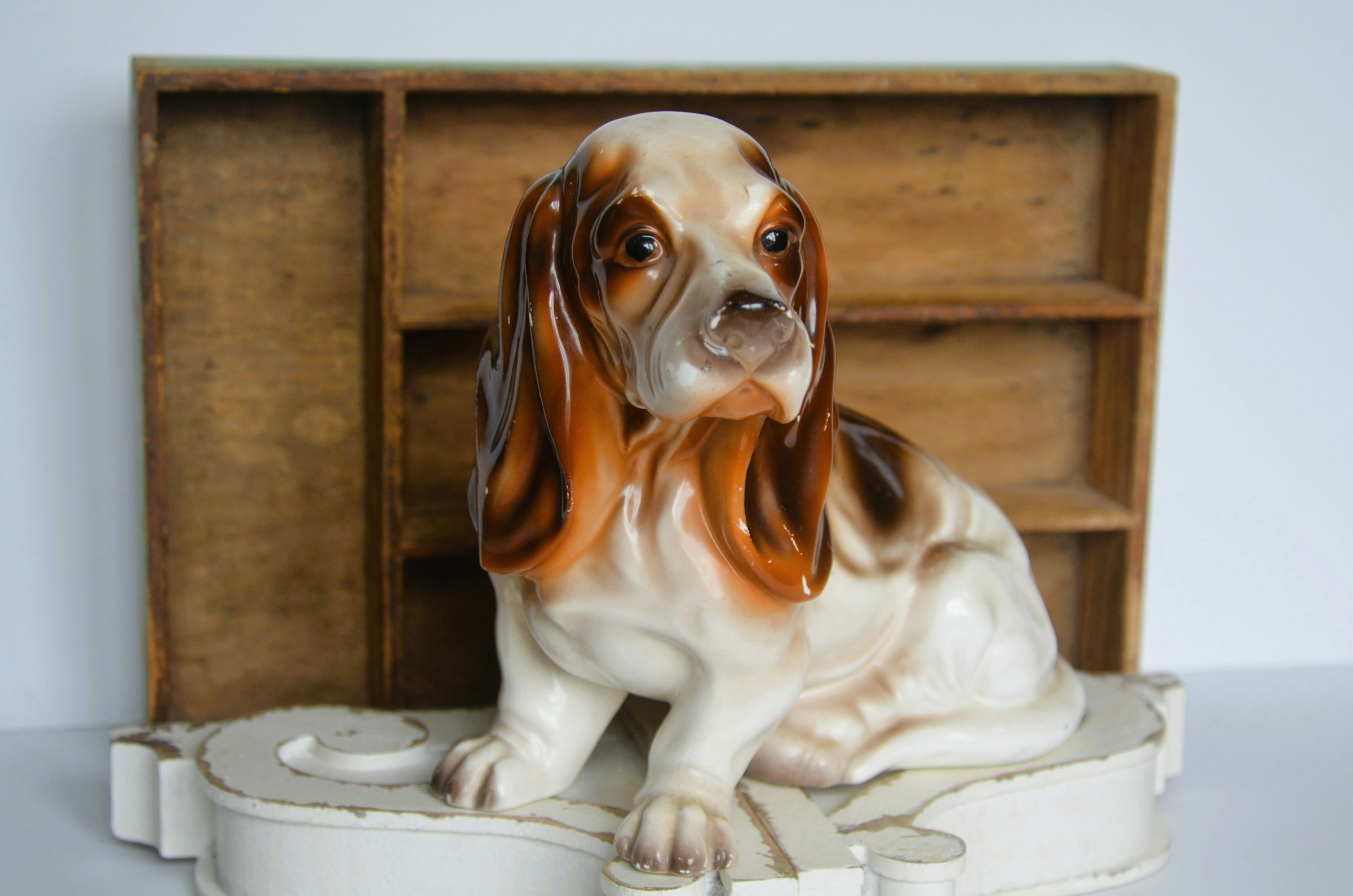
Tip it over and there it is, on a paper sticker or stamped into the base: “Made in Japan.”
That label tells you when far more than how much. Japanese exports had to read “Made in Occupied Japan” from 1947. The rule loosened at the end of 1949, and plain “Made in Japan” became standard after the occupation ended in 1952, says Camera-wiki’s history of the mark. So “Occupied Japan” points to about 1947 to 1952. No source we found says the label by itself raises the price.
A maker you can trace is what moves it. One reseller of vintage figurines on r/Antiques said they can typically sell ordinary pieces for $8 to $25 each, depending on quality and size, unless the maker can be traced, such as Lefton.
Lefton is the name to know. George Zoltan Lefton started his ceramics business in Chicago in 1941, and Japan was his main source until the mid-1970s, so most Lefton on the resale market came from there. Its maker’s mark changed over time, according to Nancy’s Antiques & Collectibles; these dates are approximate:
- 1946 to 1950: a horse and rider with “Handpainted, Exclusively Made in Occupied Japan”
- 1948 to 1953: “Lefton China, Hand Painted, Made in Japan” with a crown
- 1950 to 1955: “Geo. Z. Lefton”
- 1955 on: a crown circled by “Lefton China, Hand Painted”
Paper labels often washed off or got peeled away, though.
So if a sticker is hanging on by one corner, dust around it and keep it dry.
#8 The old dog license tag in the drawer
It’s in there with the dead batteries and the twist ties: a stamped little tag with a year on it and a hole for the ring.
Dog licenses go back further than you’d guess. The first known one dates from 1446 in Utrecht, Holland, and American towns started licensing dogs in the mid-1800s, RelicRecord reports. Because each town designed its own, tags came shaped like dog heads, bones, doghouses, stars, clovers, horseshoes, bells, hearts and even beehives. During World War II, metal ran short and some tags were made of fiber or plastic.
DogLicense.org runs a collector club that costs $30 a year, and the site’s owner buys tags from before 1900. That suggests the older tags are the ones collectors chase.
Nobody we found has published a typical sold price for tags.
The greatest tag collector of all was a dog. Owney, a terrier mix who rode the Railway Post Office trains, collected tags on his collar, and he’s preserved at the National Postal Museum with 1,017 tags.
#7 The chalkware dog won at the fair
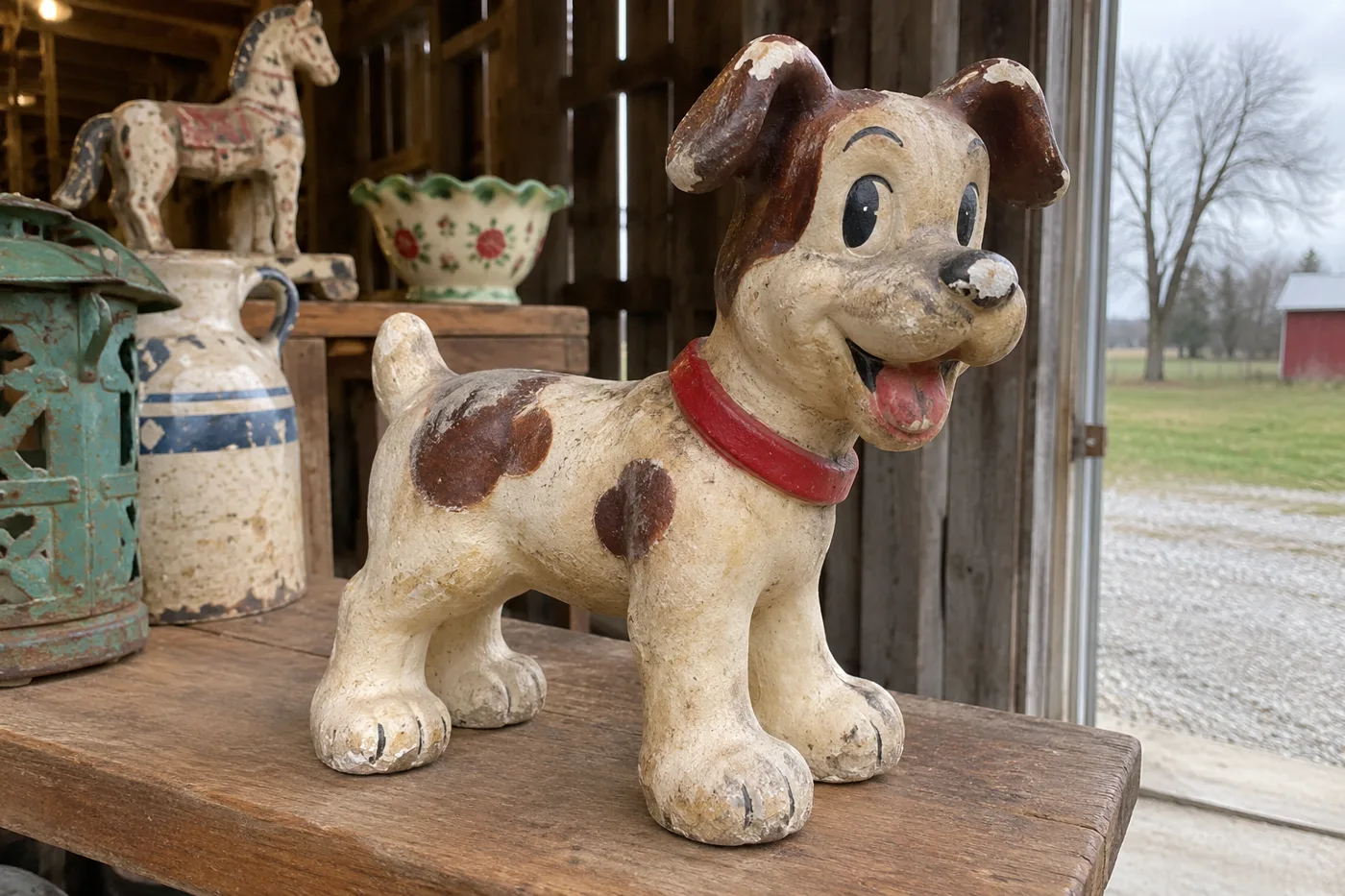
You knocked down the bottles, and the man in the booth handed over a painted dog almost too big to carry to the car.
A Dog’s Tale Collectibles, a dealer’s blog, dates carnival chalkware prizes from the 1910s or 1920s to the 1950s.
Fairs handed prizes out by the armful. A vintage toy enthusiast on r/VintageToys, looking at a stuffed fair-prize dog, said that style of toy was very common as a carnival prize in the 1950s and 1960s. Chalkware gets repainted and fake-aged, though, so test before you trust. Natural wear shows on high edges.
Chalkware or ceramic? – Weight: chalkware is lighter than ceramic but heavier than modern resin. – Feel: it’s chalky and matte under the paint. – A UV blacklight makes touch-ups glow differently from old paint. – Mold seams you can’t see at all, on a piece sold as old, suggest later work.
Sold prices for carnival chalkware didn’t turn up anywhere we trust. Before you price a big one high, get a written value from someone who handles them.
#6 The Ken-L Ration tin sign
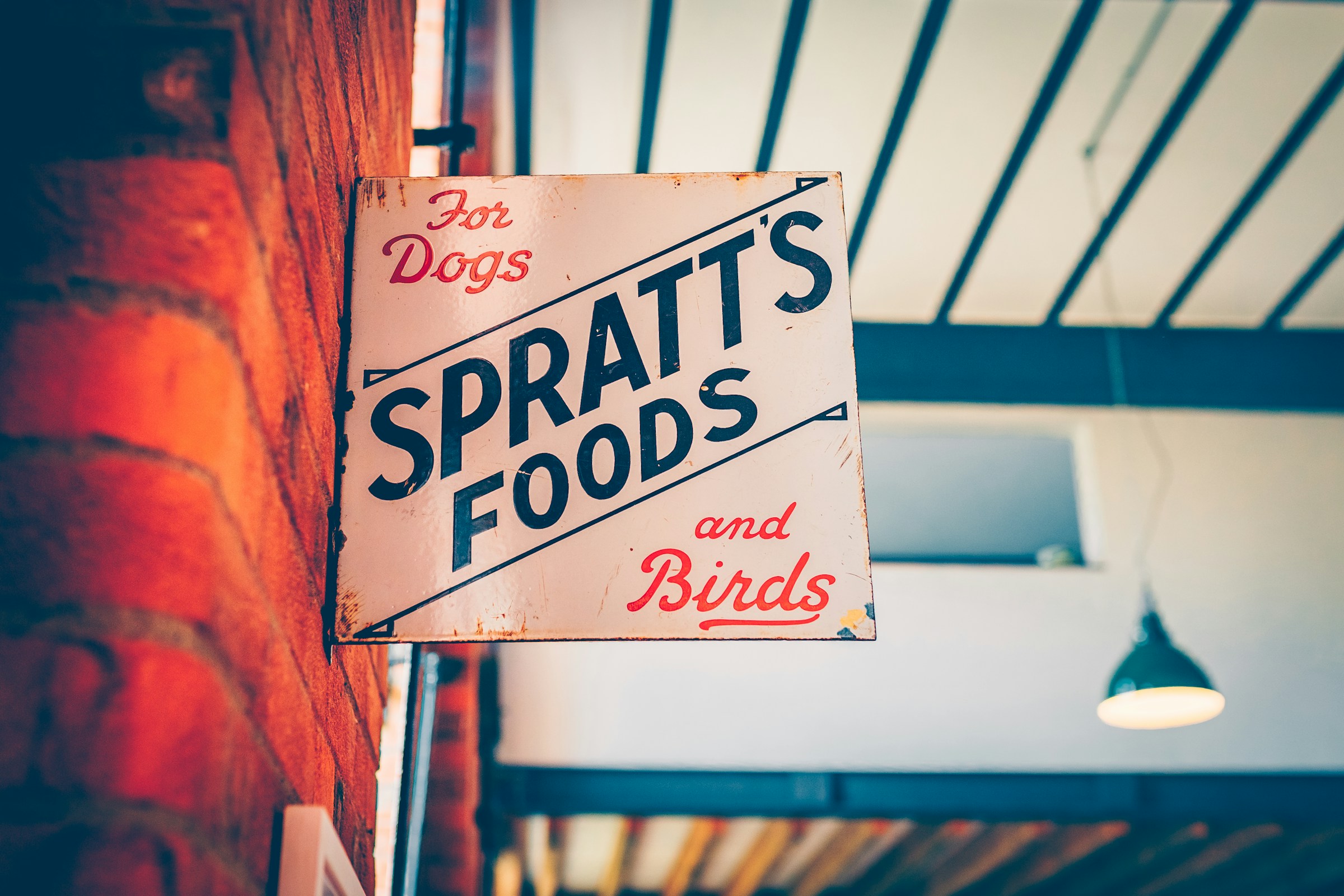
Wear didn’t scare off bidders. At Miller’s Auction Co. in December 2024, a single-sided Ken-L Ration tin sign, 14 by 21 inches and listed with “wear & patina,” drew 14 bids and a final bid of $400.
That’s the only sold price we found for dog-food advertising. Gaines and Milk-Bone tins had nothing reliable behind them, so if you have one of those, start with sold results for that exact tin.
View the Past lists the giveaways of a reproduction:
- rust that looks too even
- mounting holes that are too clean
- crisp, modern-looking printing
- distressing that looks staged
- a sign lighter than real porcelain or enamel would be
- maker’s marks in the wrong font or the wrong spot
Be wary of a seller who always seems to have the same “rare” sign in stock, and read the fine print for “vintage-style” or “replica.”
 You might also like20 Prices That Show What a Dog Cost in 1970 vs. Today
#5 Royal Doulton dogs in the china cabinet
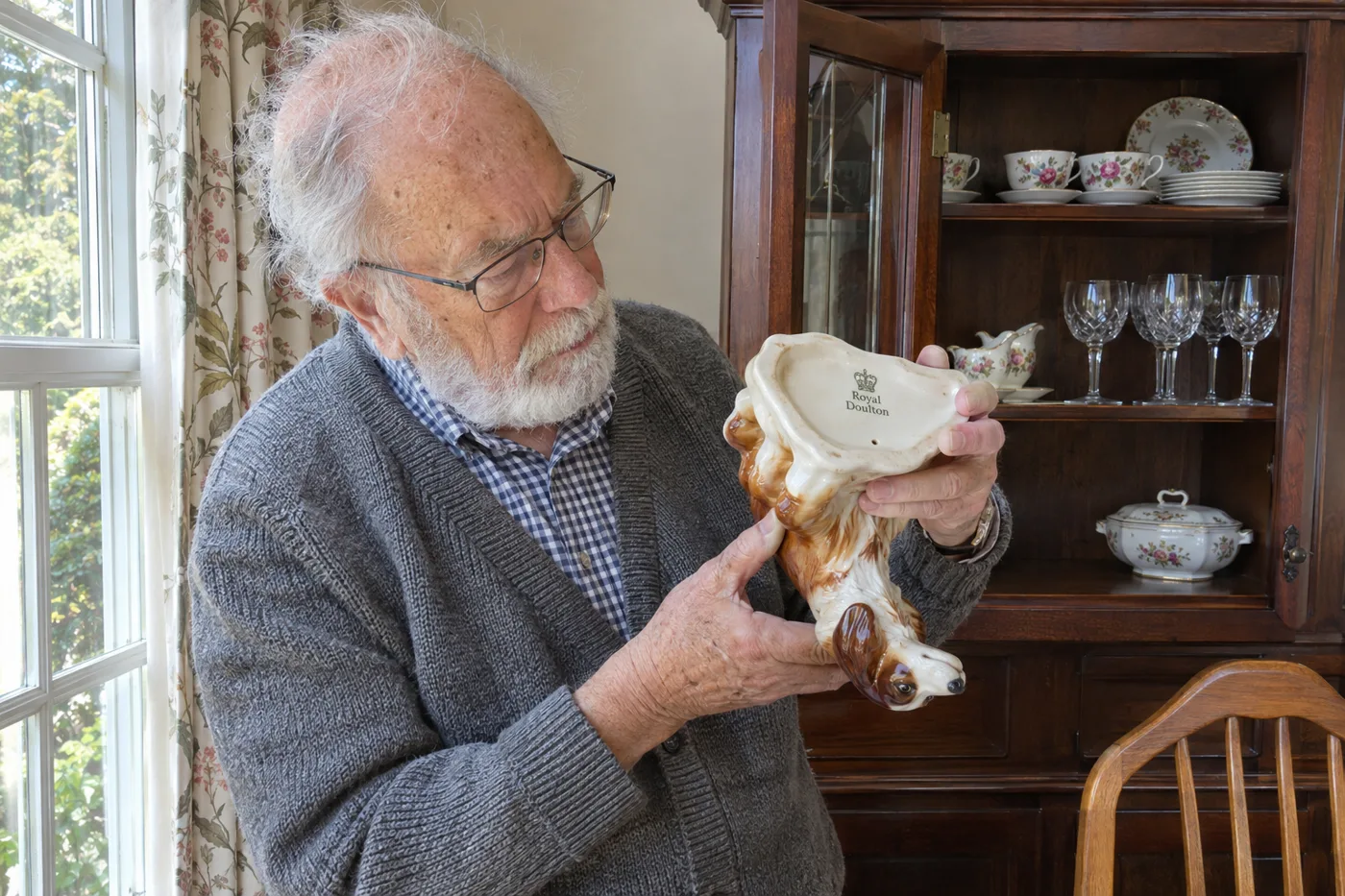
“The super-rare ones have retained their value better than the common ones,” says David Lackey, an Antiques Roadshow appraiser who runs David Lackey Antiques & Jewelry in Houston, in an appraisal of Royal Doulton figurines from about 1935.
When a commenter on r/Antiques listed better makers worth looking for, Doulton came first. And Royal Doulton’s maker’s mark can date a figure, following William Cross Antiques’ guide:
- 1927 to about 1958: some crown-and-lion stamps carry a small date number. Add it to 1927.
- 1932 to the late 1950s: registered numbers appear.
- The 1960s: registered marks disappear.
- The 1970s to 1982: a copyright date sits under the name, and the piece usually came out the following year.
Dating gets you halfway. No sold prices turned up comparing common Doulton breeds with rare ones, so the other half is an appraiser who knows which dogs were made in small numbers.
Write the stamp down exactly, number and all, before you ask anyone.
#4 Nipper, the RCA Victor dog
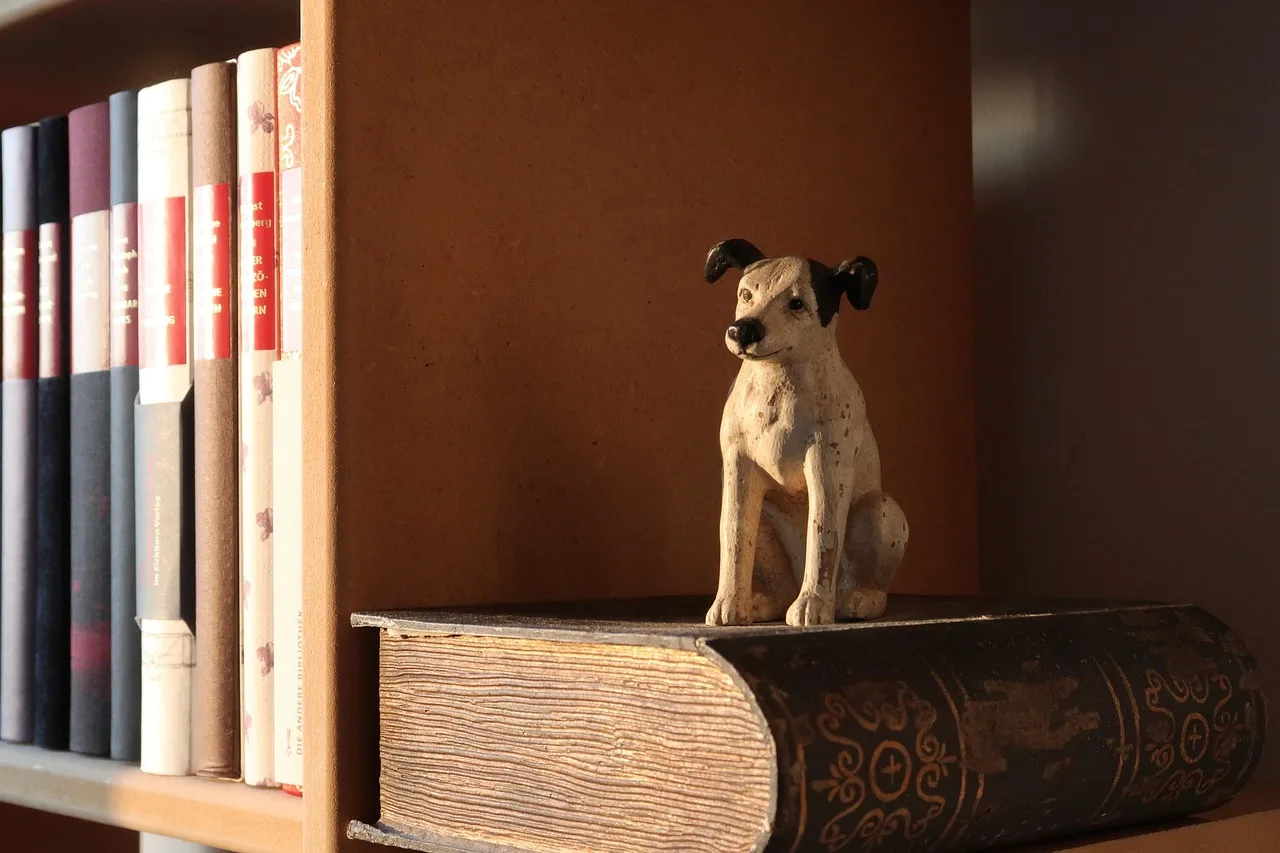
He was a real dog. Nipper was a mixed breed, probably part terrier, from Bristol, England, and he died in 1895. Francis Barraud painted him listening to a phonograph three years later, and that painting became the trademark of Victor, later RCA Victor, according to Wikipedia.
Store owners were given big chalkware Nippers as displays. A 19.5-inch one with a repaired left ear and a chipped foot sold at One Source Auctions in 2018 for $450, above its $200 to $400 estimate. Bad ear and all, people wanted him.
RCA added a puppy, Chipper, in 1991.
How to tell an old display from a reproduction is something no source we trust explains. Have yours looked at in person before you hope for a $450 result.
#3 The pair of Staffordshire spaniels on the mantel
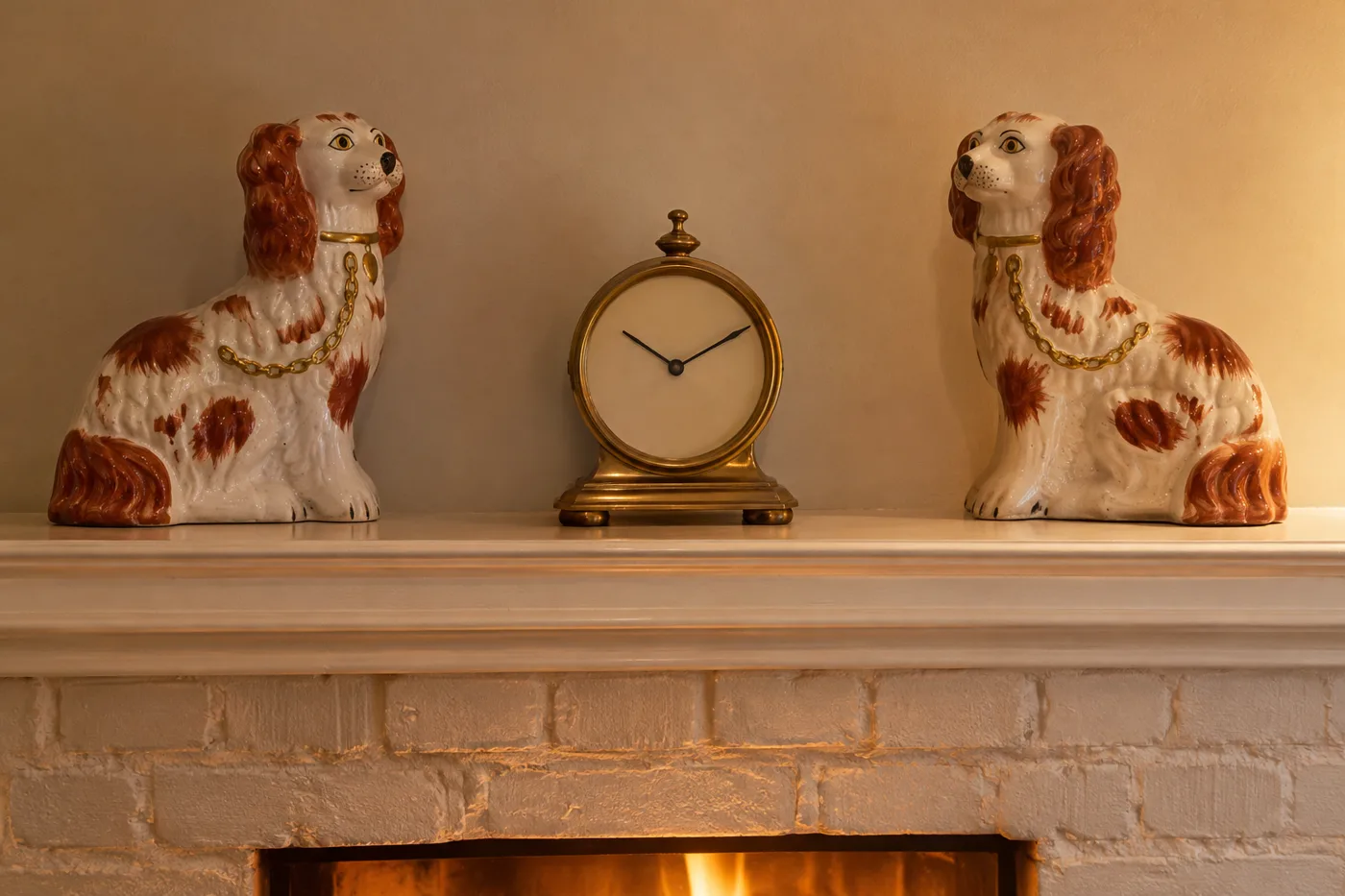
They kept watch from either end of the mantel for decades, and somebody always said they were very old.
Plenty of them are. Southern Home says Staffordshire spaniel production peaked around 1840 to 1890, and some potteries kept making them into the early 1900s. A real pair is much older than the lunch boxes and Pound Puppies. Whether yours is one of those or a later copy, the base tells you most of it.
Staffordshire spaniel checks – Turn it over. Antiques were press-molded; slip-cast copies often have a hole the size of a dime or quarter. – On real ones the base glaze is usually thick and tinged blue, and often runs onto the foot-rim. Thin, clear glaze or none is a warning. – Brassy gilt, dark-stained crazing, or crazing running through the gilt are warning signs. – A pair that matches exactly suggests a reproduction. Most real Victorian ones are unmarked.
Use at least three of those signs together, the dealer Madelena advises. One clue alone won’t settle it.
Bonhams sold three pairs of Victorian spaniels in 2024 for $384 including premium, under $130 a pair. Pook & Pook sold three pairs in August 2025 for $280 before its premium.
Lackey puts it simply: “Most Staffordshire figurines are worth somewhere between $200, $500.” One he valued at $1,000 retail in 1996 was updated to $250 to $500 in 2026.
Southern Home puts antique pairs at about $500 to a few thousand dollars, with early 20th-century pairs at the low end. For an ordinary Staffordshire dog pair, though, the auction results are the better guide. The bigger numbers belong to larger, earlier pieces, and for those a qualified appraiser’s written value is worth paying for.
#2 The heavy cast iron dog doorstop
It held the door open all summer and ambushed bare toes all year.
Like the spaniels, it’s probably older than your childhood. Antiques columnist Harry Rinker dates a Hubley-attributed dog doorstop “between 1920 and 1940” and puts its value “around $150.00,” with sales he cites running from $50 in good condition to $175 to $190 in very fine.
Two checks do most of the work on a cast iron dog doorstop:
Look at the screws. Originals used flat-head screws. “Post-World War II reproductions and copycats often were held together with a Phillips screw,” Rinker writes.
Look at the surface. “Grinding marks are a sign of a modern reproduction or copycat,” he adds. Doorstops.com lists more: a grainy surface from sand fused into the iron, crusty or blurry openings, gaps where the two halves meet, and thin or gappy bottoms where the maker skimped on iron.
Set the doorstop on its side on a folded towel and look at the bottom first.
#1 The Astronaut Snoopy doll
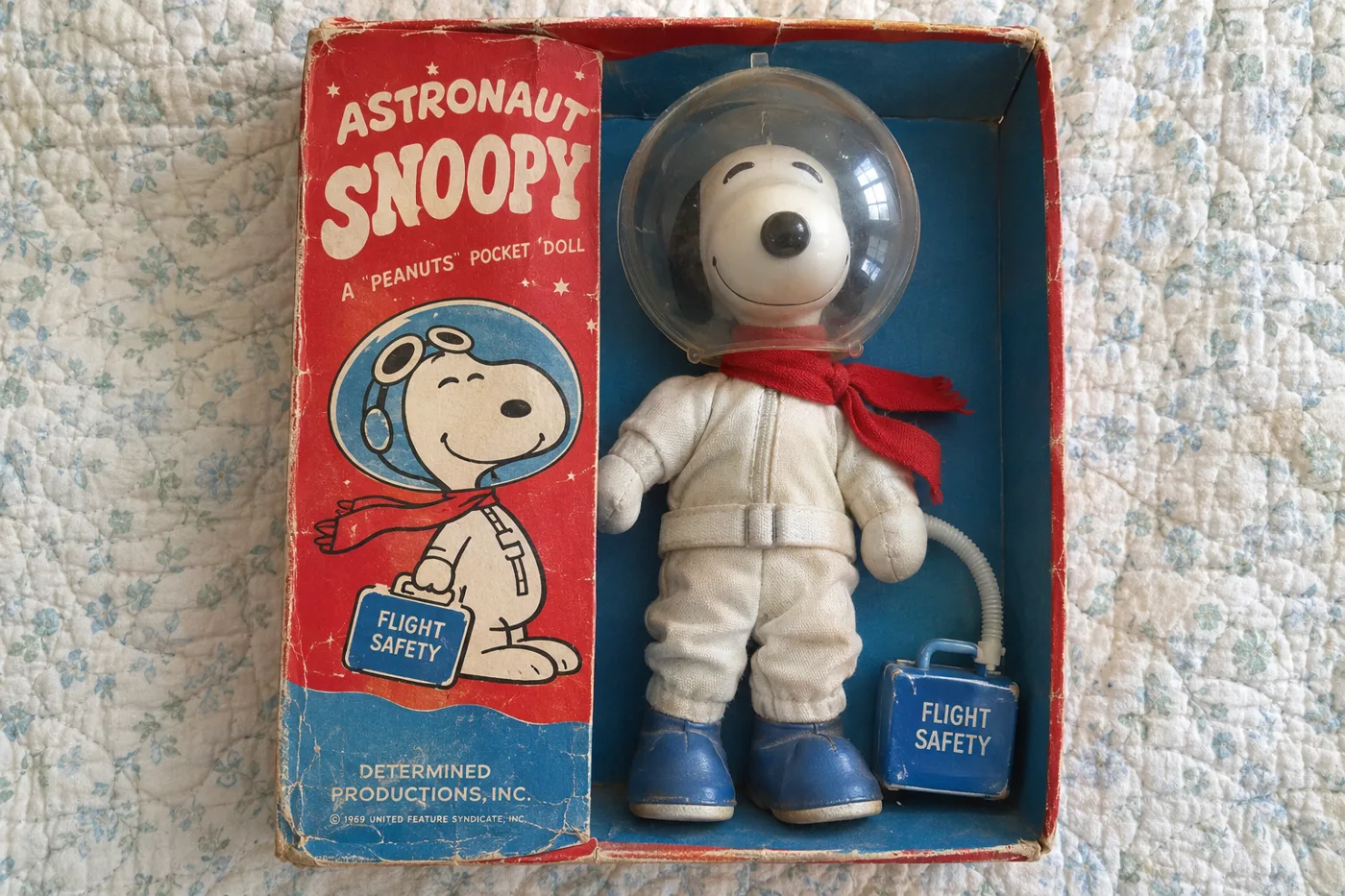
Picture the lot at Bonhams: a 10-inch Snoopy in his spacesuit, still in the red-and-blue box from 1969, made by Determined for United Feature Syndicate. Across his helmet is a signature, “Snoopy LM-4, GENE CERNAN, Apollo X LMP,” from the Apollo 10 astronaut himself.
It sold for $1,300 at the hammer, $1,625 with the buyer’s premium, The Toy Book reported in 2014.
That sale is the exception. It is not a typical value: it was driven by the signature of Apollo 10 astronaut Gene Cernan on the helmet.
If one is in the toy box, count the pieces: helmet, scarf, flight bag. Look for the box. Then ask the question nobody in the house thought to ask in 1969: did anyone ever get him signed?
Keep reading
 30 Things Your Dog Is Trying to Tell YouSee all 30 →
More you’ll enjoy
 25 Subtle Signs of Dog Stress Most Owners Walk Right Past
 17 Dog Breeds That Bite the Most, Including a Lap Dog That Out-Bites German Shepherds
 28 Things Dog Owners Did in the ’60s and ’70s That Would Raise Eyebrows Today
The bottom line
Before you look up a single price, sort the box into two piles. One pile is things you’d sell tomorrow. The other is things you wouldn’t sell for any amount. Only the first pile needs research.
For that first pile, take a phone photo of every underside, sticker and stamp before anything gets dusted or wrapped again.
For the second pile, write down where each piece came from and who it belonged to, on a card that stays with it. Tape the card to the bottom, where the next person will look first.
Bonus: Quick checks for the other dog things in the box
- A Fisher-Price Snoopy Sniffer pull toy can be dated by its ears: black oilcloth on versions made from 1938 to 1957, brown plastic on the 1958 to 1961 basset hound, and brown felt on the #181 made from 1961 to 1980.
- A bee in the mark points to Goebel, which used bee marks on all its products, and the bee dates it: a Full Bee from 1950, a Stylized Bee 1958 to 1972, the Last Bee 1972 to 1979, and the Missing Bee 1979 to 1991, per Antique Trader.
- A Steiff dog with a yellow tag and red lettering may be from today’s children’s line, Steiff says, so that tag alone doesn’t make it vintage.
- On a Homco puppy, a crossed-arrows mark with four feathers means an early piece, while crossed swords with a house roofline came later, Fab Collectibles notes.
- An old photo postcard of a family dog is a real photo if a magnifier shows solid tone with no dots, and on an AZO back, four triangles pointing up in the stamp box mean 1904 to 1918, Playle’s explains.
Questions people also ask
Are there any vintage figurines worth money?
Some are, mostly rare ones, while many common figurines sell for modest sums. On one page of completed sales, about two dozen Hutschenreuther and similar German porcelain dogs sold for $67 to $71 each (AntiquesNavigator), and three pairs of 19th-century Staffordshire spaniels sold together for $384 at Bonhams in 2024. Antiques Roadshow appraiser David Lackey says “the super-rare ones have retained their value better than the common ones” (PBS).
How to tell a vintage Staffordshire dog?
Turn it over and check the base, then look for at least three signs together. Antique spaniels were press-molded, while slip-cast copies often have dime- or quarter-sized holes (Southern Home). A thick, bluish glaze running onto the foot-rim is a good sign, and clear glaze, brassy gilt or dark-stained crazing are warnings (Madelena). For a firm answer, ask a qualified appraiser for a written value.
How much does a Staffordshire dog figurine typically cost?
Ordinary pairs have recently sold at auction for well under $200 a pair. Three pairs brought $384 with premium at Bonhams in 2024, and three pairs brought $280 before premium at Pook & Pook in August 2025. Appraiser David Lackey puts most Staffordshire figurines at $200 to $500, and larger, earlier antique pairs can bring more.
How do I find out what my vintage dog figurine is worth?
Start with the maker’s mark and the maker, then compare your piece with sold results, never asking prices. Antiques Roadshow says value depends on the object’s condition, market trends and where it’s sold, and that auction prices are often lower than retail (PBS). For a value you can rely on, pay a qualified appraiser for a formal written appraisal, which is a legal document. Ask how they charge: the International Society of Appraisers says fees can be hourly, flat or per item, and warns against anyone who charges a percentage of the appraised value.
Is my dog figurine glass, ceramic or porcelain?
Touch a bare, unglazed spot on the base with a wet finger: on earthenware the mark vanishes almost instantly as the water soaks in, while on porcelain it stays (HASENSE). Dog figurines that families think are glass are usually ceramic or porcelain, people on r/Antiques point out.
Is a “Made in Japan” figurine valuable?
The label mainly tells you when it was made, not what it’s worth. “Made in Occupied Japan” points to about 1947 to 1952 (Camera-wiki), and Lefton used an Occupied Japan mark from about 1946 to 1950 (Nancy’s Antiques & Collectibles). No source we found says the label alone raises the price. A maker you can trace matters more.


