From a yawn in your face to a tail held lower than usual, here are the subtle signs of stress in dogs, and how to tell nerves from heat, an itch, the breed or old age.
The habit at #1 may be one you’ve been blaming on the wrong thing.
He’s at your feet while you tie your shoes. You reach down to rub his ears, and he opens a yawn so wide you can count every tooth he owns. He slept nine hours. He’s had breakfast. So what was that?
Sometimes it’s nothing. Sometimes it’s one of the quiet signs your dog is anxious, the kind that slip past because nobody barked or chewed anything.
Table of Contents
#25 Yawning when he isn’t tired
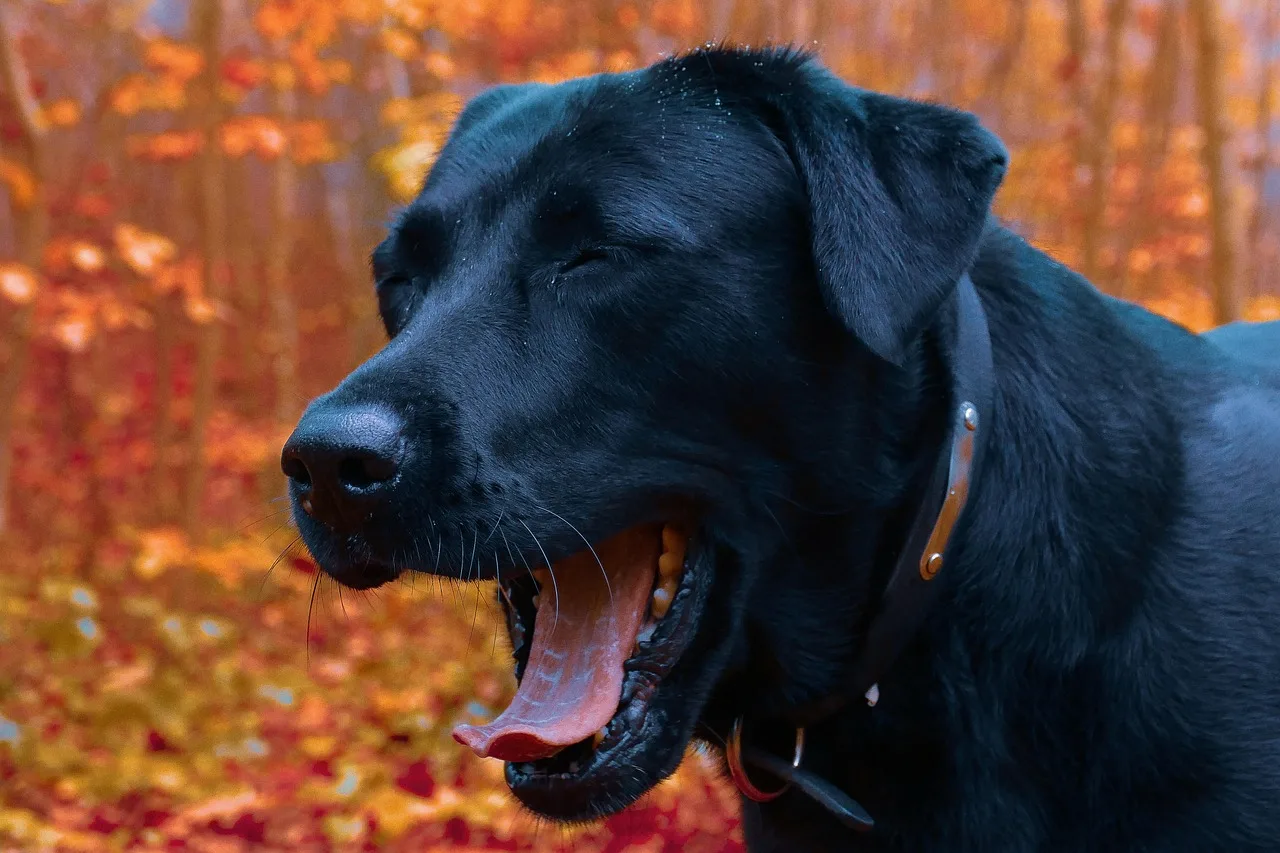
A yawn can mean three different things, and the moment it happens usually tells you which. Trainer and behaviorist Oli Juste sorts them this way in his video on small stress signs:
| The yawn | What it likely means |
|---|---|
| Slow and lazy, around naps and waking up | Tired |
| Ends in a little squeak | Excited |
| Out of nowhere | Stressed |
The third kind is the one to notice. Tufts University’s shelter dog team lists a dog yawning “though he is not tired” among the signals of a fearful dog. A Colorado State researcher who watched dogs at a daycare and in obedience classes found that most yawns happened during social moments, not around sleep.
Now the part that might make you laugh. If you yawned first, he may simply be catching yours. In a University of Tokyo study, about half the dogs yawned after watching their owner or a stranger yawn, and their heart rates didn’t change. The researchers took that to mean the catching kind has nothing to do with stress.
So back to your shoelaces. If he yawned and turned his head away as your hand came down over him, that pair is worth a second look.
#24 Lip licking with no food around
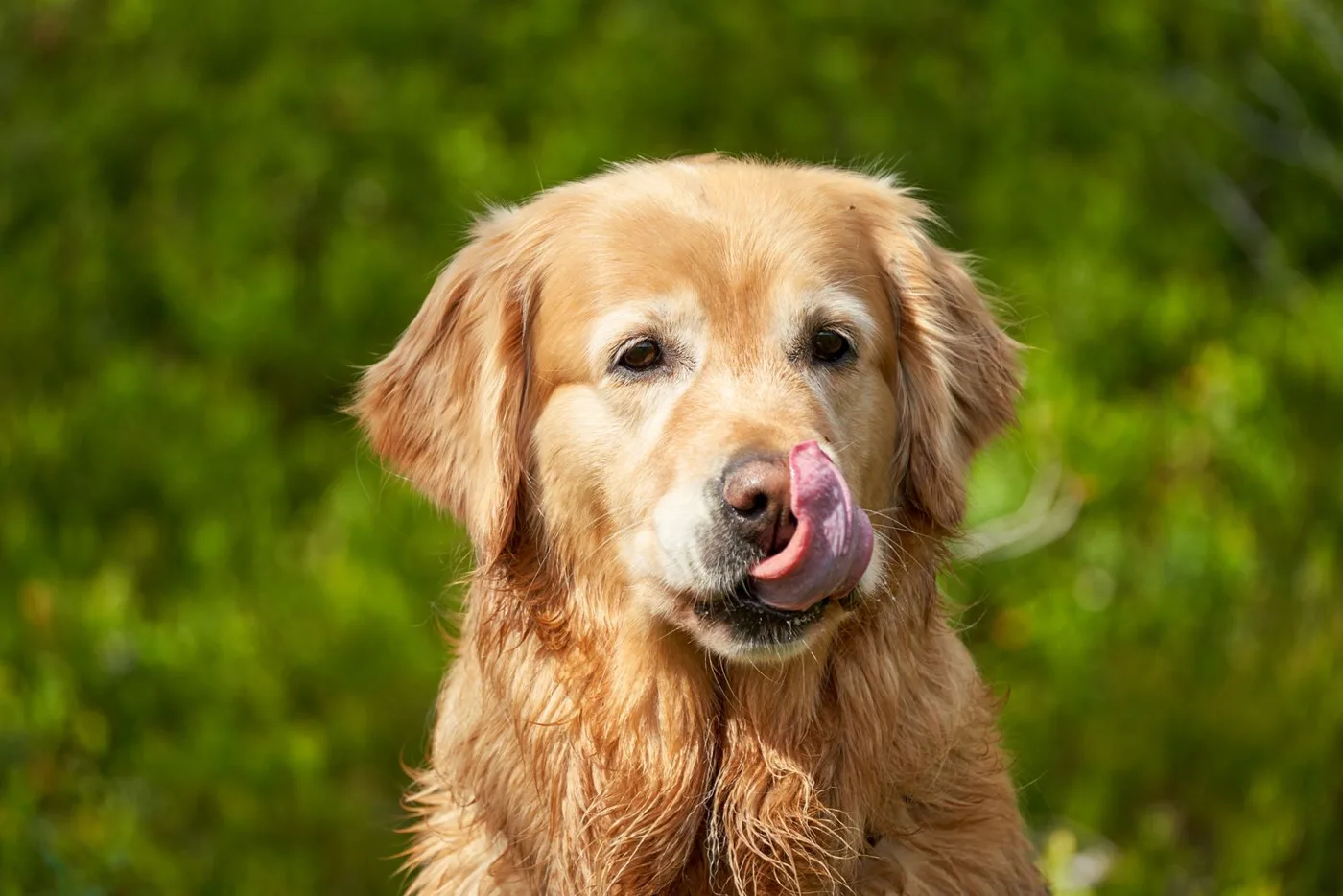
That quick flick of the tongue, gone in half a second, is mostly aimed at you.
In a University of Lincoln study, dogs licked their lips more at angry human faces than at happy ones, and more at human faces than at dog faces. Professor Daniel Mills, who studies dog behavior there, said dogs “may be using the visual display of mouth-licking to facilitate dog-human communication in particular.”
Trainers call this a calming signal. Pat Koven, a veterinary technician writing for the Veterinary Information Network, puts lip and nose licking among the ways a dog tells you he means no threat.
What it isn’t is a reliable fear meter. Licking didn’t go up in dogs filmed during New Year’s fireworks. A 2026 study that filmed 64 dogs through a test with separations and a stranger found lip licking peaked during the social parts, and concluded these behaviors “do not function as simple stress indicators.”
Next time you frown at the muddy prints on the floor and he flicks his tongue, he read your face before you said a word.
#23 Panting in a cool, quiet room
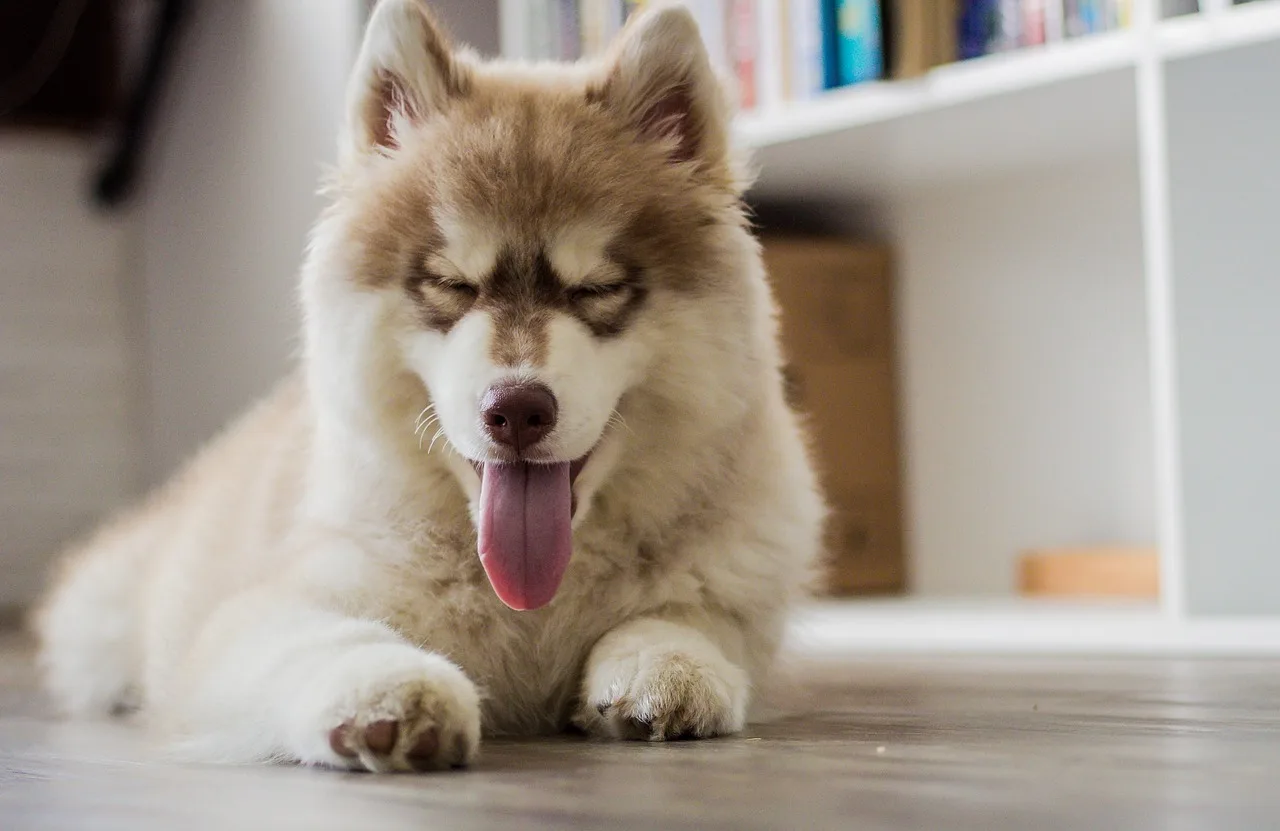
The first question is whether he earned it. Stress panting is panting “without exercise or exertion,” as Virginia Edwards of the Virginia-Maryland College of Veterinary Medicine puts it. The room is cool, there was no walk, no ball, and he’s still huffing.
The vet’s office is a classic. Some dogs pant because “just being in the doctor’s office causes them so much stress that they start panting,” Dr. Danasia Perry-Kaliati, a veterinarian, told the AKC.
You may have heard that a stressed dog’s tongue goes wide and curled at the tip, like a spoon. Behavior consultant Barbara Handelman notes it shows up in overheated dogs too, so the tongue can’t settle it for you.
Age changes the picture. AKC says panting at rest in an older dog can be a sign of Cushing’s disease, a hormone condition, and lists heart disease, breathing problems and arthritis pain as other causes. Dr. Wailani Sung, a veterinary behaviorist, counts panting among the quiet physical signs that matter more than chewed shoes: “Increased thirst, panting, pacing and excessive salivation, to name a few.”
Heat is the one to take seriously. A dog’s normal temperature runs 99.5 to 102.5°F, and AKC calls anything above that overheating that needs immediate care. Heavy panting after time in the heat is a phone call to your vet.
#22 Trembling or shaking when he isn’t cold
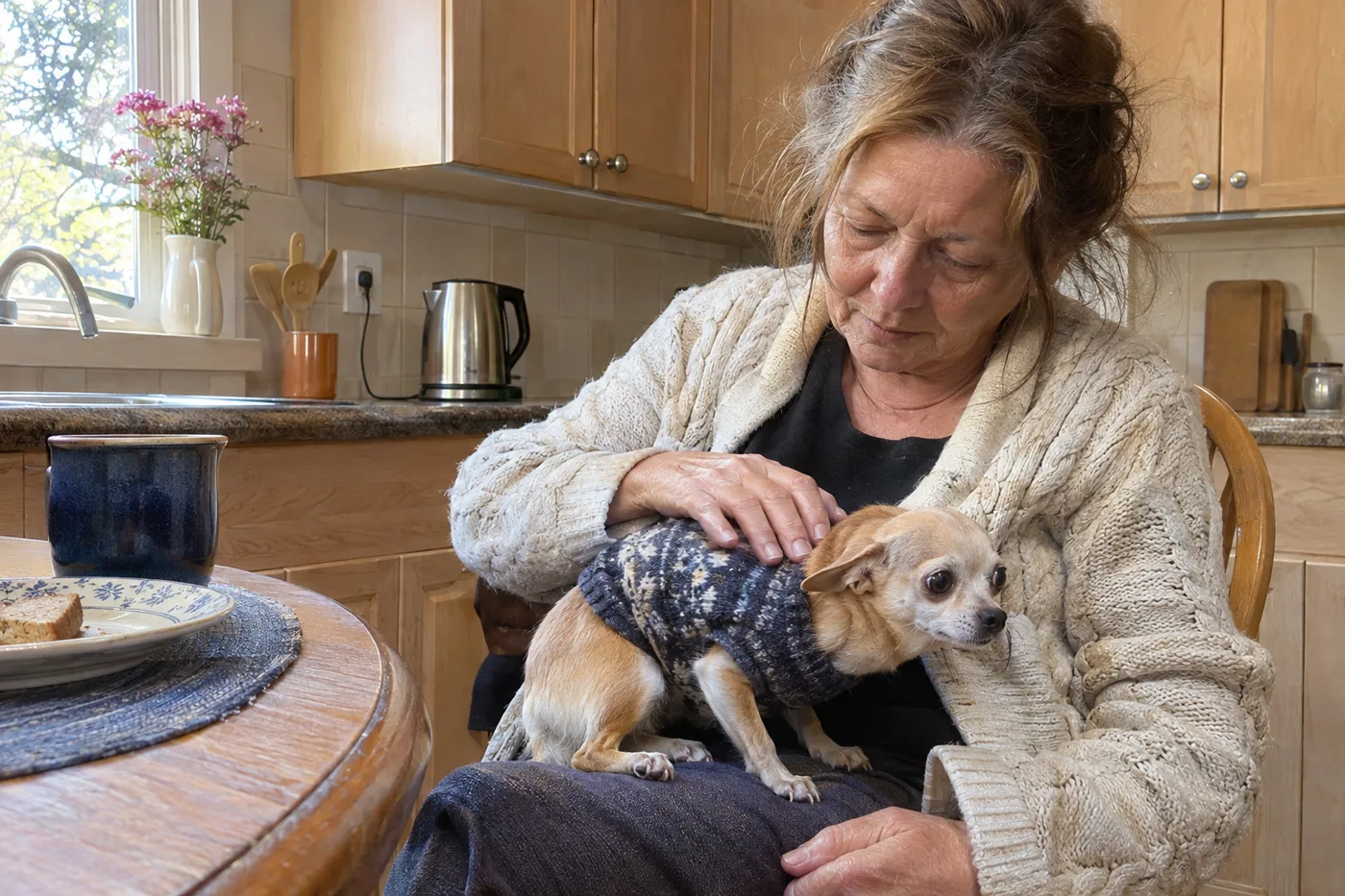
If you share your life with a tiny dog, some shivering may simply be who she is. AKC says certain toy and small terrier breeds shiver more than others.
Shaking has a long list of other causes, and only some are emotional. Tufts lists trembling among fearful signals. AKC adds low blood sugar, with toy breeds and young puppies most at risk, plus ear infections, distemper, a condition called Generalized Tremor Syndrome, and poisoning from chocolate or xylitol, a sweetener.
Trembling during a storm, with the ears flat, reads one way. Trembling on a calm afternoon for no reason you can see reads another. AKC’s advice for that second kind is short: “If your dog has started to shake, and you don’t know why, contact your veterinarian.” If there’s any chance she got into chocolate or something sweetened with xylitol, make that call now.
#21 Tail tucked lower than usual
Before you read a tail, you need to know where it sits when nothing is happening. Breeds differ a lot.
| Breed | Normal resting tail |
|---|---|
| Greyhound, Whippet | Curled under the belly |
| Siberian Husky, Norwegian Elkhound | Curled up over the back |
| Chow Chow | Carried high |
| Italian Greyhound | Carried low |
The first two rows come from VCA’s guide to tails, written with board-certified veterinary behaviorist Ellen Lindell. The last two come from the AKC. VCA also notes that “a tightly tucked, low tail can also occur when a dog is fearful.”
So the signal is the drop from his own normal. A Husky whose tail hangs straight down is telling you more than a Whippet with hers tucked. If yours is a mix, spend one quiet evening noticing where it rests.
#20 Ears pinned back flat
When researchers went through owners’ videos of 36 pet dogs on New Year’s Eve and on a quiet evening, ears going back was the strongest fireworks signal of anything they measured. It beat panting. It beat hiding.
VCA describes stressed dogs whose ears “may be pinned back against their head.” Tufts separates ears slightly back in an anxious dog from ears back in a fearful one.
Here’s where owners argue. Shepherd owners in a Reddit thread point out that their dogs drop their ears for cuddles and petting, and several replies say the same thing: read the whole dog. Ears down with a loose, wiggly body during a belly rub is one picture. Ears flat against a stiff body is another.
If you only have time to glance at one thing during fireworks, make it the ears.
#19 Pacing that never settles
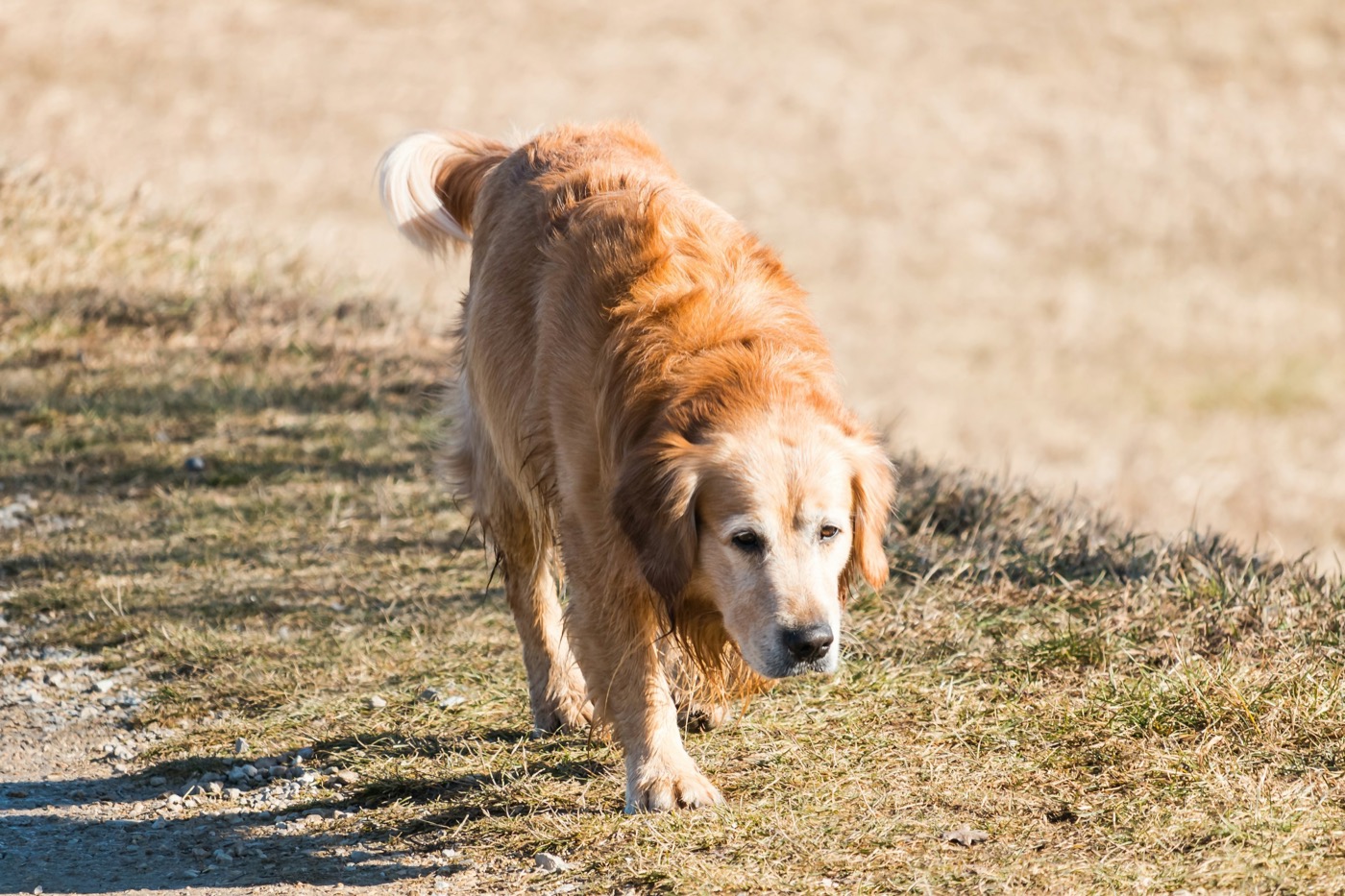
Pacing sits on Tufts’ list of anxious body language next to heavy panting and lack of focus. In a young dog, it usually means something has him on edge in the moment. In an older dog, a nightly pacing habit can mean something else.
Dr. Lynne Seibert, a board-certified veterinary behaviorist, writes about canine cognitive dysfunction syndrome, the age-related decline in a dog’s thinking and memory. Its signs include restlessness, especially at night, and in some dogs more vocalizing, along with changes in sleep and activity. The figures she cites run from about 28% of dogs aged 11 to 12 up to 68% of dogs aged 15 to 16.
Pain can wake a dog up too. When NC State researchers put activity monitors on 27 senior dogs for about two weeks, the dogs with more joint pain tended to be up and moving between 4 and 5 a.m. on weekends.
What vets look for in an aging brain – Disorientation, and changes in how he greets and interacts with you – Sleep and wake times turning upside down – House soiling in a dog who knew better – Activity changes and anxiety, often worse at night
If you’re hearing the click of nails up and down the hall at 4 a.m., write down the time and bring it to your vet.
#18 Hiding under the bed or behind furniture
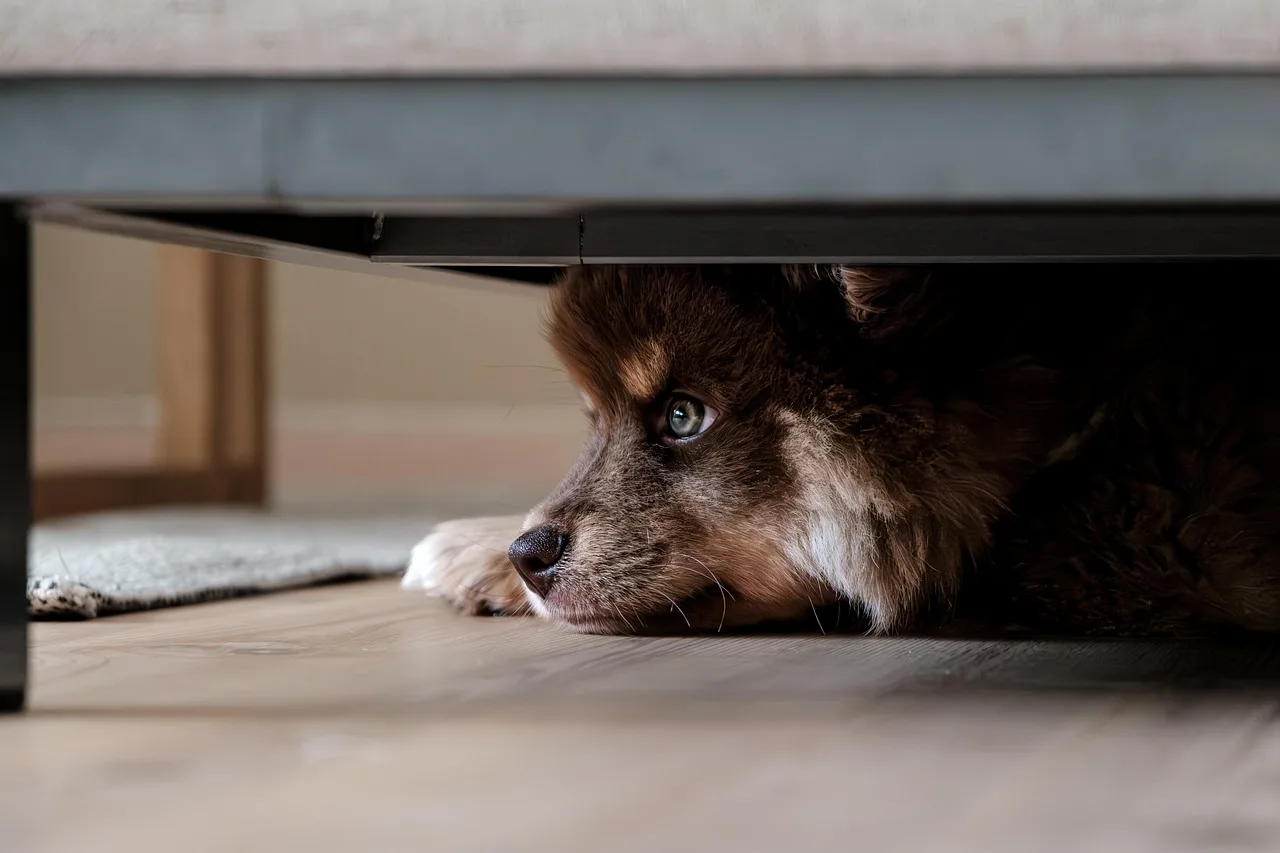
On a storm night, the move a lot of us reach for is the wrong one. Humane World for Animals is blunt: “Don’t put your dog in a crate to prevent them from being destructive during a thunderstorm. They’ll still be fearful while in the crate and likely to injure themselves.”
What works better is a safe place you set up for him. VCA’s storm guide, adapted from two board-certified behaviorists, recommends a designated spot he learns to relax in through positive training. Veterinary behaviorist Dr. Sara Bennett suggests having it ready whenever the forecast gives a 40% or higher chance of storms. An open crate with a moving blanket over it can be that spot. The shut door is what does the harm.
Hiding rose modestly in the fireworks videos from #20, though the effect didn’t hold up once the researchers corrected for testing many behaviors at once. Sometimes the hiding place is you: VCA notes that some tense dogs move behind a trusted person. If he slips behind you in the vet’s lobby, you’ve been picked.
Some dogs never bark or wreck anything. They just vanish. Owners in one r/DogAdvice thread say this quiet kind of fear gets missed because most of what’s written is about loud dogs.
“If I drop something, he will hide under the bed for an hour. It’s hard to watch.” Owner of a shy rescue dog, r/DogAdvice
 You might also like17 Everyday Things Your Dog Secretly Hates (And What To Do Instead)
#17 Drooling with no food around
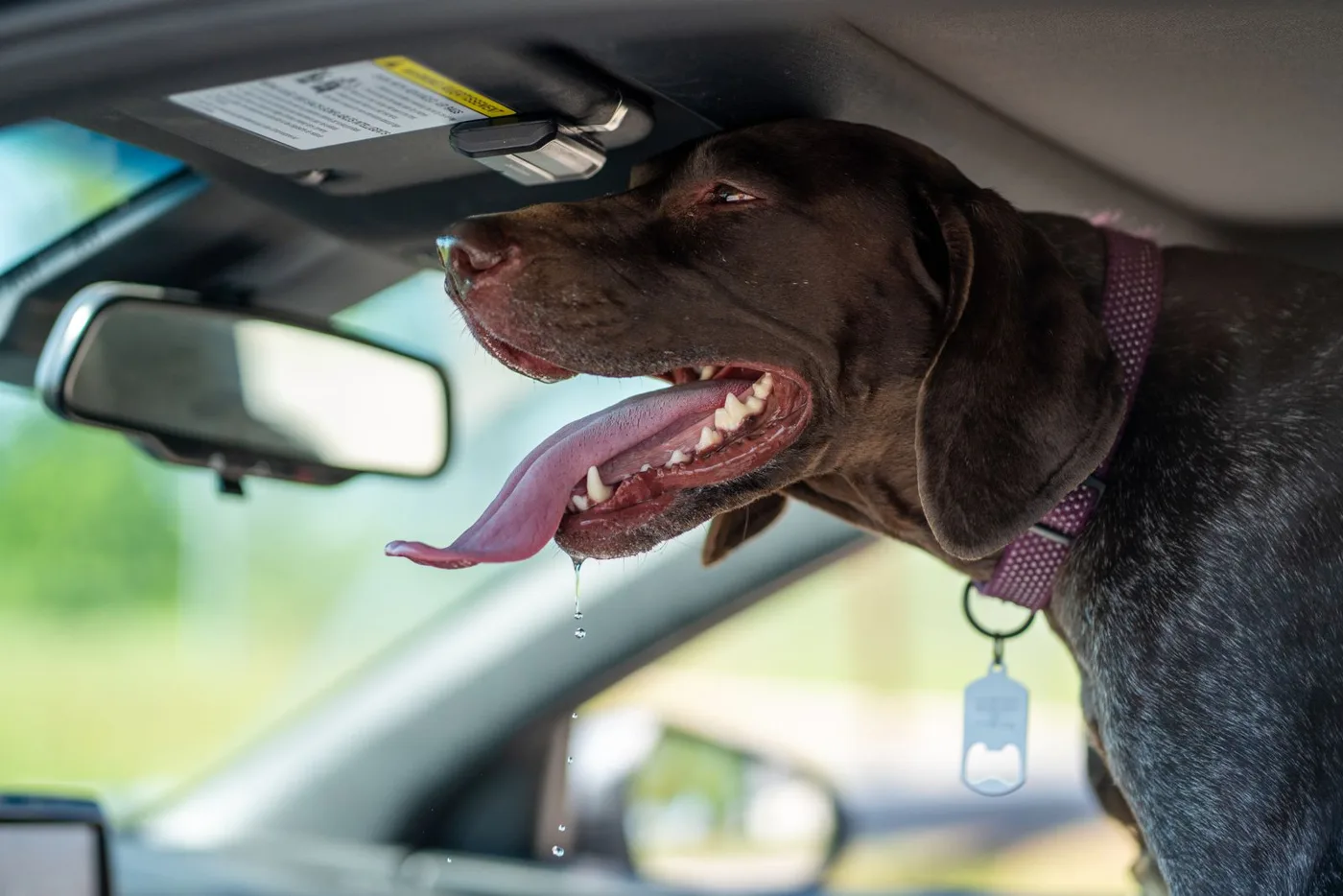
Ten minutes into the drive to the vet, there’s a shiny string hanging off his lip and a damp patch on the seat. Nerves? Maybe. VCA says dogs may drool when nervous.
His stomach is the likelier suspect. AKC says “Motion sickness is a common cause of nausea, which is why a lot of dogs drool in the car.”
And some dogs just drool. Bloodhounds, Saint Bernards and Mastiffs have lips that can’t hold what they make, so their drool tells you about the breed, not the mood.
One way to sort it: if he drools on the way to the park as well as the vet, the car is the problem. AKC also says to talk to your vet about any new or increased drooling. There’s more on the car at #3.
#16 Whale eye: white showing at the corner
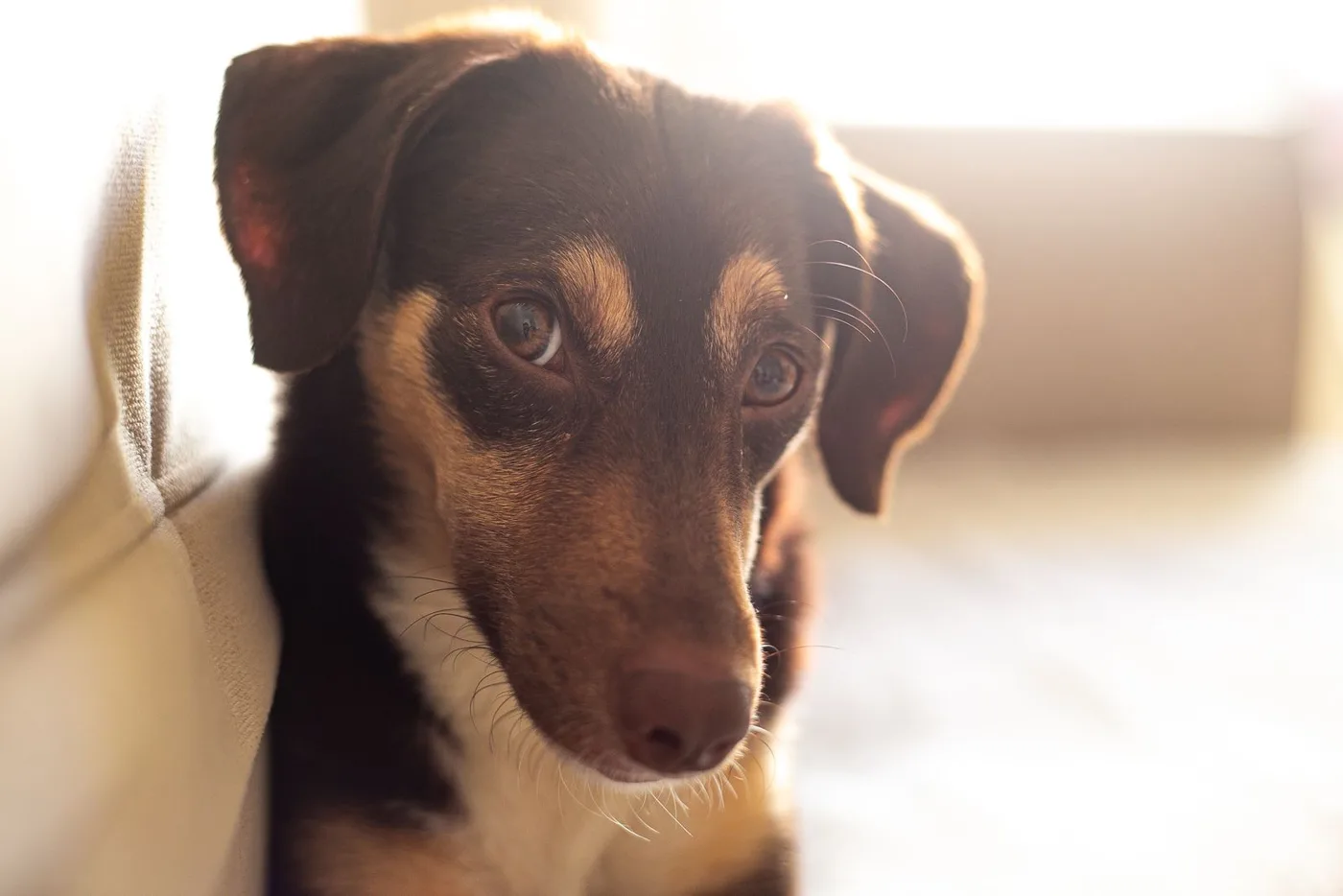
You’ve probably seen it in a photo and thought it was adorable. The dog’s head points one way, his eyes slide the other, and a crescent of white shows at the corner.
That’s whale eye. Virginia Edwards of the Virginia-Maryland vet college describes it as a dog that “turns its head but keeps its eyes fixed on something,” and AKC says dogs frequently show it when they feel anxious, worried or pressured.
When psychologist Stanley Coren went through 250 internet photos of people hugging dogs, he counted eye whites as a stress sign, and about 82% of the dogs showed at least one. It was one researcher’s look at photos rather than a formal study, but the pattern is hard to unsee.
Viewers of a veterinary team’s TikTok on stress signs admitted they’d thought whale eye was cute. Another owner put the shock in one line:
“My dog does this all the time! We’ve had him for 2 years, since he was a pup. You’re telling me he’s anxious?” Dog owner, commenting on a trainer’s TikTok about anxiety
Tufts lists whale eye alongside freezing as what a dog shows when his quieter signals get ignored. When you see that white crescent mid-hug, let go first and take the picture later.
#15 Turning the head away during a hug
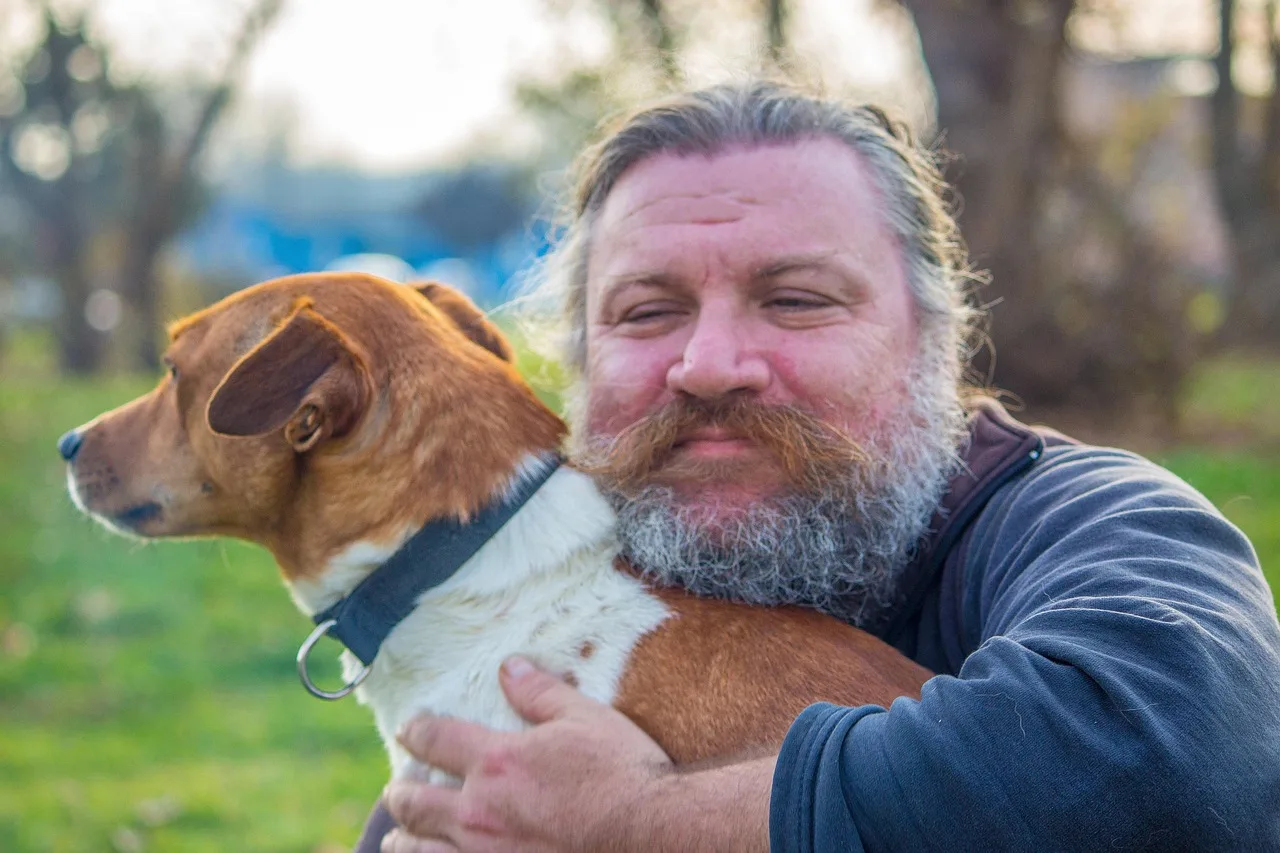
In Coren’s same set of hug photos, only about 8% of the dogs looked comfortable. Roughly 10% were hard to call. The rest were showing stress, and turning the head away was one of the signs he counted.
His reason has to do with how dogs are built. They’re “cursorial animals, which means they are designed for swift running,” and holding one still in a hug can raise his stress until, if it gets intense enough, he may bite.
The head turn is the dog being polite. Oli Juste says it plainly: “A head turn is also a sign of stress.” Pat Koven calls these small moves “attempts by your dog to prevent aggression proactively.”
If anyone in your house is a hugger, a scratch on the chest while he’s free to walk away keeps the affection and drops the trapped part.
#14 A brief freeze when touched
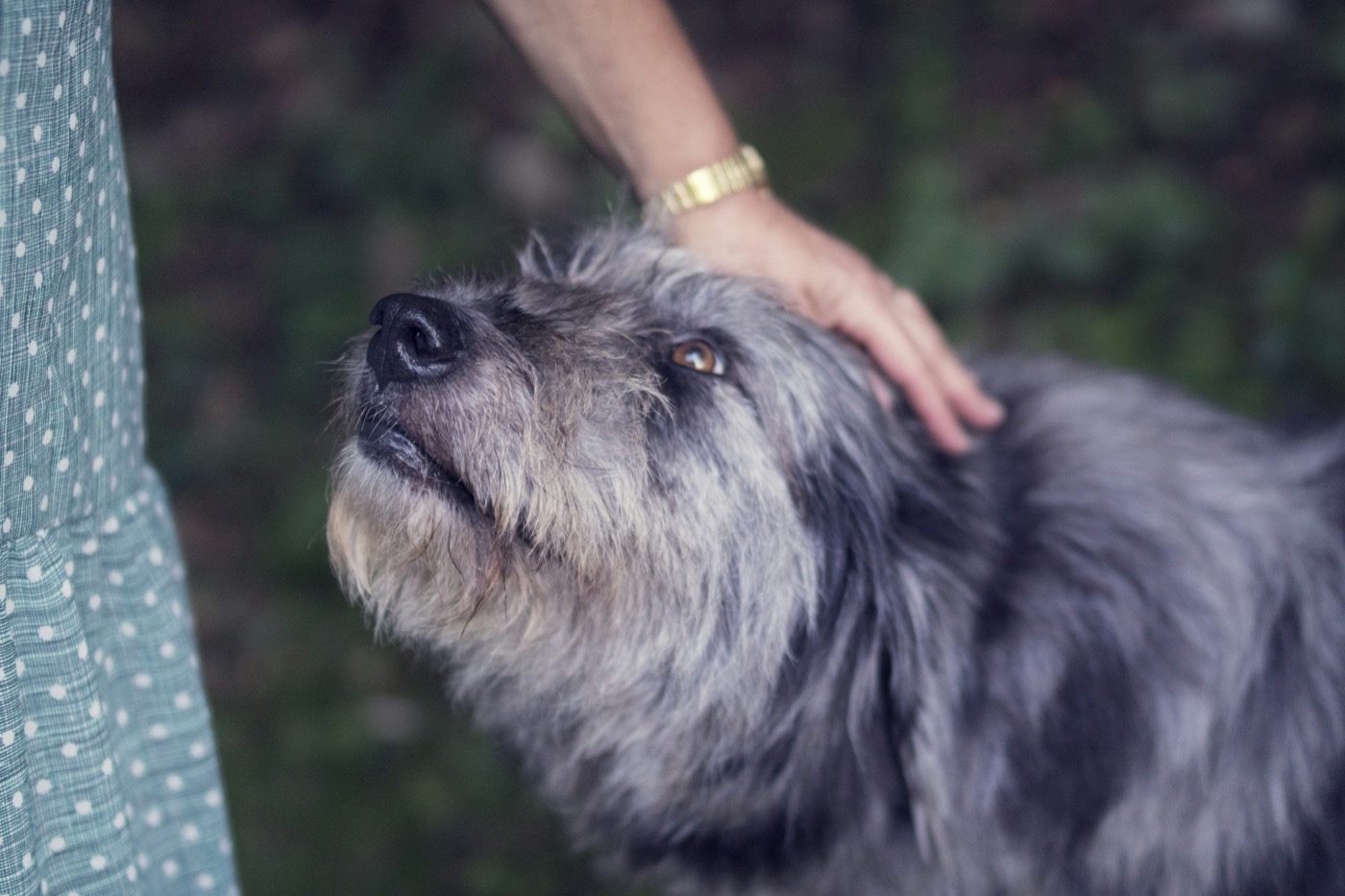
Of all the quiet signs, the freeze is the one nobody notices.
Your hand is on his back, and he goes still as a lawn ornament. Tufts says fearful dogs may freeze when approached, and that stiffening is one of the signals that comes after the quiet ones are ignored.
Vet and behaviorist Kendal Shepherd mapped how this escalates on an 11-rung Ladder of Aggression:
How the ladder climbs – Bottom rungs: yawning, blinking, nose licking – Rung 8: stiffening up, staring – Rung 9: growling – Rungs 10 and 11: snapping, then biting
That’s why the same page warns against training a dog out of growling. A growl is his last spoken warning: “pay attention to it and the next step on the ladder does not need to be climbed.”
When you feel him go still under your hand, lift your hand away. That’s you stepping off at rung 8.
#13 The guilty look after a mess
You come home to the trash can on its side and coffee grounds across the floor. He slinks over, head low, eyes up, tail thumping in small apologetic beats. Guilty as charged, surely.
Dog cognition researcher Alexandra Horowitz tested exactly this at Barnard College. Owners told their dogs not to eat a treat and left the room. Some owners were then told the wrong thing about whether the dog had eaten it. Dogs looked most “guilty” when scolded, and innocent dogs that got scolded looked guiltier than dogs that had really done it.
Veterinarian Dr. Em of Vet Med Corner doesn’t soften it: “This is not what’s going on at all. That behavior that you notice when you come home, those are appeasement behaviors.” He’s reacting to your face and voice right now, trying to head off trouble.
That look isn’t guilt. Clean it up without a word and buy a can with a lid.
#12 Jumping up on visitors
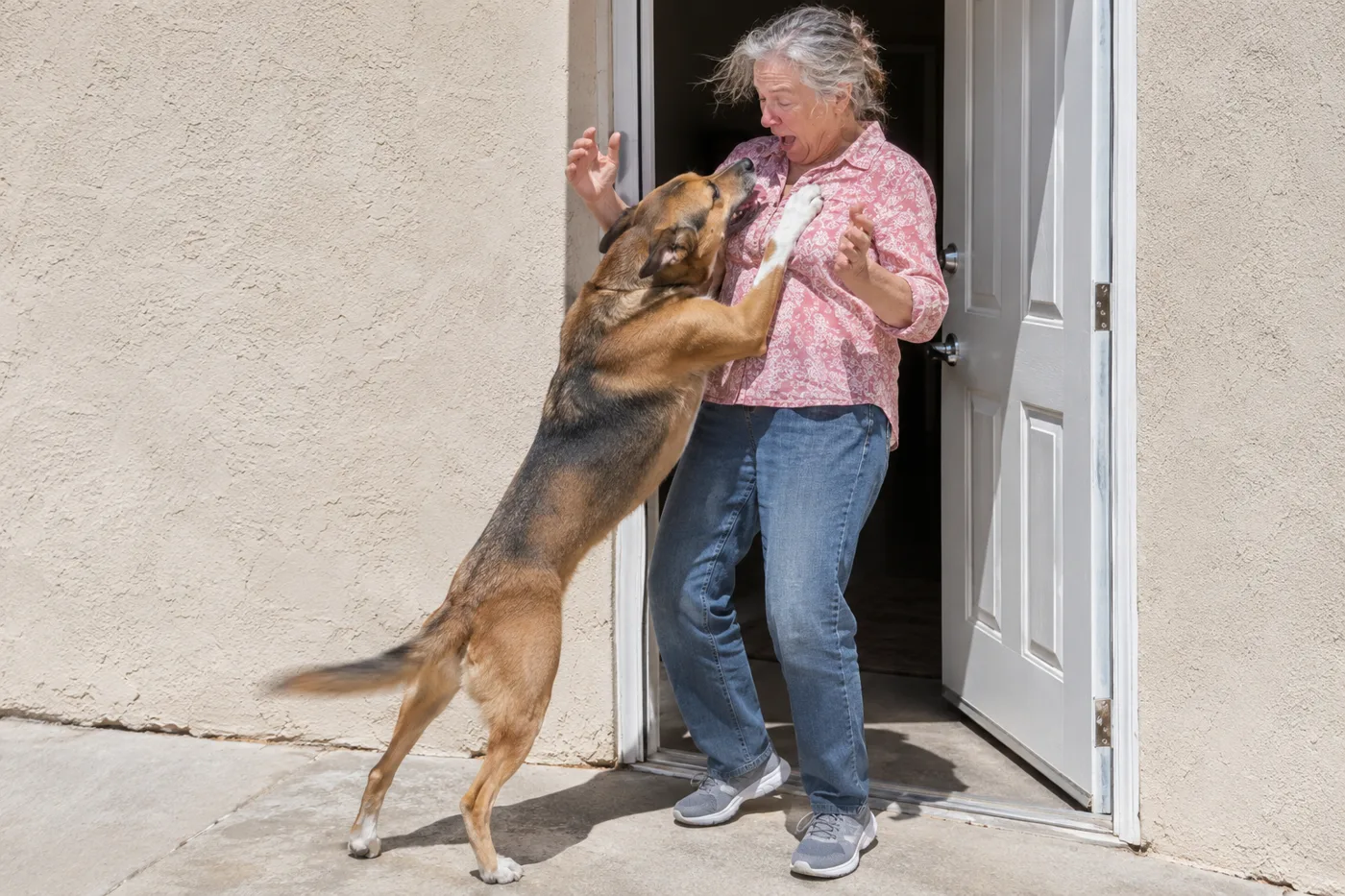
You’ve probably called it bad manners for years, and in some dogs it is. In others, it’s nerves.
VCA’s behavior team says “dogs lacking confidence may jump up because of underlying anxiety or conflict about the pending interaction.” Oli Juste puts it more kindly: “Not always a sign of naughtiness, sometimes it might just mean your dog is a little bit anxious for the situation.”
The scolding doesn’t help either way. “Whether you scold your dog verbally or even push him away as he jumps, you are still giving him attention,” VCA notes. Its fix is to reward four paws on the floor before the jump starts.
What undoes it is the visitor who says “oh, I don’t mind” and pets him while he’s up. Ask them to wait until his feet are down.
#11 The over-the-top homecoming greeting
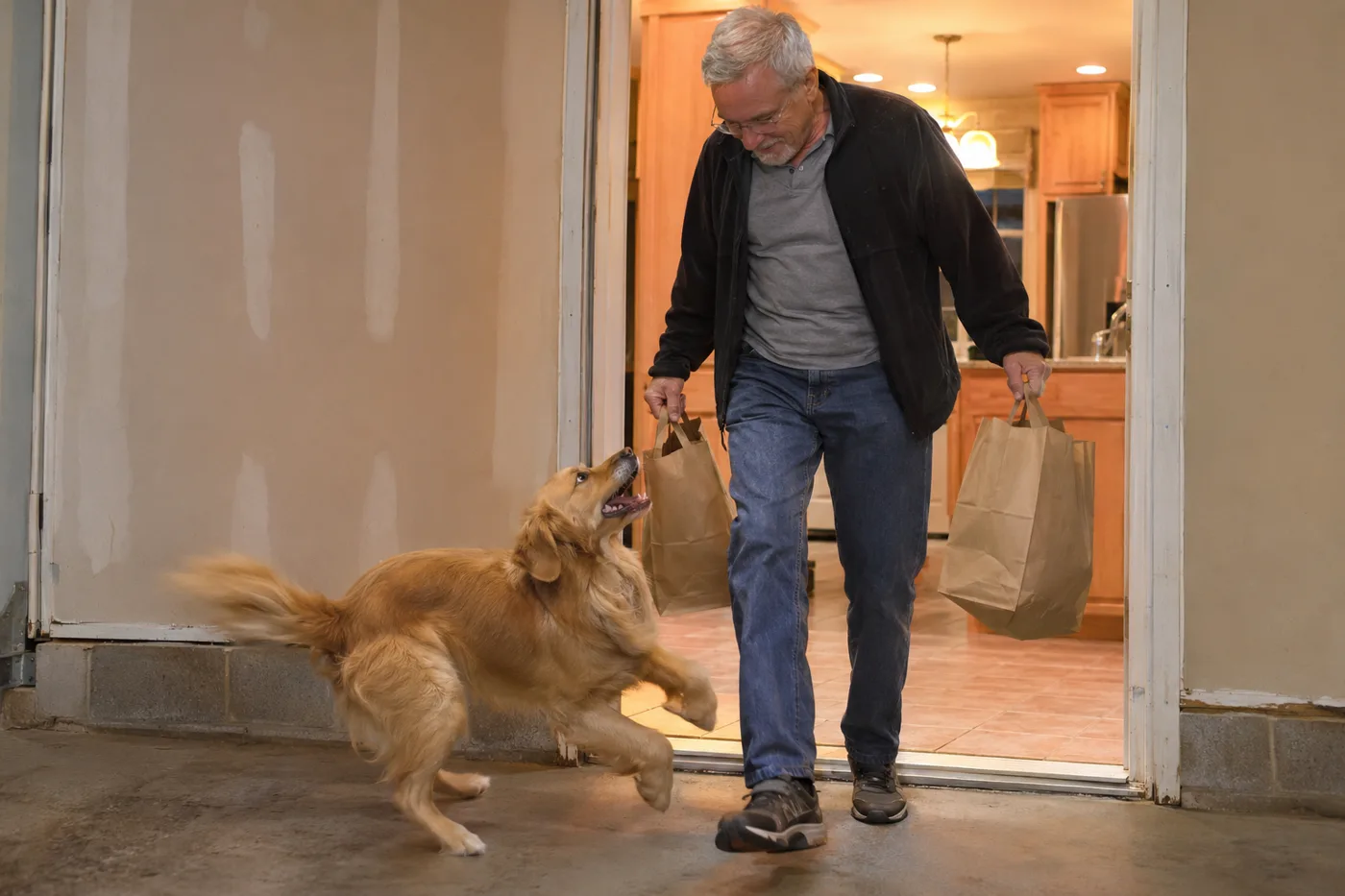
This is the one where the experts disagree out loud.
Veterinary behaviorist Dr. Kelly Ballantyne, writing for the American Veterinary Society of Animal Behavior, lists “excessive greetings” among the classic signs of separation anxiety. A review by psychologist Rebecca Sargisson describes dogs with separation problems showing “excessive excitement” when the owner gets back.
MSPCA-Angell isn’t having it: “If your dog is super-happy to see you when you’ve been gone, that simply means they are super-happy to see you.”
Excited or anxious? I’d go by what else is happening. A wild greeting plus chewed door frames, puddles and an untouched breakfast is a pattern. A wild greeting on its own, in a calm house, is a dog who likes you a lot. Enjoy it.
#10 Panicking at keys or a suitcase
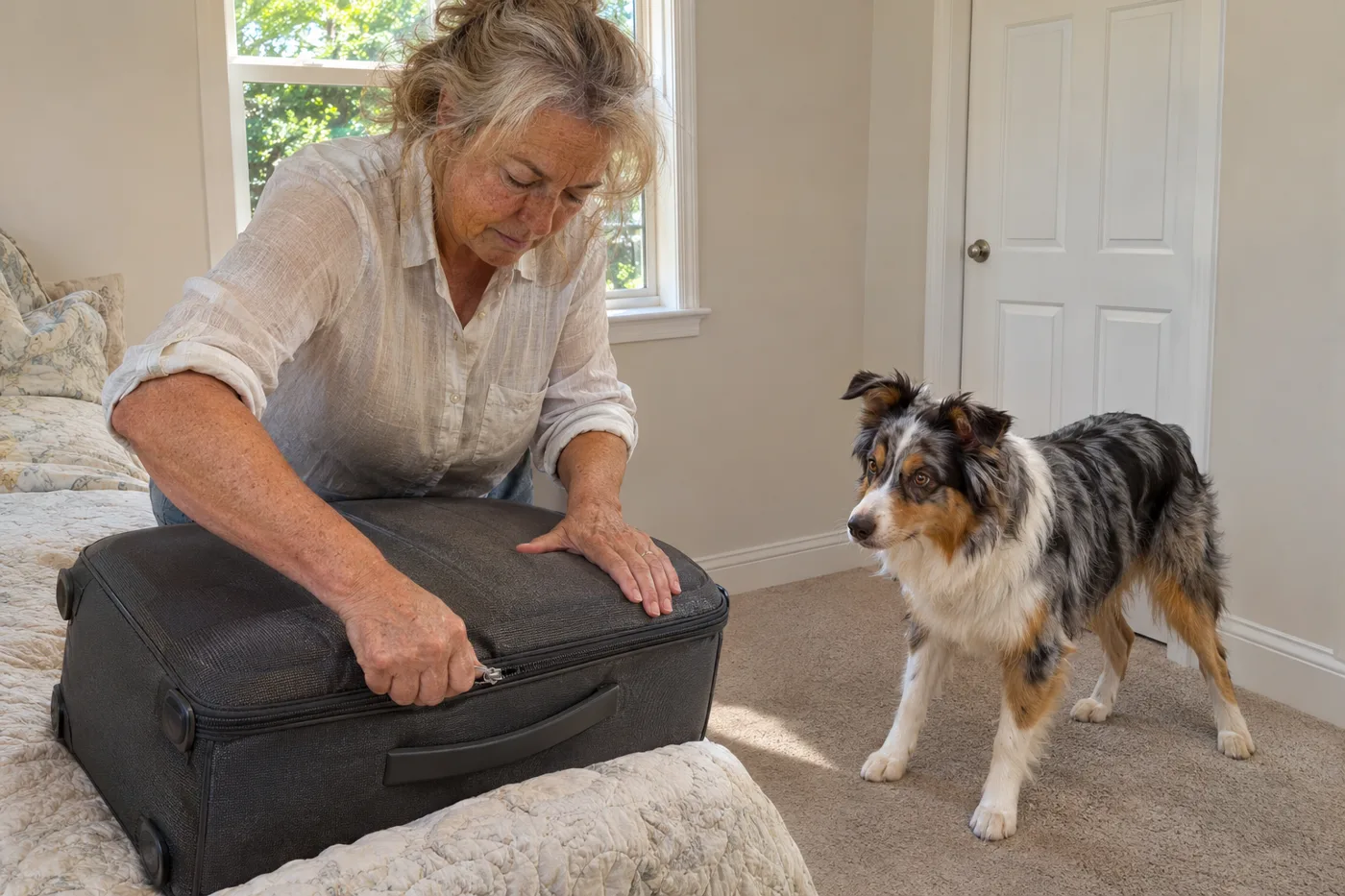
The suitcase comes out of the closet and the Aussie starts pacing like he’s been told the house is being sold. You may wonder what you did to him. Probably nothing.
“My Aussie is like this too and he’s never been anything but insanely spoiled lol.” Australian Shepherd owner, TikTok comment
Board-certified behaviorist Lisa Radosta and Ariel Fagen write that “the owner didn’t cause the behavior by loving the pet too much, spoiling it, or not being dominant.”
The fix is to make the cues boring. The ASPCA suggests using them in different orders several times a day without leaving: put on your shoes, then sit down and watch TV.
One Aussie owner in that TikTok thread found a workaround: they pack a bag for the dog at the same time as their own.
 You might also like17 Things Your Vet Notices About Your Dog (and a Few Only You Can Spot)
#9 Following you everywhere, even the bathroom
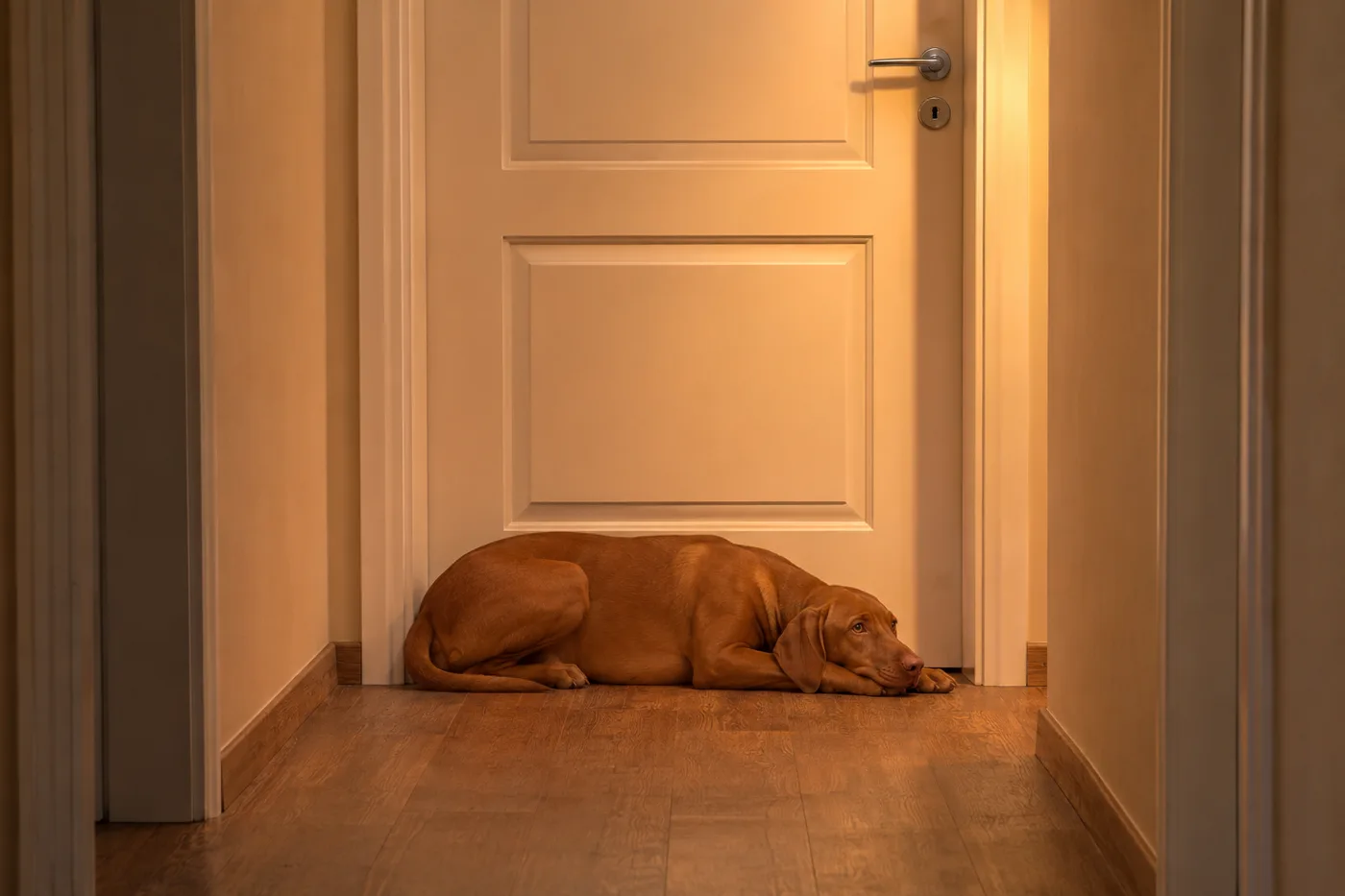
Some dogs were built for this. PetMD’s veterinary writer JoAnna Pendergrass names Vizslas, Labrador and Golden Retrievers, bred to work closely with people, plus Shih Tzus and Cavalier King Charles Spaniels, bred as companions. If one of those is waiting outside the bathroom door, that’s the job description.
The line between clingy and anxious is what happens when you leave. “Clingy dogs want to be around you when you’re at home, but they don’t panic when you’re not there.”
The thing to watch for is a sudden change. PetMD says senior dogs with vision or hearing loss, or with cognitive decline, can suddenly become clingy. A review led by the University of Lincoln’s Daniel Mills adds that “comfort seeking, clinginess, and attention seeking” are widely recognized by owners as a response to pain.
A shadow since puppyhood is a personality. A shadow since last month is a vet question.
#8 Ignoring food or treats while you’re out

You leave a stuffed chew and come home four hours later to find it exactly where you left it, untouched. Dr. Em lists this among signs of separation distress: “They might not want to eat while you’re gone.”
Behavior consultant Pat Miller, writing in Whole Dog Journal, says the most common reason is stress, and she has a simple test to find out what kind. Have a friend or neighbor stay with your dog while you go out, and see whether the food gets eaten.
- He eats with someone else there. Any company helps, so he’s struggling with being alone. A sitter or a friend dropping by may make a real difference.
- He still won’t eat until you’re home. It’s you he’s waiting for, and that’s the harder version to work on.
If skipped meals come with vomiting or diarrhea, VCA counts that as stress-related stomach upset worth mentioning to your vet.
#7 Accidents in a house-trained dog soon after you leave
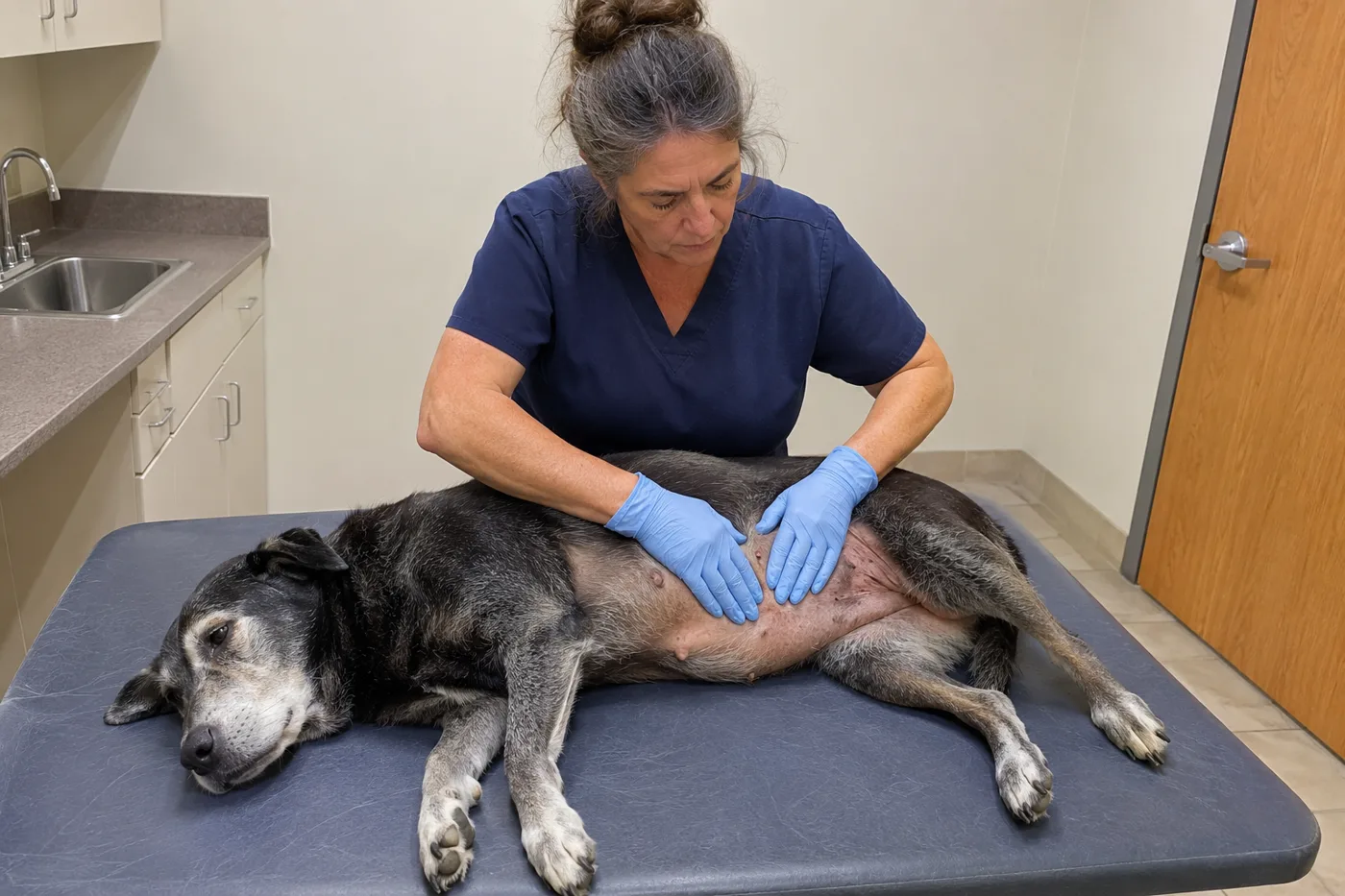
Before anyone says anxiety, a vet should rule out the plumbing. The ASPCA lists the medical causes to check first:
- A urinary tract infection or bladder stones
- Diabetes or kidney disease
- A weak sphincter from old age, or hormone changes after spay surgery
- Medications that cause frequent urination
Dr. Wailani Sung’s own list is longer. In her talk on separation anxiety, she also wants to rule out marking, cognitive dysfunction in older dogs, house training that was never quite finished, pain and arthritis, gut disease and thyroid problems, which she checks with a blood test. For anyone with a senior dog, that list is the starting point.
Marking looks different from a full accident. Dr. Ballantyne says marking dogs typically leave small amounts on vertical surfaces.
The anxious pattern is about timing. Veterinary behaviorist Dr. Ilana Reisner says these dogs eliminate only when the owner is gone, “typically immediately after, or within 30 minutes of, the owner’s departure.” A puddle by the door every time you run to the store, right after he’s been out, fits.
Whatever the cause, the ASPCA asks you not to scold: “Anxious behaviors are not the result of disobedience or spite. They are distress responses!”
#6 Chewing doors and window frames
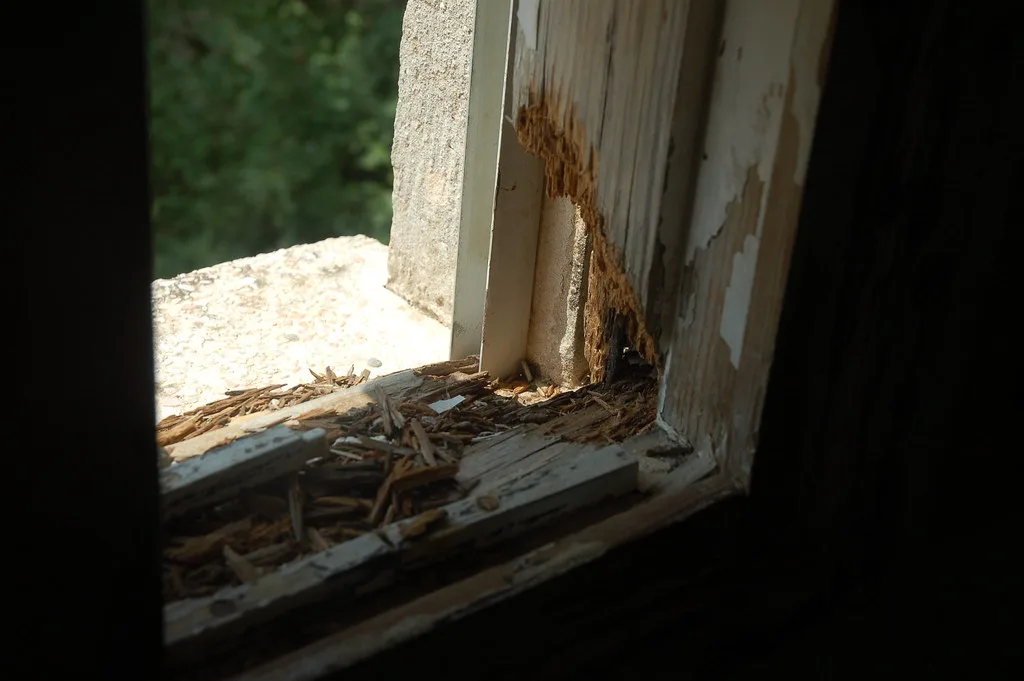
Gouges in the trim by the front door. Teeth marks on the windowsill. The ASPCA says dogs with separation anxiety chew door frames and window sills and dig at doorways, and that escape attempts can injure them, especially around windows and doors.
Separation anxiety also shows up among the top reasons people give up their dogs. In a survey the FDA cites, 3 of the 10 most common problems people reported when surrendering a dog to a humane society fit separation anxiety.
Not every door scratcher is scared, though. A 2021 study found that dogs scoring high on “demanding” behavior barked more and were more likely to scratch the door, which points to frustration rather than fear. A dog who scratches and barks like he’s filing a complaint may be a different case from one who whines without barking, the pattern that goes with fear.
For real separation anxiety, medicine is an option your vet may raise, usually alongside training rather than instead of it. Your regular vet can handle milder cases. The extreme or stubborn ones go to a specialist, and that isn’t cheap: Tufts’ vet hospital charges $605 for a first 90-minute behavior consult. Some pet insurers, Embrace for one, say FDA-approved anxiety medicine your vet prescribes may be eligible for reimbursement.
What a vet might prescribe – Clomipramine or fluoxetine: daily, alongside training, for separation anxiety – Dexmedetomidine gel: given before a known noise, like fireworks – Tasipimidine: approved by the FDA in May 2026, the first for both noise fear and separation anxiety – Selegiline: for seniors with cognitive dysfunction, often 4 to 12 weeks to show results
Owners in r/DogAdvice threads describe it as trial and error: a first drug that did little, doses adjusted, a switch to a different kind. Several say it only worked with the training.
#5 Heavy shedding at the vet or in the car
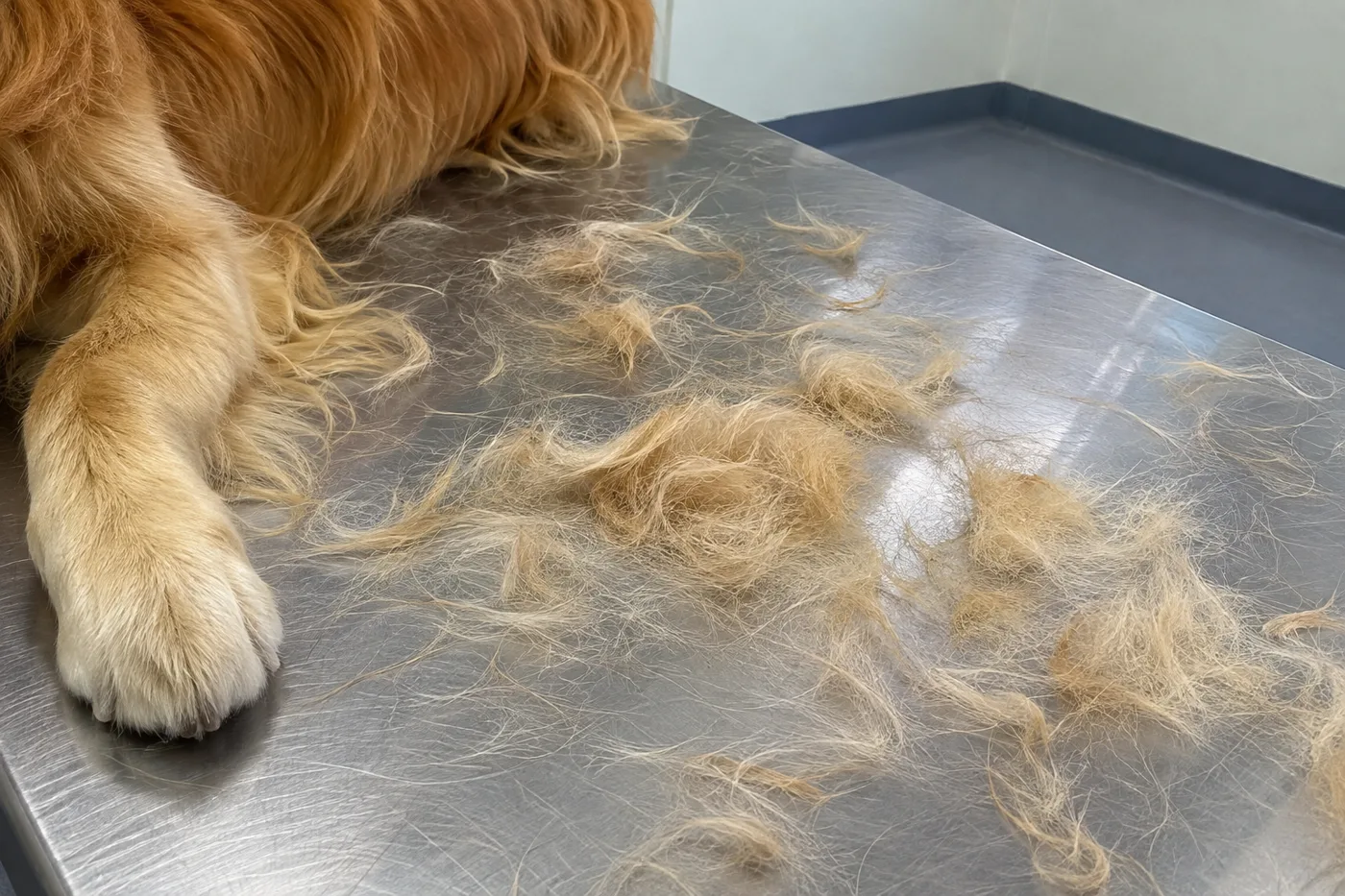
Golden and corgi owners in the comments on that veterinary team’s TikTok asked the fair question: does it count if my dog always sheds?
The answer is in the timing. VCA notes that show dogs who get nervous in the ring often “blow their coat,” and that dogs shed a lot at the vet clinic. Oakland Veterinary Referral Services says a rush of adrenaline releases the hair, though nobody’s quite sure why.
Ordinary shedding has its own rhythm. AKC says seasonal shedding peaks in spring and fall, and thick double-coated dogs like Golden Retrievers shed all year.
If you lift your hand off the exam table and it’s covered in loose fur, that’s most likely nerves. Tumbleweeds under the bed every day is the coat. Bald patches, inflamed skin or sudden hair loss are neither, and AKC says those need a vet.
#4 Scared or cowering only at night
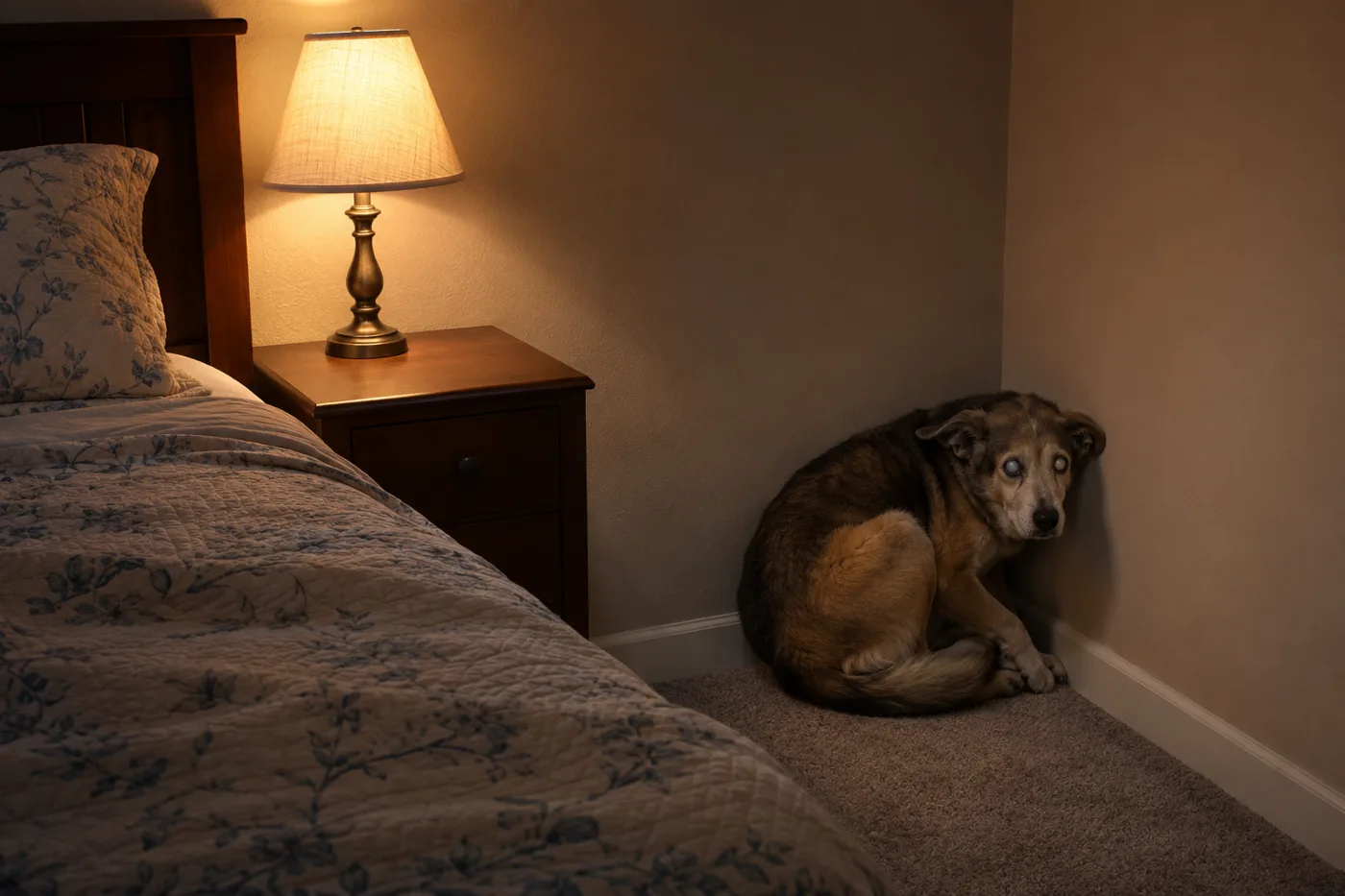
The lamps are off, the house is quiet, and she’s pressed into a corner with wide eyes, shaking at nothing you can see. In the morning she’s fine.
“She gets anxious at nighttime for no reason, she cowers in the corner, makes anxious faces, acts scared, refuses to go outside.” Owner of a dog whose anxiety comes only at night, r/DogAdvice
If yours is the quiet kind, she counts. In an older dog, the nighttime restlessness of cognitive dysfunction from #19 is a leading suspect, but it isn’t the only one. Fear of thunder became more common with age in a survey of 13,715 dogs in Finland.
Before calling it decline, Dr. Seibert lists what a vet should rule out: dental disease, urinary or kidney trouble, high blood pressure, joint pain, hormone disease, vision or hearing loss, and nerve problems.
One thing you can probably cross off yourself is the bluish haze in her eyes. PetMD says that cloudiness, called lenticular sclerosis, typically starts around age 10, affects nearly all dogs over 13, and doesn’t take away vision, though it can change depth perception.
Before the appointment, jot down what time it starts and what she does. Ten words on a sticky note will help your vet more than “she’s been weird.”
#3 Ears low and body rigid in the car
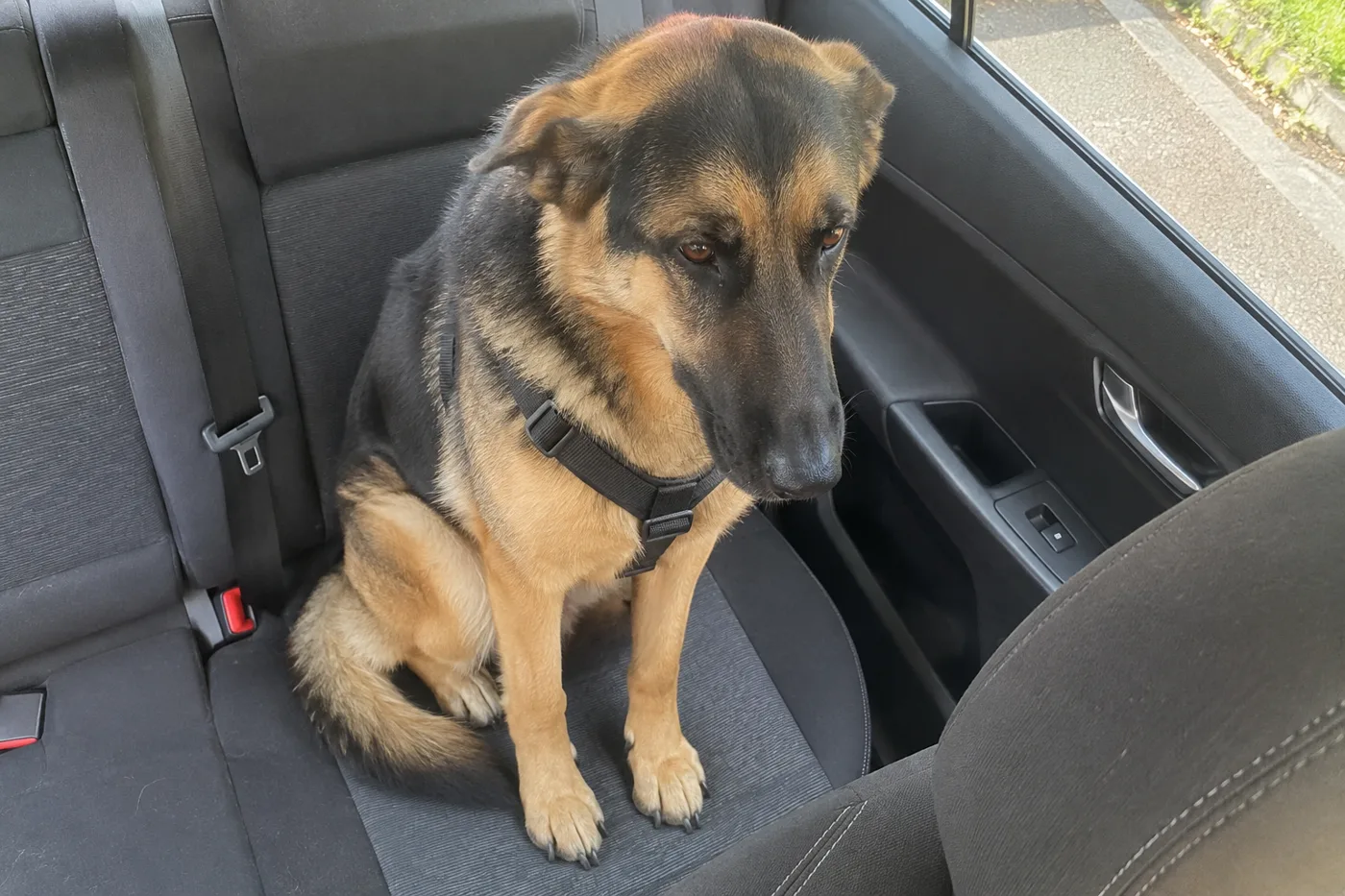
Plenty of owners say the car is where they first notice anything. In a Reddit thread, one shepherd owner described a dog with no panting and no whining, just a stiff body, and asked if that still counted. Commenters pointed straight at the ears.
It counts. A 2024 study found dogs panted noticeably more during car travel than when separated from people.
But some of what looks like car nerves is nausea. In the FDA-approved label for maropitant, an anti-nausea medicine, 7% of treated dogs vomited during a one-hour car trip, compared with 55% on a placebo. That’s a lot of carsick dogs. It’s labeled for vomiting, not anxiety, so it’s a question for your vet rather than a calming pill.
Cornell’s canine health center says many dogs, especially puppies, get motion sick, and suggests not feeding for 4 to 6 hours before a trip. If your dog is diabetic or prone to low blood sugar, ask your vet before skipping any meal: Michigan State’s vet hospital tells owners of those dogs to feed as usual, even before an appointment. If the stiff posture fades on an empty stomach, you had a queasy dog all along.
#2 Refusing a walk at the curb
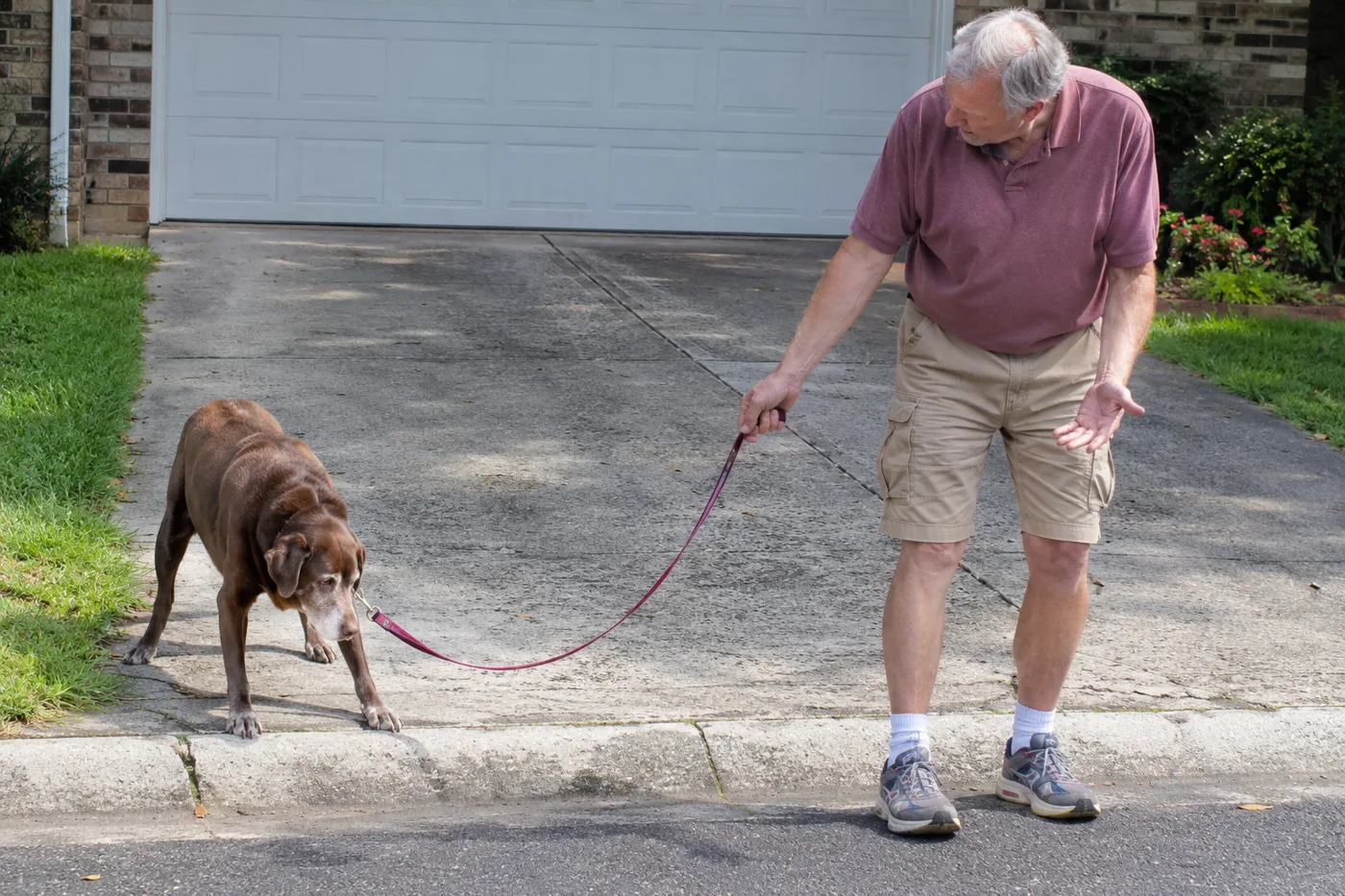
He gets to the end of the driveway and plants all four feet. You coax. He leans back. A trainer would call it fear of traffic or noise, and in a young dog that may be right.
In an older dog, think pain first. University of Lincoln researchers went through the records of 20 noise-sensitive dogs and found that the ones with muscle or joint pain developed their noise fears about four years later in life than pain-free dogs. Every dog that was given pain treatment improved.
Mills put the rule simply: “whenever there is a late age onset to a behaviour problem, medical issues including those related to pain, should be carefully evaluated.”
It’s not rare. Osteoarthritis affects roughly 20% of dogs over one year old. A dog who seems jumpy may really be a dog whose hips hurt every time a passing truck makes him flinch.
For a dog who’s newly scared in later life, the vet comes before the trainer. Tell your vet how old he was when it started.
#1 Licking or chewing paws until raw
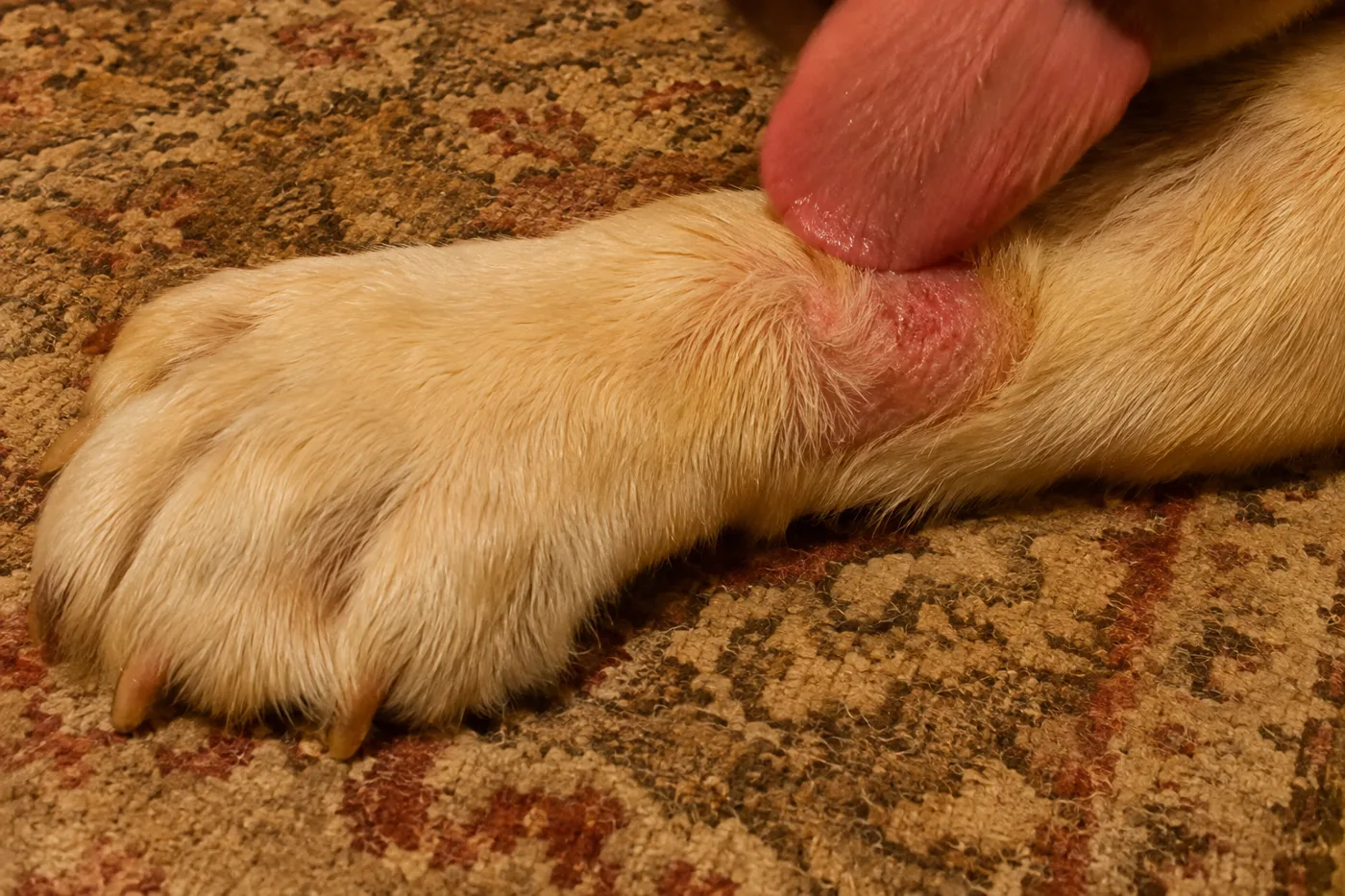
Every night, the same wet, steady slurp from across the room. A patch on the front wrist has gone pink and bare. You’ve tried the cone, the bitter spray, the “leave it.” Someone told you it’s anxiety. Someone else said allergies. It’s been years.
VCA says the sore that develops, a lick granuloma, comes from both physical causes like allergies, infection and joint pain and psychological ones like fear and anxiety. It usually shows up on the wrist of a front leg. The breeds VCA sees most often read like a roll call of family dogs: Labradors, Golden Retrievers, Dobermans, Great Danes, Weimaraners and Boxers.
Here’s what makes this the big one. University of Nottingham researchers studied 895 Labradors and Goldens, 343 of them with itchy allergic skin. The itchy dogs chewed more, groomed themselves more, were more hyperactive and sought more attention. They did not show more general anxiety. The authors suggest these dogs may be living with low-level, ongoing stress caused by the itch itself.
Veterinarian Dr. Em describes how alike the two look: “I think about pets that feel itchy, they might have a hard time settling, they might pace, they might lick, they might chew.”
In a Lab or Golden, the “anxious” licking may be the itch talking. Calming treats won’t touch an itch. Ask your vet about the skin first. VCA says vets may use skin tests, biopsies and X-rays for arthritis to find the cause. Once the itch is under control, the dog you thought was a nervous wreck may finally settle down.
Keep reading
 30 Things Your Dog Is Trying to Tell YouSee all 30 →
More you’ll enjoy
 25 Classic Movie and TV Dogs, and What Really Happened to Them
 20 Prices That Show What a Dog Cost in 1970 vs. Today
 17 Dog Breeds That Bite the Most, Including a Lap Dog That Out-Bites German Shepherds
The bottom line
In an Italian study, owners and a veterinary behaviorist watched dogs for three minutes in a vet’s waiting room. Each side called about 3 in 10 of the dogs highly stressed. They just didn’t pick the same dogs. The owners spotted the hiding and the pulling toward the door, and missed the quieter stuff. More than half the dogs were showing at least four signals.
You don’t have to catch all of them. You do have to know what normal looks like for your own dog: where his tail rests, how he yawns when he’s sleepy, how much he sheds on a lazy Sunday. A yawn or a lick only means something against that.
Veterinary behaviorist Karen Overall once said, “Fear deprives dogs of joy and damages relationships.” The good news is how often the cause turns out to be something you can fix: a sore hip, a queasy stomach, an itch.
At your next vet visit, give him those three minutes in the waiting room. Phone in your pocket, eyes on him.
Bonus: Five small moves the experts swear by
When he’s stressed, move him away from the trigger and into a quiet space first. Virginia Edwards of the Virginia-Maryland vet college says getting the dog out of the setting can keep everyone safe and happy.
For mild trouble with being alone, the ASPCA suggests a food puzzle toy that takes 20 to 30 minutes to finish, handed over as you leave.
Practice leaving in seconds, not minutes. Separation anxiety trainer Terrie Hayward says the dog’s body language sets the pace, not the clock, and a standard instruction to leave for five minutes is often too much.
Hayward also warns against “trigger stacking.” Skip practice when he’s hungry, needs to go out, or you’ve just rushed in frazzled yourself.
On car days, Cornell recommends a crash-tested harness, seat belt or travel crate and points to the Center for Pet Safety for tested options.
Questions people also ask
How do I know if it’s separation anxiety?
The clearest way to tell is to film your dog after you leave. Dr. Kelly Ballantyne, a veterinary behaviorist, advises recording at least the first 30 to 60 minutes, because many dogs show distress within the first 10. Look for quiet signs like restlessness, panting, lip licking and whining as well as the loud ones. MSPCA-Angell says that if a dog settles within about 15 minutes, it’s not a clinical problem.
Is my dog panting from anxiety or is he just hot?
If he hasn’t exercised and the room is cool, stress or a medical cause is likelier than heat. A normal dog temperature is 99.5 to 102.5°F, and AKC says panting at rest in an older dog can be a sign of Cushing’s disease, heart disease or arthritis pain. Heavy panting after time in hot weather needs a vet right away.
What are the causes of dog anxiety at night?
In older dogs, cognitive dysfunction is a leading cause, with restlessness that tends to come at night. It affects about 28% of dogs aged 11 to 12 and 68% by 15 to 16. Joint pain, noise fears that grow with age, hearing or vision loss, high blood pressure and urinary problems can also be behind it, so a vet should rule those out.
Could my dog’s anxiety be a medical problem?
Yes, often. A review led by Professor Daniel Mills estimates that around a third of dog behavior cases referred to specialists involve pain. Itchy allergic skin can produce chewing and restlessness that look like anxiety, and some medications cause house soiling. This matters most when the behavior starts suddenly or late in life.
Is there medication for dog anxiety, and is it daily or only for storms?
Both kinds exist, and your vet decides which fits. Clomipramine and fluoxetine are daily medicines for separation anxiety, used alongside training. Dexmedetomidine gel is given before a known noise like fireworks. Tasipimidine, approved by the FDA in May 2026, is given about an hour before the trigger and is the first approved for both noise fear and separation anxiety.


